Cardano founder Charles Hoskinson (@IOHK_Charles) says artificial intelligence has advanced in mathematics far beyond what he ever anticipated, pointing to recent claims involving an AI-gener
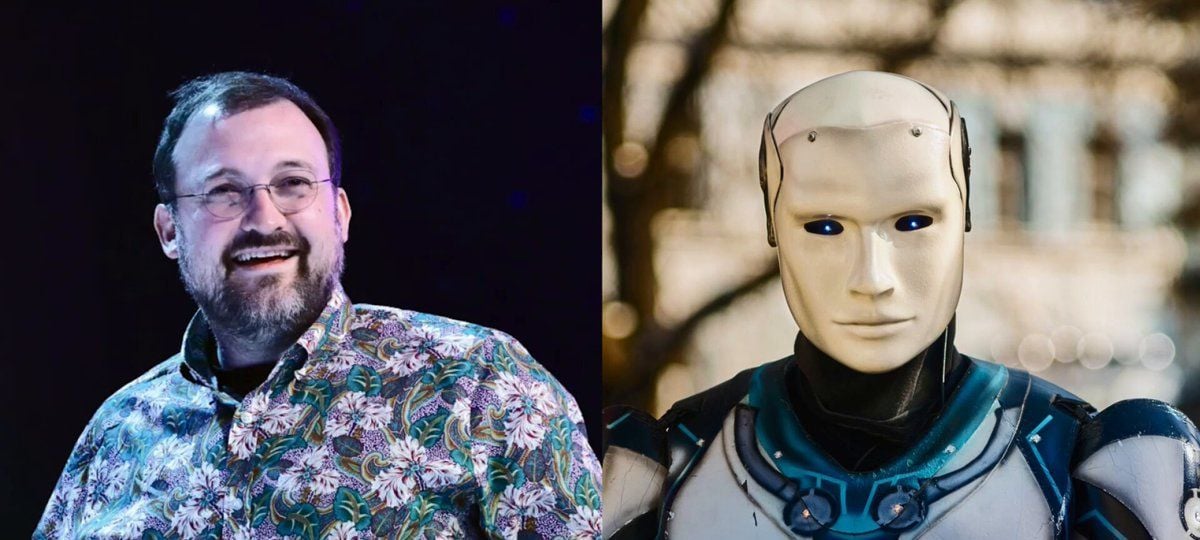
Cardano founder Charles Hoskinson (@IOHK_Charles) says artificial intelligence has advanced in mathematics far beyond what he ever anticipated, pointing to recent claims involving an AI-generated approach to one of the field's most stubborn open problems as a turning point.
A Progress He Did Not Expect
Speaking during a YouTube broadcast, Hoskinson said he originally expected formal systems to help larger teams of mathematicians collaborate and verify human-written proofs. He did not expect large language models to generate complete proofs themselves so soon."We never anticipated the extent to which AI would come in," Hoskinson said, adding that the idea of AI fully writing a proof had previously appeared "pretty far out."
Hoskinson said artificial intelligence has moved well beyond merely assisting mathematicians, noting that systems can now independently generate and formally verify complex proofs. His comments came directly in response to OpenAI's announcement that an internal AI system had produced a claimed solution to the Navier-Stokes existence and smoothness problem. The Navier-Stokes problem, which has gone unresolved for roughly 90 years, asks whether smooth three-dimensional fluid motion can break down under the equations that govern how liquids and gases move.
OpenAI said an internal model "significantly more capable than GPT-6 Astra" produced a proof that the three-dimensional Navier-Stokes equations can develop a singularity in finite time.According to the Wall Street Journal, OpenAI said the system deployed up to 10,000 AI agents in parallel over approximately 88 hours, with computing costs running into the millions of dollars. The company released a 165-page proof and a Lean formalization, with Lean being a programming language that checks each step of a mathematical argument for logical validity.
Questions Over Provenance and Research Privacy
During the broadcast, Hoskinson called the reported capabilities "pretty remarkable," but also addressed unresolved questions about the work's provenance and the privacy of research submitted to cloud-based AI services. The announcement has not been without controversy. New York University math professor Tristan Buckmaster released a statement saying he and Anthropic researcher Levent Alpoge had been looking into the Navier-Stokes problem, a culmination of work that began last year, and had used a mix of large language models, including OpenAI's Codex.OpenAI denied accessing private work but could not exclude de-identified usage data influencing model improvements.
Hoskinson also raised concerns about researchers sharing unpublished ideas with cloud-based AI systems, arguing that academics and entrepreneurs may expose private research notes, intellectual property, or early-stage ideas when using centralized models.The Clay Mathematics Institute still classifies Navier-Stokes as unsolved, pending publication, peer review, and broad mathematical acceptance.
Hoskinson has a direct personal connection to formal mathematics. In 2021, he donated $20 million to Carnegie Mellon University to establish the Hoskinson Center for Formal Mathematics.His comments reflect a broader shift in how he views AI-assisted mathematics: from a technology primarily useful for checking and coordinating human work, toward systems that may increasingly participate directly in the construction and verification of sophisticated mathematical proofs.
Sources:OpenAI: On the Navier-Stokes Millennium Prize ProblemQuanta Magazine: AI Has Solved One of Math's $1 Million Millennium Prize ProblemsCNBC: OpenAI claims to have solved the 90-year-old Navier-Stokes math problem in 88 hours