Cardano treasury proposal has entered a crucial stage as the network evaluates whether expanding its treasury spending capacity can better support long-term ecosystem development. The latest
Cardano treasury proposal has entered a crucial stage as the network evaluates whether expanding its treasury spending capacity can better support long-term ecosystem development. The latest governance initiative seeks to raise the Net Change Limit (NCL) from 350 million ADA to 500 million ADA, increasing the treasury’s funding capacity by 43%.
The proposal comes as Cardano advances its Voltaire governance framework while on-chain metrics point to improving wallet activity and renewed user participation. Although the network’s treasury already holds substantial reserves, the broader question is whether disciplined governance and efficient capital deployment can translate additional funding into sustainable ecosystem growth or whether a higher spending ceiling could weaken fiscal discipline if oversight does not keep pace.
What does the Cardano treasury proposal indicate about the network’s next phase?
The Cardano treasury proposal centers on increasing the amount of treasury funds that can be allocated for ecosystem development under the network’s governance framework. The proposal seeks to raise the Net Change Limit from 350 million ADA to 500 million ADA, representing a 43% increase in treasury funding capacity. If approved, the revised limit would remain in effect until July 2027.

Cardano Treasury Proposal Targets 43% Budget Increase Amid ADA Ecosystem Recovery 4
The additional allocation is intended to support infrastructure, decentralized finance (DeFi), developer initiatives, and broader ecosystem projects as Cardano’s governance model continues to evolve. Rather than changing the treasury’s total holdings, the proposal expands the maximum amount that governance can authorize for funding during the approved period.
Why is treasury governance receiving greater attention?
The Cardano treasury proposal arrives as the network’s treasury continues to hold significant reserves. The treasury currently contains approximately 1.47 billion ADA, while only around 68 million ADA has been withdrawn to date. This suggests that available funding has consistently exceeded actual usage. Governance participation is also becoming a central focus.
DRep voting currently represents more than 5 billion ADA, yet proposal ratification has averaged around 56%. Those figures highlight that while voting power is substantial, proposal approval remains comparatively moderate. This combination places greater importance on governance quality. A higher spending limit could accelerate ecosystem development if funds are allocated efficiently.
At the same time, it could also reduce fiscal discipline if oversight, participation, and accountability fail to improve alongside the expanded funding capacity. Supporting governance discussions for Cardano’s broader budget process also emphasize measurable ecosystem goals, standardized proposal templates, minimum funding thresholds, and DRep validation to strengthen accountability throughout treasury allocation.
What do on-chain metrics reveal about network participation?
Recent network activity shows signs of improving participation, although those signals remain at an early stage. Since the June 23 bottom, Cardano has added 14,783 non-empty wallets, reversing the previous slowdown in holder growth. The increase suggests that users have continued entering the network or rebuilding positions despite elevated market uncertainty. The wallet growth occurred alongside ADA recovering toward approximately $0.20, marking a 35% rebound from its late-June low.
Together, these developments may indicate growing participation and reduced speculative activity. However, these remain early indicators rather than confirmation of a lasting trend. Continued wallet expansion alongside sustained price strength around the recovery level could signal that accumulation is beginning to replace the earlier phase of market capitulation, but additional data will be needed to confirm whether that transition is durable.
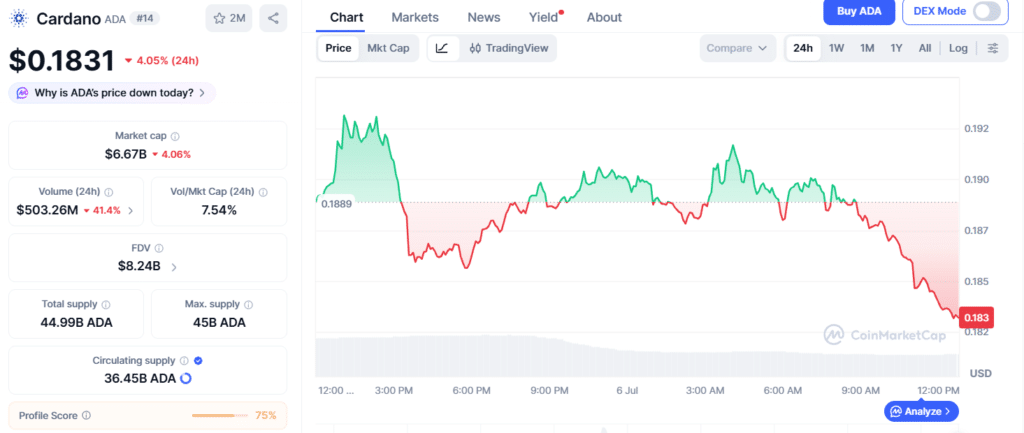
Outside the governance proposal itself, current market data shows ADA trading around $0.1834, down 3.49% over the past 24 hours. The cryptocurrency currently has a market capitalization of $6.67 billion, reflecting a 3.5% daily decline.
Cardano Treasury Proposal Targets 43% Budget Increase Amid ADA Ecosystem Recovery 5
Its 24-hour trading volume stands at $503.37 million, down 41.38%, while the volume-to-market-cap ratio is 7.53%. These figures illustrate that short-term market conditions remain volatile even as wallet activity has shown signs of improvement.
Can governance execution determine the proposal’s success?
The long-term impact of the Cardano treasury proposal will depend less on increasing available funding and more on how effectively those resources are allocated. Current governance discussions increasingly focus on measurable outcomes instead of simply expanding budgets. Standardized proposal structures, defined performance indicators, and stronger DRep evaluation are expected to provide clearer benchmarks for treasury spending.
Cardano’s governance model has long emphasized research and structured decision-making. The current phase tests whether that framework can translate into timely funding decisions while maintaining transparency and accountability across the ecosystem. Ultimately, the proposal’s success will depend on whether governance execution matches the larger funding capacity without compromising fiscal discipline.
What are the key risks and limitations?
The Cardano treasury proposal increases the maximum amount that governance can allocate from the treasury, but it does not guarantee that those funds will be deployed effectively. If governance quality, proposal scrutiny, and DRep accountability do not improve alongside the higher spending limit, larger allocations could produce limited measurable benefits.

Cardano Treasury Proposal Targets 43% Budget Increase Amid ADA Ecosystem Recovery 6
That makes oversight just as important as the size of the treasury itself. Similarly, the recent increase in wallet activity and ADA’s rebound toward $0.20 should be viewed as early indicators rather than confirmed evidence of a sustained recovery. Even so these indicators are still developing and could lose momentum if market sentiment weakens or governance execution fails to deliver expected results.
Conclusion
The Cardano treasury proposal means a big step for governance as the network checks if bigger treasury spending can help long-term ecosystem growth. Upping the Net Change Limit from 350 million ADA to 500 million ADA would give more funding flexibility till July 2027 but it also puts more duty on governance participants.
While the treasury contains approximately 1.47 billion ADA and DRep voting represents more than 5 billion ADA, proposal ratification has averaged 56%, the effectiveness of future spending will depend on oversight as much as available capital. Recent wallet growth, the recovery toward $0.20, and the current price of $0.1834 show positive but early signs. Whether the Cardano treasury proposal really strengthens the ecosystem will depend on careful execution, clear decisions, and the network balancing growth with fiscal responsibility.
Glossary
Cardano Treasury Proposal: A plan to expand Cardano’s treasury funding limit.
Net Change Limit (NCL): The maximum treasury spending allowed.
Cardano Treasury: A pool of ADA for ecosystem funding.
Voltaire Era: Cardano’s decentralized governance phase.
DRep: A community representative who votes on proposals.
Frequently Asked Questions About Cardano Treasury Proposal
What change does the proposal make?
The proposal aims to raise the Net Change Limit from 350 million ADA to 500 million ADA.
How much would treasury funding increase?
The proposal would increase the treasury funding limit by 43%.
The additional funding could support infrastructure, DeFi, developers, and ecosystem projects.
How many new wallets has Cardano added recently?
Cardano added about 14,783 non-empty wallets after the June 23 market bottom.
Could the proposal help Cardano’s long-term growth?
Yes. If approved and managed well, it could support stronger ecosystem development over time.
Sources
CMC
AMBcrypto
Bitcoinist