TLDR CELC stock fell 0.49% to $65.25, then dipped another 1.39% after hours to $64.34. Gedatolisib triplet delivers 21.5 months without progression in one key subgroup. Triplet response rate
TLDR
- CELC stock fell 0.49% to $65.25, then dipped another 1.39% after hours to $64.34.
- Gedatolisib triplet delivers 21.5 months without progression in one key subgroup.
- Triplet response rate reaches 59%, versus 33% for the control treatment group.
- Gedatolisib dropout rates hit 5% and 4%, versus 19% for alpelisib treatment.
- Eight-study analysis favors gedatolisib regimens in progression-free survival.
Celcuity reported promising breast cancer treatment results from its Phase 3 VIKTORIA-1 trial, strengthening the outlook for gedatolisib. New analyses showed longer disease control and higher response rates across several patient groups. However, CELC stock declined during regular trading and extended its losses after the closing bell.
Celcuity (CELC) Stock Falls Despite Positive Phase 3 Results
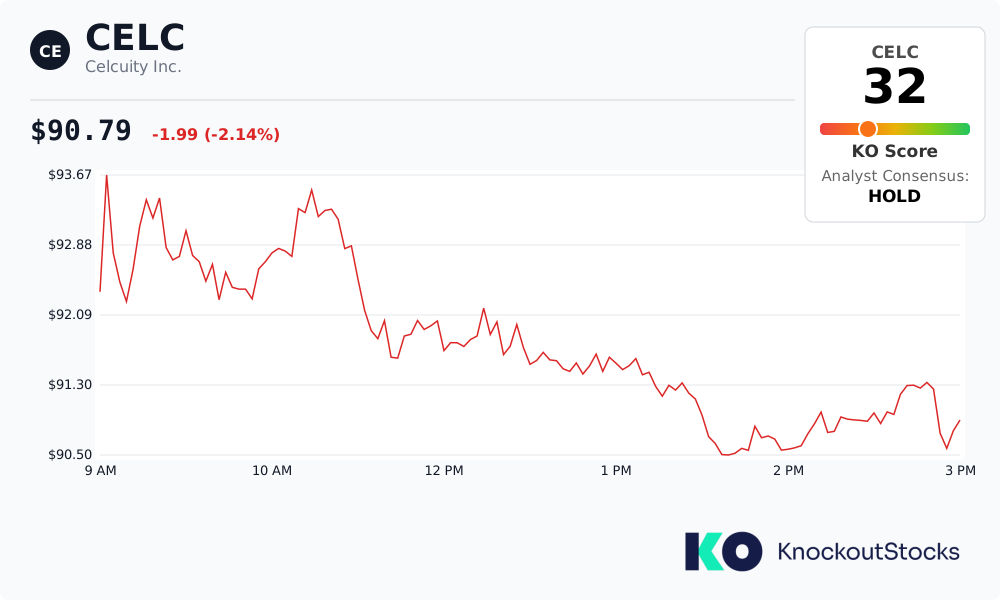
Celcuity shares slipped 0.49% to $65.25, a decline of $0.32 during the regular session. The stock then lost another 1.39% in after-hours trading and reached $64.34. The decline followed a volatile session despite the company’s latest clinical findings.
Celcuity Inc., CELCCelcuity develops targeted treatments for solid tumors, with gedatolisib central to its breast cancer program. The company presented fresh findings at the European Society for Medical Oncology (ESMO) Congress on October 24, 2026. Barbara Pistilli of Gustave Roussy presented the new PIK3CA-mutant subgroup results.
The Phase 3 study tested gedatolisib combinations in patients with advanced HR-positive, HER2-negative breast cancer. Researchers compared gedatolisib combinations with existing treatment options, including alpelisib plus fulvestrant. The findings support Celcuity’s development plans, although the results do not establish regulatory approval.
Celcuity Phase 3 Trial Shows Longer Progression-Free Survival
Patients without liver metastases recorded 21.5 months of median progression-free survival with the gedatolisib triplet. By comparison, the alpelisib and fulvestrant control group reached 9.1 months. The trial reported a hazard ratio of 0.46 and a p-value of 0.0016.
Among patients with liver metastases, the triplet delivered 9.1 months, compared with 4.6 months for controls. Meanwhile, the gedatolisib doublet achieved 11.1 months for that subgroup. Both regimens showed statistically significant differences against the control in these patients.
Furthermore, triplet recipients without visceral metastases reached 21.5 months versus 9.2 months with standard treatment. Patients with visceral metastases recorded 9.8 months on the triplet, compared with 5.6 months for controls. These comparisons demonstrated benefits across disease locations, although subgroup sizes differed.
Gedatolisib Response Rates and Safety Strengthen Growth Outlook
In the PIK3CA-mutant cohort, the triplet achieved a 59% response rate, compared with 33% for controls. The doublet produced a 43% response rate, while triplet responses lasted a median 19.4 months. The alpelisib combination recorded a median response duration of 7.5 months.
Celcuity also reported a 39% response rate for the triplet in patients with PIK3CA wild-type tumors. The doublet reached 34%, while fulvestrant alone reached 1%. Moreover, treatment-emergent adverse events prompted gedatolisib discontinuation in 5% of triplet patients and 4% of doublet patients.
By contrast, 19% of patients discontinued alpelisib because of treatment-emergent adverse events. A separate analysis of eight trials also favored gedatolisib combinations over other regimens on progression-free survival measures. Together, these findings strengthen Celcuity’s clinical development outlook, although indirect comparisons cannot replace direct head-to-head trials.
The post Celcuity Inc. (CELC) Stock: Promising Phase 3 Breast Cancer Data Fuels Growth Hopes appeared first on Blockonomi.