A joint team from blockchain security firm CertiK and Columbia University has put some of the AI industry's foundational code under a mathematical microscope. Using formal verification, the r
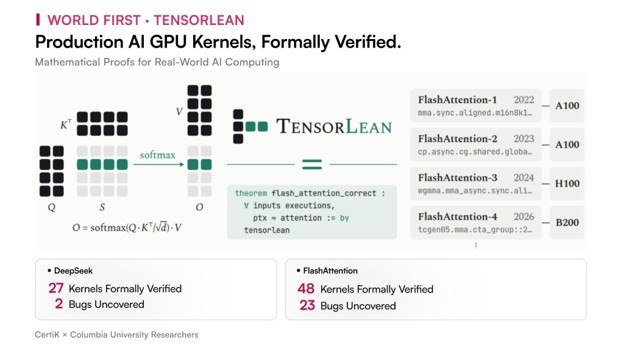
A joint team from blockchain security firm CertiK and Columbia University has put some of the AI industry's foundational code under a mathematical microscope. Using formal verification, the researchers inspected more than 100 production GPU kernels, including code from DeepSeek and the widely adopted Flash Attention library. They uncovered 25 bugs. The findings mark a significant step toward applying machine-checkable mathematical proofs to the highly optimised software powering modern AI.
The team introduced TensorLean on November 20, a framework designed to verify the correctness of GPU kernels under defined execution conditions. As AI labs race to speed up model training and reduce inference costs, ensuring that low-level hardware operations perform their intended computations is becoming increasingly important.
Verifying AI Computing Infrastructure
GPU kernels are low-level programs responsible for much of the computational work involved in AI training and inference. A single error can silently produce incorrect results while the system continues operating, affecting subsequent outputs or even causing a training run to deviate from its intended course.
According to the researchers, TensorLean was applied to more than 100 production kernels spanning several generations of GPU hardware. The research uncovered two bugs in DeepSeek kernels and 23 more in FlashAttention.
Unlike standard software testing, which checks specific examples and sample inputs, TensorLean relies on formal verification. This mathematical method can prove that a program consistently meets defined requirements across specified input and execution conditions, ruling out errors within the scope of the verification.
Verifying production GPU code is particularly challenging because of the performance optimizations involved. TensorLean accounts for overlapping data transfers and computation, changing execution configurations based on workload size, and low-precision arithmetic. It inspects PTX code directly, the intermediate representation generated within NVIDIA's GPU compilation pipeline. The researchers then develop proofs in Lean, an interactive proof assistant that makes the mathematical results machine-checkable within defined numerical tolerances.
The researchers said the main challenge was completing mathematical proofs without abstracting away the complex optimizations that make production AI code fast, ensuring verification accounts for the conditions under which the kernels actually execute.
Implications for AI Infrastructure Costs
For companies running large-scale AI infrastructure, computational errors can have significant financial consequences, particularly when they force costly training runs to be repeated.
The researchers illustrated the potential financial impact with a straightforward scenario. If a training run consumes $100 million in computing resources and 1% of that computation must be repeated because of an error, the additional cost would amount to $1 million.
TensorLean allows developers to rerun verification after updating code to improve performance, checking whether optimizations have introduced computational errors. Teams can also reuse existing proof specifications across related mathematical operations, reducing the work required to verify additional kernels.
Ronghui Gu, co-founder of CertiK and a computer science professor at Columbia University, said the goal is to ensure that every performance improvement is backed by reliable evidence of correctness, reducing the risk of computational errors reaching large-scale AI training and deployment.
Formal Verification Expands Into AI Software
The project fits into a growing push to bring mathematical proofs into everyday software engineering. In October, Anthropic published research on using Claude to construct mathematical proofs for open-source software. While Anthropic's research explored using AI to construct proofs for general software, TensorLean applies formal verification directly to the underlying computations powering AI models.
The research team has not announced a commercial rollout schedule or identified AI labs adopting the framework. Going forward, the challenge will be extending formal verification across larger kernel libraries while keeping proofs aligned with production code as developers continue to optimize and update their software.