Commodity Futures Trading Commission (CFTC) Chair Michael Selig says the fight over prediction markets now puts company executives at risk of jail. In a November 13 CNBC interview at Cantor C
Commodity Futures Trading Commission (CFTC) Chair Michael Selig says the fight over prediction markets now puts company executives at risk of jail. In a November 13 CNBC interview at Cantor Convergence, he called the criminal charges brought by states “really egregious.”
Selig argues that the platforms provide legitimate products in accordance with federal regulations. In contrast, states suggest that sports-event contracts are the same as gambling contracts. The debate hinges on the conflict between federal law on derivatives and the law on gambling as imposed by states.
From a jurisdiction fight to a fight over jail
Selig said the legal dispute should not expose executives to jail:
“That’s not something that should be at the risk of going to jail.”
In October, Utah filed felony charges against Kalshi and its two cofounders. No one has been convicted, but the charges carry possible jail time. Prosecutors had not specified penalties. Selig wants the Supreme Court to settle the regulatory question.
The CFTC takes Louisiana to court
The CFTC has answered state enforcement with lawsuits. On November 13, it sued Louisiana after a state judge ordered more than 30 companies tied to CFTC-regulated derivatives to stop operating there. The agency said the order came without notice or a hearing.
Louisiana is the 12th state the CFTC has sued over its jurisdiction. The regulator has also filed briefs in four federal appeals courts and one state supreme court. The Justice Department and CFTC separately challenged Arkansas Attorney General Tim Griffin’s action against Kalshi.
44 states say the CFTC is overreaching
In a July letter, 44 state attorneys general argued that Congress never gave the agency power to regulate sports bets as derivatives. They said sports wagers lack derivatives’ hedging or price-discovery role.
States also have tax revenue to protect. The National Conference of State Legislatures cited an American Gaming Association estimate that prediction markets may have diverted betting activity that would otherwise have generated more than $1 billion in state sports-betting taxes.
Why this is headed to the Supreme Court
The dispute over federal and state authority has divided appeals courts. After the Third Circuit sided with Kalshi, New Jersey officials petitioned the Supreme Court. They want the justices to decide whether the Dodd-Frank Act prevents states from enforcing gambling laws against sports contracts offered on CFTC-registered exchanges.
The Ninth Circuit ruled the other way. The Sixth Circuit denied interim relief but stopped short of deciding the underlying legal question.
Stanford law professor Joe Grundfest expects the Supreme Court to take up the dispute. However, the justices have not agreed to hear the case. Kalshi’s response is due on December 7.
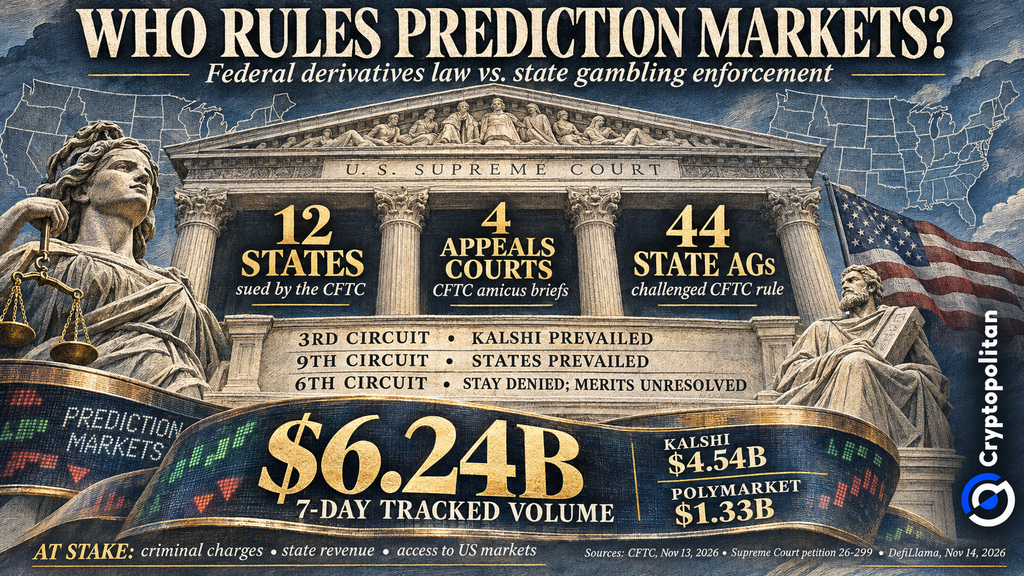
CFTC vs. States: Prediction Market Regulation and $6.24B Trading Volume
The uncertainty hangs over a sizable market. As of November 14, DefiLlama tracked $6.24 billion in seven-day prediction-market trading volume across 138 protocols. Kalshi accounted for $4.54 billion and Polymarket $1.33 billion. The figures cover only the platforms DefiLlama monitors.
Conflicting state rules could raise compliance costs, restrict market access and fragment trading liquidity. Britain offers a comparison. Prediction-market products generally appear to require betting-intermediary licences, depending on their structure. Financial instruments face separate oversight, as Norton Rose Fulbright explains.
Political scrutiny could add further pressure. Cryptopolitan reported that Senator Elizabeth Warren plans closer oversight of prediction markets if she becomes Senate Banking Committee chair in January. Her appointment remains unconfirmed.
Despite the legal challenges, Selig remains firm about the CFTC’s authority:
“Our view on the statute is that we have exclusive jurisdiction over these markets.”
If you're reading this, you’re already ahead. Stay there with our newsletter.