The U.S. Commodity Futures Trading Commission (CFTC) has filed a lawsuit against the state of Utah and its attorney general, escalating a long-running fight over who has authority to regulate
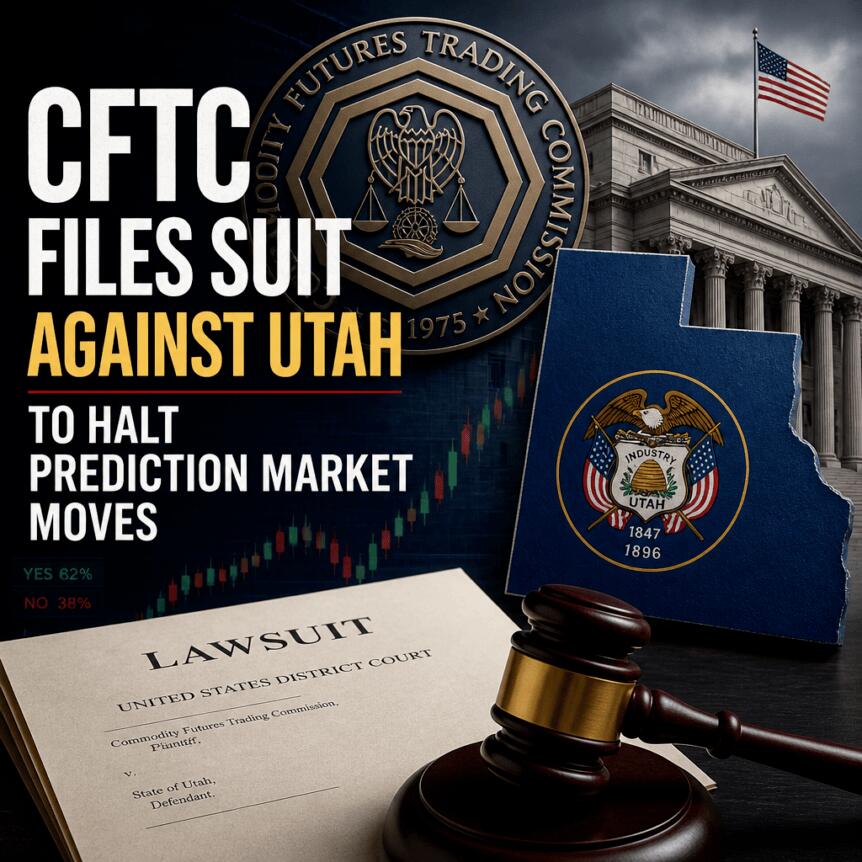
The U.S. Commodity Futures Trading Commission (CFTC) has filed a lawsuit against the state of Utah and its attorney general, escalating a long-running fight over who has authority to regulate U.S. prediction market platforms.
According to a Monday filing in the U.S. District Court for the District of Utah, the regulator is challenging Utah’s legal efforts tied to Kalshi and its affiliates—efforts that Utah officials say are aimed at compelling the return of up to $60 million in profits they allege were generated through unlawful betting.
Key takeaways
- The CFTC is suing Utah and Attorney General Derek Brown, arguing the state is trying to limit CFTC-regulated trading venues.
- At the center of the dispute is whether “event contracts” offered by prediction market exchanges fall within the Commodity Exchange Act as federally regulated derivatives.
- CFTC Chair Michael Selig has previously asserted that the agency has exclusive jurisdiction over prediction markets, contributing to repeated federal-versus-state conflicts.
- Multiple states have filed their own challenges involving Kalshi, and the outcome may hinge on how the U.S. Supreme Court handles related petitions.
CFTC challenges Utah’s approach to prediction markets
The CFTC’s legal action follows a week after Utah officials announced they would pursue court action against Kalshi and affiliated entities. In its filing, the agency contends that Utah is attempting to sidestep what Congress intended by restricting the operation of CFTC-registered exchanges.
The regulator argues that Utah’s efforts amount to an improper intrusion into an area Congress designed for federal oversight—specifically, the regulation of commodity derivatives markets through the CFTC framework.
In the lawsuit, the CFTC states that the prediction market “event contracts” targeted by Utah are “swaps” under the federal Commodity Exchange Act. It further asserts that the exchanges offering those contracts for trading are CFTC-regulated Designated Contract Markets (DCMs).
That framing is central to the dispute: if the contracts are swaps offered through CFTC-regulated venues, then the CFTC’s position is that states cannot impose their own restrictions or end-runs around the federal regulatory scheme.
Exclusive federal jurisdiction vs. state enforcement
The conflict is not merely procedural; it reflects a deeper jurisdictional disagreement between federal and state authorities over the scope of the CFTC’s role.
As the CFTC has argued publicly for months, it maintains “exclusive jurisdiction” over prediction markets. The filing points to the idea that Utah’s attempt to limit CFTC-regulated trading effectively undermines the federal scheme Congress established.
By contrast, Utah officials have characterized their case as necessary enforcement against allegedly illegal activity. In the lead-up to the new federal complaint, Utah’s attorney general said he intended to pursue relief that includes repayment of profits allegedly obtained improperly—up to $60 million, as described in the reporting on the state’s action.
For market participants, the stakes go beyond a single platform. A state-level effort to constrain contracts offered by federally regulated venues could, if successful, create an inconsistent patchwork of rules across states—potentially affecting how prediction market operators structure their offerings and compliance programs.
Kalshi says federal oversight should control
In response to Utah’s lawsuit, Kalshi spokesperson Jacki McGavick said the platform is operating under federal oversight and that no individual state should be able to impose a “veto” over it.
“As a national derivatives market overseen by the CFTC, Kalshi answers to federal law, and no single state should have a veto over it.“
That argument aligns directly with the regulatory posture reflected in the CFTC’s filing: prediction market trading offered through CFTC-regulated entities should be governed by a uniform federal framework rather than state-by-state challenges.
Supreme Court could determine who gets the final word
This case represents another step in the broader legal battle over prediction markets—an arena where federal agencies and state governments have repeatedly clashed.
Earlier, New Jersey officials petitioned the U.S. Supreme Court in an effort to resolve their dispute with Kalshi. Other states have also raised related challenges, including actions in Michigan, Ohio, Kentucky, Nevada, Massachusetts, Wisconsin, and New York. As of Tuesday, the Supreme Court had not indicated whether it would hear those arguments.
That matters because jurisdictional questions often take on outsized importance in derivatives-adjacent industries: when the highest court decides whether federal law preempts state enforcement in a particular context, it can reshape the compliance landscape not only for prediction markets, but potentially for other forms of event-based or contract-style trading that regulators treat as derivatives.
In other words, even as lower courts consider filings like the CFTC’s Utah case, the possibility of a Supreme Court ruling creates a high-stakes backdrop for operators, investors, and legal counsel watching for clarity on preemption and regulatory authority.
What to watch next
For now, the key question is how the district court will address the CFTC’s claim that Utah is improperly interfering with federally regulated exchanges and contracts. At the same time, market participants should closely monitor whether the Supreme Court agrees to take up the related prediction market cases, since a high-court decision could determine the boundaries of state enforcement versus federal oversight more broadly.
This article was originally published as CFTC Files Suit Against Utah to Halt Prediction Market Moves on Crypto Breaking News – your trusted source for crypto news, Bitcoin news, and blockchain updates.