The U.S. Commodity Futures Trading Commission (CFTC) has approved updated reporting rules for prediction markets, aiming to bring more clarity to how event contracts should be reported as the
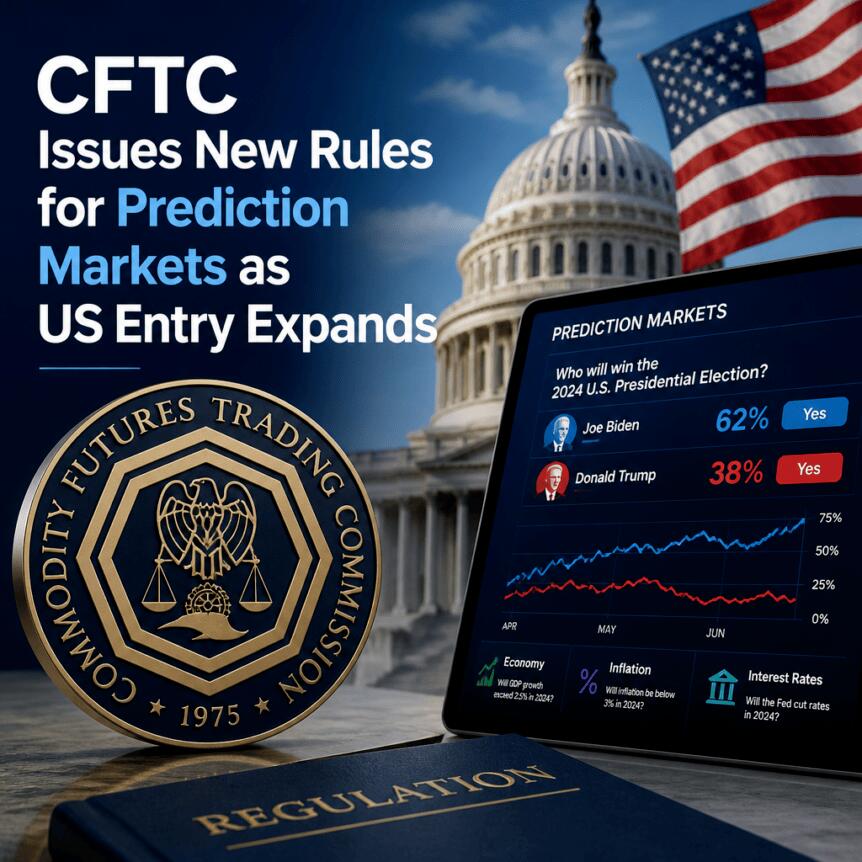
The U.S. Commodity Futures Trading Commission (CFTC) has approved updated reporting rules for prediction markets, aiming to bring more clarity to how event contracts should be reported as the sector attracts new applicants and operators.
Announced Monday, the CFTC said exchanges will report certain event contracts in a way that more closely matches established futures and options reporting. The move also ends the need for exchanges to repeatedly seek case-by-case no-action relief for these reporting obligations—relief that the CFTC previously characterized as temporary workarounds.
Key takeaways
- The CFTC’s new framework standardizes how exchanges report specific event contracts, aligning reporting practices with futures and options models.
- Exchanges will no longer need separate no-action requests for these reporting requirements, replacing a longstanding patchwork.
- Rules apply to certain fully collateralized event contracts, meaning operators must set aside sufficient collateral to cover potential losses.
- Customer data collection requirements will expand, including details such as names, addresses, occupations, and employers.
- Compliance timelines span phases, with some deadlines extending into 2027, while exchanges get a one-year window for the new customer information rules.
Standardized reporting to replace “no-action” stopgaps
In its announcement, the CFTC described the previous approach as inadequate for a market that has continued to evolve. CFTC Chairman Michael Selig said the earlier no-action letters were “band-aids for unworkable regulations,” underscoring that the regulator viewed them as emergency measures rather than a durable solution.
Under the approved rules, exchanges will report event contracts under a standardized regime similar to how futures and options transactions are reported. The regulatory intent is straightforward: reduce uncertainty about what must be filed, and lower administrative friction for exchanges seeking to operate prediction markets within the federal framework.
While the reporting change clarifies obligations for covered event contracts, it does not eliminate the requirement for new exchange operators to obtain regulatory approval before launching.
Why the shift matters as prediction markets scale
In a final rule document released in September, the CFTC said it had been reviewing at least 12 applications from companies looking to launch exchanges that could offer these kinds of contracts. The approval Monday builds on that broader push to formalize the reporting process while the number of market participants increases.
The regulator also provided perspective on growth. According to the CFTC’s final rule, exchanges certified about 1,600 event contracts for listing in 2025. That compares with an average of roughly five new listings per year between 2006 and 2020, highlighting a sharp acceleration in activity over the past several years.
The CFTC expects the new reporting framework to lower some reporting costs. However, exchanges will face expanded compliance duties as well—particularly around user identification.
As the CFTC stated, exchanges will be required to collect more information about their customers, including names, addresses, occupations, and employers. The regulator said knowing where traders work could help identify potential access to inside information or possible influence over event outcomes—concerns that have also attracted political attention in Washington.
New customer data requirements and compliance timelines
The CFTC’s final rule indicates that exchanges have one year from the rule’s publication in the Federal Register to meet the new customer information requirements. Beyond that, other components of the rule will roll out in phases, with some deadlines scheduled for 2027.
This phased approach matters for operators planning launches and upgrades. Reporting changes that arrive on different schedules can create temporary operating complexity—especially for teams building compliance workflows, vendor integrations, or reporting pipelines intended to meet both near-term and later requirements.
The expanded data collection also ties into parallel enforcement and policy efforts in the U.S. Earlier reporting noted that U.S. lawmakers proposed rewarding whistleblowers with up to 30% of the financial penalties collected in certain prediction market fraud cases. The CFTC’s emphasis on trader information reflects similar concerns about market integrity and the risk of unfair advantage.
Rules evolve further on what contracts can be listed
The reporting update is only one part of the CFTC’s broader regulatory agenda. The agency is also working on separate rules intended to clarify which types of events prediction markets can offer contracts on.
According to a government review portal, the White House received those rules for review on Nov. 20, but the final text has not yet been made public. That leaves room for uncertainty about how the event-eligibility rules will ultimately be framed—an issue that will likely influence operator decisions and market offerings.
Meanwhile, U.S. legislative developments continue to shape the environment. On Nov. 19, the U.S. Senate passed the DEATH BETS Act, which would ban federally regulated prediction markets from offering contracts tied to war, military operations, terrorism, assassinations, and individual deaths. The bill is still awaiting House approval.
The newest CFTC reporting rules also do not settle a long-running jurisdiction dispute. The CFTC has maintained that certain event contracts fall within its authority, and it has sued 12 states that argue sports-related contracts should be regulated under state gambling frameworks.
For market participants, these overlapping tracks—federal reporting standards, potential limitations on event types, pending federal legislative restrictions, and ongoing state-vs-federal legal conflict—means the regulatory picture will remain dynamic even after the reporting rules take effect.
Investors, traders, and exchange operators should watch how the phased compliance deadlines play out, whether the CFTC’s forthcoming event-eligibility rules narrow or expand what markets can list, and how federal legislation like the DEATH BETS Act progresses in Congress.
This article was originally published as CFTC Issues New Rules for Prediction Markets as US Entry Expands on Crypto Breaking News – your trusted source for crypto news, Bitcoin news, and blockchain updates.