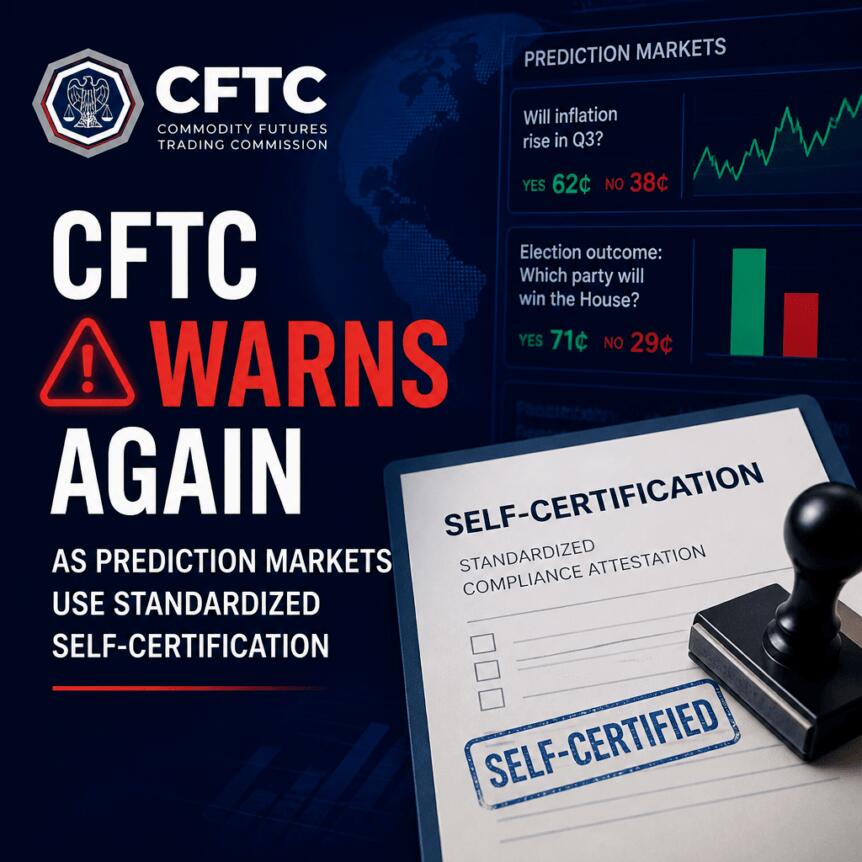
The US Commodity Futures Trading Commission (CFTC) has issued another warning to prediction market operators, urging them to follow its rules when certifying event contracts that cover a wide
The US Commodity Futures Trading Commission (CFTC) has issued another warning to prediction market operators, urging them to follow its rules when certifying event contracts that cover a wide range of possible outcomes. The regulator said some platforms are submitting “self-certified” listings without providing the specific terms and compliance analysis required for each contract permutation.
In an advisory released on July 24 and published as part of a Friday notice, the CFTC reiterated that—despite ongoing policy discussions and proposed rulemaking—operators may still self-certify certain event contracts as compliant with the Commodity Exchange Act (CEA) and CFTC regulations, as long as they do so within the statutory self-certification framework.
Key takeaways
- The CFTC warned that broad, template-style self-certifications for event contracts are not acceptable for listings under its jurisdiction.
- Operators are expected to submit the terms and conditions for each proposed permutation, along with concise explanations tied to the product and the relevant commodity and compliance requirements.
- The advisory underscores the regulator’s view that generalized submissions have been a recurring issue, with a similar warning issued earlier this year.
- The latest move comes just before a public comment deadline tied to the CFTC’s proposed amendments on public interest determinations for certain event contracts.
Why the CFTC is pushing back on “self-certified” event contracts
According to the CFTC’s July 24 announcement, the agency has observed multiple instances where event contracts are being self-certified by platforms without supplying the full details the CFTC says it needs. Specifically, the regulator criticized submissions that do not include the terms and conditions of each proposed permutation, nor a concise explanation and analysis explaining how the product’s terms and conditions relate to compliance expectations.
The advisory frames this as a compliance execution problem rather than a blanket prohibition on prediction market products. The CFTC emphasized that operators can certify certain event contracts without seeking prior commission approval, but they must do so properly under the self-certification structure established by law and CFTC regulations.
In the regulator’s words, broad, template-style certifications should not be submitted. The CFTC’s concern is that generalized paperwork makes it harder to evaluate whether each individual contract listing complies with the CEA and applicable CFTC requirements—particularly when a contract covers a wide swath of events and permutations.
A warning issued twice in 2026
The July 24 advisory is not the first time the CFTC has flagged the issue this year. The agency referenced a similar warning on March 12, again targeting overly generalized submissions. By issuing the guidance for a second time, the CFTC is effectively signaling that it expects corrective action and that it views continued template-style filings as a repeated compliance failure.
For operators, this matters because self-certification is often treated as a faster path to listing products compared with seeking affirmative approval. If the CFTC continues to find that filings lack the required detail, platforms may face heightened regulatory scrutiny, which can translate into delays, requests for additional information, or more direct enforcement consequences—especially for contracts built around broad event categories.
The advisory arrives shortly before the CFTC’s July 27 deadline for submitting comments on proposed rule amendments related to how the agency conducts public interest determinations for certain event contracts.
Those proposed amendments aim to clarify how the CFTC determines whether specific event contracts are contrary to the public interest under the CEA. The CFTC described the approach as a three-step analytical framework intended to evaluate contracts based on their involvement in certain enumerated activities—such as terrorism, assassination, or gaming—so that only appropriate contracts are listed for trading.
The proximity between the self-certification warning and the comment period is likely not accidental. For prediction market businesses, the next regulatory phase could change how contracts are assessed for public interest risks even if self-certification remains available in some circumstances. Operators will therefore need to reconcile two parallel expectations: submit sufficiently detailed self-certifications now, while also preparing for potential changes in the CFTC’s public interest evaluation standards later.
What changes for operators: from templates to permutation-specific filings
The practical thrust of the CFTC’s message is straightforward: when an event contract can take many forms—or when it is designed to cover numerous permutations—operators need documentation that matches that complexity. The CFTC’s criticism centered on certifications that do not provide, for each proposed permutation, the terms and conditions and a concise compliance explanation tailored to the product’s conditions, the underlying commodity, and applicable compliance considerations.
That means the template approach that may be common for scaled product development—where only a few parameters are varied across listings—could be viewed by the CFTC as insufficient when the certification is expected to demonstrate compliance for each unique configuration.
For market participants such as traders and liquidity providers, the filing quality issue may not directly change how contracts trade day-to-day, but it does affect listing stability and regulatory risk. If contract certifications are challenged, the availability of products could be disrupted, and participants may face sudden changes in trading access or contract availability.
Legal practitioners have also pointed to how the pending amendments could alter the regulatory landscape. Earlier coverage noted that law firm Ropes & Gray said the CFTC’s proposed changes could “rewrite the rulebook” for prediction market contracts, reflecting how significant the public interest determination framework could be if adopted.
What to watch next
With comments due July 27 on the proposed public interest determinations framework, prediction market operators should expect follow-on developments that could refine what the CFTC considers acceptable contract listings and how self-certification must be documented. The key question ahead is whether operators will update certification practices to avoid template-style submissions and how the CFTC will translate its three-step framework into enforceable guidance if the proposed amendments move forward.
This article was originally published as CFTC Warns Again as Prediction Markets Use Standardized Self-Certification on Crypto Breaking News – your trusted source for crypto news, Bitcoin news, and blockchain updates.