The Chainlink network's treasury has passed a round mark. According to several industry outlets reporting on September 26 and 27, 2026, the Chainlink Reserve holds exactly 6,047,498 LINK. In
The Chainlink network's treasury has passed a round mark. According to several industry outlets reporting on September 26 and 27, 2026, the Chainlink Reserve holds exactly 6,047,498 LINK. In September alone, 373,791 tokens were added, worth a good $4.3 million at the price at the time. Alongside that, the price of Chainlink has risen sharply: in the early hours of September 29, 2026, LINK trades at $15.56, up around 10.6 percent within 24 hours and 16.7 percent over the week.
For you as an investor in Germany these are two different things, and they need to be kept apart. The reserve is a structural change on the supply side. The price jump is a day's move. What follows sets out what lies behind the reserve, which levels the price has just marked, and what you need to keep an eye on when buying, on the holding period, on staking and on leveraged positions.
Chainlink Reserve: 6,047,498 LINK now sit in the network treasury
The Chainlink Reserve is an on-chain treasury of the network into which part of the revenue from the oracle services flows, where it is converted into LINK and held. It is not a fund you can buy units in, and it is not a foundation handing out money. What is meant is simply a holding that grows as long as the network takes in revenue.
The current level of 6,047,498 LINK is cited consistently by several specialist services, among them Coingabbar with the date September 26 and Coin-Turk with the same figures. Both also list the same September increase: 373,791 LINK. You can look up the holding yourself on the project's official reserve page, which tracks the development continuously.
More interesting than the absolute number is the pace. At the end of the first quarter of 2026, according to the same reports, the reserve held around 3.06 million LINK. The holding has therefore almost doubled in a good six months. Anyone watching the project over a longer period will read one thing above all into that: the revenue feeding the reserve now comes in regularly, not just in isolated cases.
Payment Abstraction: where September's 373,791 LINK come from
Payment Abstraction is the mechanism with which Chainlink collects payments in any token and converts them into LINK automatically. A company booking a data service therefore does not have to buy LINK on the market itself. It pays in whatever currency suits it, and in the background the equivalent value lands in the treasury as LINK.
That sounds technical, but it has a very tangible consequence. Every new large customer raises the ongoing buying pressure on LINK, without that customer ever making a purchase decision about the token. This is precisely where the reserve connects with the corporate news of recent weeks that we have already covered, such as the inclusion of Chainlink in a banking standard from Infosys on September 24.
One caveat belongs with this. How much revenue actually accrues, and what share of it moves into the reserve, is not published by the project as a line item per customer. The inflow is documented; its origin in detail is not. Anyone extrapolating an annual revenue figure from 373,791 LINK in September is working with a number nobody has verified.
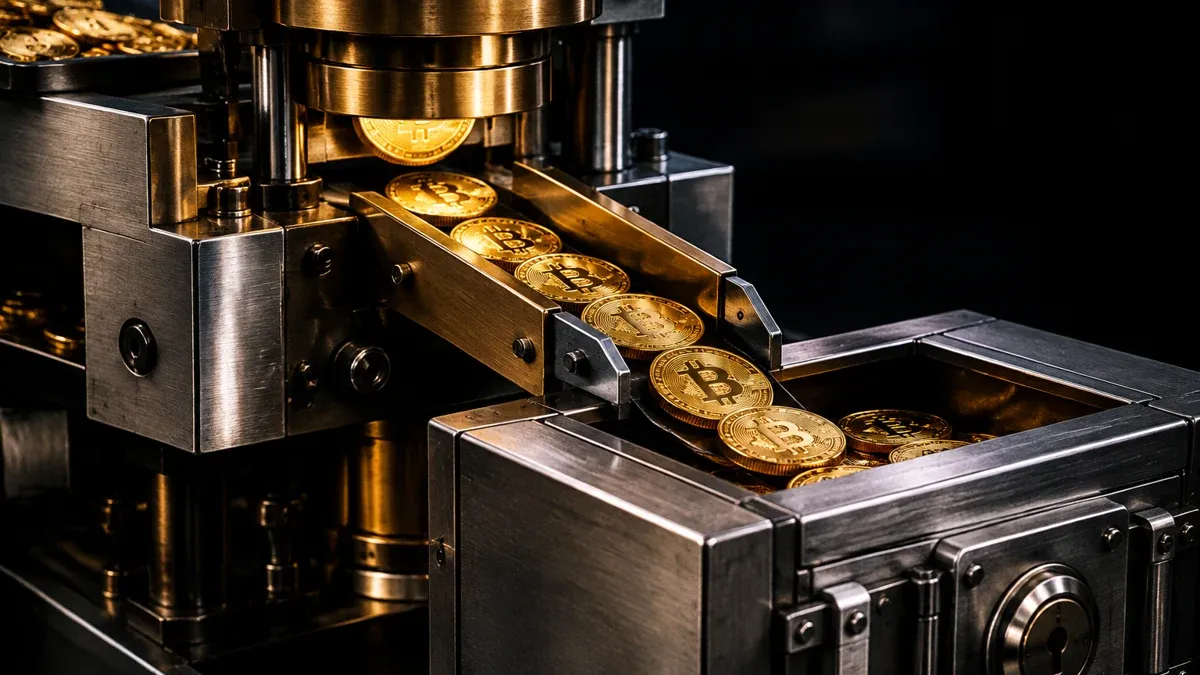
Payment Abstraction collects payments in any token and puts the equivalent value into the reserve as LINK.
What 6 million LINK mean for the circulating supply
Of the 1,000,000,000 LINK that will ever exist, around 748.1 million are currently in circulation. The reserve's 6,047,498 LINK work out at roughly 0.8 percent of that. It is noticeable, yet it is no supply shock, and anyone selling it as one is overstating the case.
Here is one way to place it: with trading volume of around $1.44 billion in 24 hours, the reserve's $4.3 million of purchases across the whole of September move less than the market turns over on an average morning. The effect lies in duration, not in day-to-day trading. A holding that grows every month and is not sold takes supply off the market piece by piece.
LINK price at $15.56: the 24-hour high and low compared
In the early hours of September 29, 2026, LINK stands at $15.56. The range of the past 24 hours runs from a low of $13.54 to a high of $15.49. Around 14 percent lies between those two points, and the price is quoted at the upper edge of that range.
Over a month the gain comes to just under 34.8 percent, over a week to 16.7 percent. With a market capitalisation of about $11.6 billion, LINK ranks 13th among the largest cryptocurrencies. The all-time high of $52.70 from May 2021 is still around 70 percent away.
These figures are snapshots. The price changes while you read, which makes it useless as a forecast. What the values do deliver is something else: reference points you can pin your own decision to instead of pinning it to a headline.
Buying LINK in Germany: MiCA authorisation, spot purchase and custody
If you want to buy LINK in Germany, the simplest route runs through a trading platform holding an authorisation under the EU regulation MiCA. MiCA is the European legal framework for crypto assets, which obliges providers to hold authorisation and own funds, to segregate client money and to supply comprehensible information sheets. A platform without that authorisation may no longer address retail clients in the EU through regular channels.
Three things differ considerably between providers in practice: the trading fee per purchase, the mark-up in the price itself, and whether you are allowed to move the purchased tokens to a wallet of your own at all. The third point tends to be overlooked and is the most important one if you intend to hold for the long term. If you then want to keep the tokens in your own custody, you need a device or software of your own for that; which devices are suitable is shown in our hardware wallet comparison.
One more thing applies to a spot purchase: you buy the token itself and no certificate on it. That matters for tax, and it is the reason why the question of the withdrawal route to your own wallet is not a side issue.
Many readers ask about staking at this point, and the answer turns out differently from what other networks have taught them. Staking at Chainlink means you deposit LINK as security for the correct operation of the oracle services and receive a payment for it. The programme runs in version v0.2 and has a fixed cap.
That cap stands at 45 million LINK in total, of which 40,875,000 LINK sit in the community pool. This pool was full within a few hours of launch. Since then the rule is: new room only opens up when an existing participant withdraws their tokens. There is no waiting list and no allocation, only first come, first served. The terms are set out on the project's staking page.
Anyone still looking for an ongoing yield almost inevitably ends up with third-party offers, meaning exchanges or custodians paying a return on deposited tokens. That is something entirely different from staking in the protocol: there you also carry the provider's default risk. Anyone using such offers should therefore establish first who holds the tokens during that time and what happens to them if the provider becomes insolvent.
A one-year holding period: the tax on LINK gains in Germany
For private investors in Germany, a sale of LINK counts as a private disposal under section 23 of the Income Tax Act. If more than twelve months lie between purchase and sale, the gain stays tax free. Sell within that period and the gain is taxable at your personal income tax rate, as soon as the sum of all private disposal gains in a year reaches the threshold of €1,000.
Threshold here really does mean a threshold and not an allowance. Anyone reaching €999 of gains in a year pays nothing. Anyone reaching €1,001 pays tax on the full amount and not merely on the one euro above it. This difference costs money regularly, because it gets overlooked.
What matters in practice is the allocation of the individual purchases. If you have bought in tranches over months, every tranche has its own acquisition date, and on a sale it has to be clear which of them is going out. For that, the tax authorities accept the first-in-first-out method, under which the oldest tokens count as sold first. Without clean records it can hardly be reconstructed after the fact, and in case of doubt the tax office estimates to your disadvantage.
A note on staking through third parties: payments from such offers are as a rule other income and are taxed in the year they are received, independently of the one-year period. Anyone mixing the two should keep the positions separate.
After twelve months of holding, the gain from a LINK sale is tax free in Germany.
Leverage and liquidation: what a tenfold leverage withstands at $15.56
A price running from $13.54 to $15.49 within 24 hours attracts leveraged positions. A sober calculation is worth doing here. The liquidation price is the price at which the security deposited is used up and the position is closed by force.
With tenfold leverage, a counter-move of around ten percent is arithmetically enough for that, with twentyfold leverage around five percent, in each case before fees and financing costs. Measured against this Wednesday's daily range, which alone came to around 14 percent, a long position with tenfold leverage would have been liquidated at that day's low, even though the price ended up considerably higher.
That is the real point: in a strong move, the result is decided by the path taken and not by the direction. Anyone working with leverage should know the liquidation price before entering and not go looking for it once the position is already running.
Levels above and below: $13.54, $15.49 and the all-time high at $52.70
Three values serve as orientation, all of them drawn from the price data itself and carrying no opinion. On the downside, the low of the past 24 hours at $13.54 is the first level; below it the previous week's price territory begins. On the upside, the daily high at $15.49 is the point at which the current move was last halted.
The third level is historical: $52.70 from May 9, 2021. That value shows how far the way to the previous peak still is, and it puts this week's jump in perspective. A gain of 34.8 percent in a month is a lot; measured against the all-time high, around 70 percent is still missing.
We are deliberately leaving out analysts' price targets. For the figures circulating in recent days, no originator attributable by name could be established, and a number without a sender is not information.
What the reserve does not deliver
Finally the counter-check, because a growing network treasury is readily declared a price guarantee on social networks. It is nothing of the kind. The reserve does not buy prices, it collects revenue. There is no obligation to support the price when it falls, and the project likewise publishes no plan for when tokens might be released again.
Just as little does the reserve say anything about the quality of the individual integrations. An inflow of 373,791 LINK in one month documents that revenue is accruing. It does not document that this revenue will accrue again next month. Anyone wanting to follow the development looks at the holding across several months, not at the report of a round number.
Chainlink Reserve: your next three steps
- Look up the holding yourself. Open the project's reserve page and compare the holding shown there with the 6,047,498 LINK from this article. If the number differs, something has been added or has flowed out since, and you have the more current value. Your own holdings are best tracked in a portfolio tracker with a tax function.
- Settle the buying route and the withdrawal before you buy. Check in our exchange comparison whether your platform holds a MiCA authorisation, what fee applies per purchase and whether a withdrawal to a wallet of your own is possible.
- Note the purchase date and keep yield offers separate. Record the acquisition date for every tranche so the one-year period can be proven. If you are also looking at yield offers, compare them in the overview of staking platforms and treat them separately from plain holding for tax purposes.
(As of September 29, 2026. This article is not investment advice. Prices and fee structures change; check the terms with the provider before you buy.)