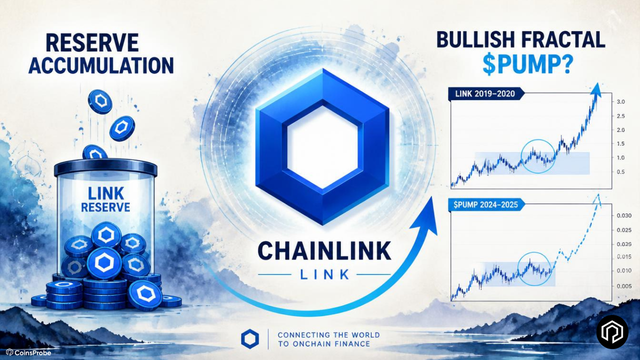
Key Highlights LINK is mirroring PUMP’s pre-rally fractal, with $10.905 cleared and $13.526 now the key confirmation level. Chainlink Reserve added 462,730 LINK worth over $4.4M in August, br
Key Highlights
- LINK is mirroring PUMP’s pre-rally fractal, with $10.905 cleared and $13.526 now the key confirmation level.
- Chainlink Reserve added 462,730 LINK worth over $4.4M in August, bringing holdings to 5.67M LINK.
- PUMP gained 149% in 30 days, while LINK is up 39%, suggesting LINK could be entering a similar expansion phase.
- A sustained move above $13.526 could strengthen the bullish fractal thesis.
Two tokens from entirely different sectors of the crypto ecosystem are drawing a specific and visually striking comparison from the technical analysis community — and the timing of the comparison is not coincidental. Pump.fun’s PUMP has delivered one of the strongest 30-day performances in the market at +149%, completing a chart structure that Chainlink’s LINK appears to be building right now. Simultaneously, the Chainlink Reserve published its August accumulation update — converting real protocol revenue into LINK holdings at a pace that is creating a new and structurally unique demand sink for the token.
The performance gap between PUMP and LINK over 30 days is significant — and it is precisely this gap that the fractal comparison is attempting to contextualize. The analyst argument is not that LINK will replicate PUMP’s exact percentage gain — it is that LINK’s weekly chart structure currently resembles PUMP’s chart at the point just before PUMP’s most explosive expansion phase began.
 LINK and PUMP Tokens Prices on 28 Aug 2026 | Source: Coinmarketcap
The Chainlink Reserve — Real Revenue Converted Into LINK, Every Month
Before examining the fractal comparison, the fundamental development that gives LINK’s technical structure additional weight deserves its own analysis.
On August 27, 2026, the official @chainlink account published the latest Reserve update:
- August accumulation: 462,730 LINK — valued at more than $4.4 million
- Total Reserve holdings: 5,673,707 LINK
- Average cost basis: ~$11.14 per LINK
- Current value of holdings: mid-$60 million range (price dependent)
 Chainlink $LINK Reserve Update | Source: @chainlink (X)
What the Chainlink Reserve Actually Is
The Reserve — launched in 2025 — is a structural demand mechanism that is fundamentally different from buyback programs funded by token treasuries or emissions. The Reserve operates through Payment Abstraction and other Chainlink services to convert mixed revenue streams into LINK:
Sources of Reserve funding:
- Enterprise contract revenues from off-chain clients
- On-chain service fees generated by CCIP, data feeds, and other Chainlink products
- Certain staking-related revenue shares
All converted revenue flows into a timelocked on-chain contract — publicly trackable via the metrics.chain.link dashboard — with withdrawals not expected for years. The stated goal is long-term economic sustainability rather than short-term price support.
Why This Matters Structurally
The Reserve is creating a structural buyer funded by real usage — not by printing new tokens, not by selling from a treasury, and not by leveraged speculation. Every month that Chainlink’s enterprise clients pay for oracle services, every CCIP cross-chain transaction, every staking fee — a portion of that real economic activity converts into LINK held in a timelocked contract that cannot be immediately sold.
As covered in our Chainlink 5-month whale activity high and 2023 fractal analysis and Chainlink Wyckoff accumulation and all-time high holder count breakdown, the large-holder accumulation that has been building in LINK throughout 2026 now has a named, on-chain, publicly trackable institutional accumulation mechanism behind it — the Reserve converting $4.4 million+ in August alone.
At an average cost basis of $11.14 — almost exactly where LINK is currently trading — the Reserve is accumulating at the current price level. This is not a coincidence: it means the Reserve’s monthly buying is occurring at prices that institutional LINK holders are also accumulating at, creating a structural demand floor at the current price zone.
The PUMP vs. LINK Fractal — Reading the Weekly Chart
Analyst @Axel_bitblaze69 posted a side-by-side weekly chart comparison on August 28, 2026, presenting the structural case that LINK is currently forming the same pattern PUMP completed before its explosive +149% 30-day advance.
 PUMP and LINK Fractal Setup/Source: @Axel_bitblaze69 (X)
The Shared Structure — Four Matching Elements
Both the PUMP weekly chart (left) and the LINK weekly chart (right) display the same four-stage structural pattern:
StagePUMPLINK1. Prolonged DowntrendExtended decline from ATHExtended decline from ATH2. HTF Base / Demand Zone~$0.001481 (red zone)~$7.854 (red zone)3. First Flip Reclaimed~$0.002194 (cyan level)~$10.905 (cyan level)4. Second Flip Ahead~$0.002623 (green — cleared)~$13.526 (green — pending)
PUMP’s Completed Structure — The Template
PUMP’s weekly chart shows the full pattern already completed:
After a prolonged downtrend from its highs, PUMP found a higher-timeframe (HTF) base near $0.001481 — the red demand zone where aggressive accumulation occurred. From that base, price reclaimed the first flip level at $0.002194 (cyan), then broke through the second flip at $0.002623 (green). The move through those two levels in sequence — base → flip 1 → flip 2 — was followed by the sharp vertical expansion that produced the +149% 30-day performance currently visible on the chart.
As covered in our PUMP Power of 3 expansion analysis and PUMP revenue-backed rally breakdown, PUMP’s move was not purely technical — it was supported by genuine platform revenue and a buyback mechanism that provided fundamental backing for the technical structure.
LINK’s In-Progress Structure — Where It Stands Now
LINK’s weekly chart shows the same four stages — but with the fourth stage (second flip) not yet completed:
After a prolonged downtrend from its 2024–2025 highs, LINK found its HTF base near $7.854 — the red demand zone on the right chart. Price has since reclaimed the first flip level at $10.905 (cyan) — and at the current price of $11.73, LINK is trading above the first flip with the second flip at $13.526 (green) as the next structural test.
The $13.526 second flip level is the key threshold. PUMP’s pattern shows that the most explosive price action came after the second flip was reclaimed and held — the structural signal that the base-to-expansion transition was complete. If LINK follows the same sequence and converts $13.526 as support on a sustained weekly basis, the fractal projects a significant expansion phase ahead.
What Makes This Fractal Comparison Credible — And Where Its Limits Are
What Strengthens the Comparison
Structural precision: The four stages of the pattern — prolonged downtrend, HTF base, first flip, second flip — are visible on both charts with clearly defined price levels rather than abstract comparisons.
Current positioning: LINK is at the structurally equivalent point to where PUMP was just before its expansion — not after, not during, but at the inflection between the first flip reclaim and the second flip test. The timing of the comparison is analytically relevant.
Fundamental support: PUMP’s move was backed by a buyback mechanism funded by platform revenue. LINK’s potential move has the Reserve — a real-revenue-funded accumulation program that bought 462,730 LINK in August alone at current price levels.
Broader market context: The current crypto environment — Bitcoin reclaiming the 1,130-day SMA, CryptoQuant declaring the bear cycle over, Bull Score at 80 — is structurally more favorable for altcoin expansion than the environment in which LINK spent most of its corrective phase.
Where the Comparison Has Limits
Different asset categories: PUMP is a high-beta launchpad token with a speculative narrative and a buyback flywheel. LINK is a $8.77 billion market cap oracle infrastructure asset with institutional adoption and DeFi security scale. The percentage magnitude of comparable moves may differ significantly due to the size difference alone.
Liquidity and holder base: PUMP’s holder base is more speculative and momentum-driven. LINK’s is more institutional and long-term oriented. This affects how quickly and aggressively the market responds to technical level reclaims.
The $13.526 level must hold: Multiple replies to @Axel_bitblaze69’s original post noted that the fractal comparison requires the $13.526 second flip to be reclaimed and held — not just touched — before the expansion thesis has technical validity. A rejection at $13.526 and reversion below $10.905 would invalidate the comparison.
The most analytically complete framing of the current LINK situation combines three elements simultaneously:
The fractal (technical): LINK’s weekly structure has completed the same base-building and first flip stages that preceded PUMP’s +149% expansion. The second flip at $13.526 is the next structural test.
The Reserve (fundamental): Chainlink is accumulating 400,000+ LINK per month using real enterprise revenue — creating a demand sink at current price levels that is funded by the same institutional adoption that gives LINK its long-term value narrative.
The market regime (macro): Bitcoin declaring a bull cycle via the 1,130-day SMA reclaim and CryptoQuant’s Bull Score at 80 provides the broadest risk-on context that altcoin expansion phases require.
None of these elements guarantees the fractal plays out. All three pointing in the same direction simultaneously is what makes the current LINK setup one of the more complete convergences of technical, fundamental, and macro factors in the altcoin space at the time of writing.
Disclaimer: The views and analysis presented in this article are for informational purposes only and reflect the author’s perspective, not financial advice. Technical patterns and indicators discussed are subject to market volatility and may or may not yield the anticipated results. Investors are advised to exercise caution, conduct independent research, and make decisions aligned with their individual risk tolerance.