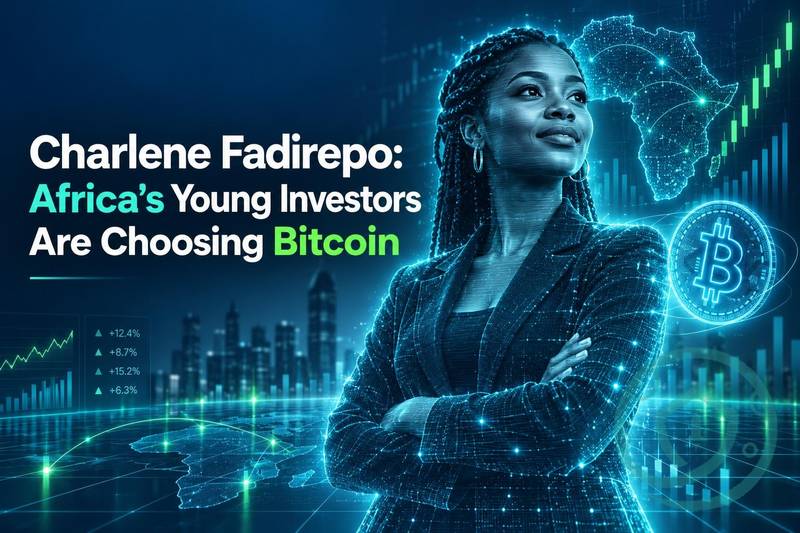
Former federal regulator Charlene Fadirepo has stated that young investors across Africa have made their choice: Bitcoin. The observation, shared via Bitcoin Magazine, frames a generational a
Former federal regulator Charlene Fadirepo has stated that young investors across Africa have made their choice: Bitcoin. The observation, shared via Bitcoin Magazine, frames a generational and geographic shift in how the continent's youth approach store-of-value assets and financial participation, filtered through the lens of someone who has spent a career inside U.S. regulatory infrastructure.
Why Charlene Fadirepo Says Africa's Young Investors Are Choosing Bitcoin
Fadirepo's background as a former federal regulator gives the statement weight that typical crypto commentary lacks. Regulatory insiders who turn toward Bitcoin advocacy tend to frame adoption not as speculation but as a rational response to institutional gaps, currency instability, and restricted access to global financial rails. For related coverage, see SEC Approves 3x Bitcoin Futures ETF Listing.
The claim centers on a demographic decision, not a market trade. Young investors in Africa, according to Fadirepo's reported statement, have decided on Bitcoin, a word that implies conviction and finality rather than speculative positioning. That framing matters when evaluating what adoption signals actually mean for network utility and long-term holding behavior.
KEY POINTS
- Former federal regulator Charlene Fadirepo attributed a Bitcoin preference shift to young investors in Africa, per Bitcoin Magazine reporting.
- The statement comes from a regulatory background, lending it a policy and access-oriented framing rather than a purely market-driven one.
- No supporting statistics or country-level breakdowns were included in the reported remarks; the claim reflects Fadirepo's observation, not independently verified survey data.
Fadirepo's perspective connects to a broader regulatory discussion around Bitcoin's role in economies where traditional banking penetration is uneven. Her prior regulatory work positions the statement as a systemic observation: when legacy financial infrastructure fails to serve young people, permissionless networks fill the gap. That dynamic has been discussed in the context of U.S. regulatory milestones like Bitcoin ETF approvals, which increase institutional legitimacy globally, not just in Western markets.
What This Investor Shift Could Mean for Bitcoin Adoption in Africa
If Fadirepo's characterization reflects a durable trend, the implications for Bitcoin's on-chain user base are structural. A young demographic base that selects Bitcoin as a primary savings or transfer vehicle creates low-churn, long-duration holding patterns, which are distinct from speculative trading cohorts. That kind of adoption is the foundation institutional allocators point to when justifying long-term exposure, as seen in moves like BlackRock's continued Bitcoin accumulation and Morgan Stanley's Bitcoin ETF position topping 10,500 BTC.
The risks are significant and should not be glossed over. Fadirepo's statement, as reported, is a single attributed observation without accompanying survey data, regional breakdowns, or methodology. Translating a regulator's qualitative read into confirmed adoption figures requires independent evidence that is not present in the current reporting.
From a regulatory standpoint, young African investors choosing Bitcoin also creates a feedback loop that regulators in those jurisdictions must navigate. Greater grassroots adoption tends to accelerate formal policy attention, which can cut toward legitimization or toward restriction depending on the political economy of each country. Fadirepo's framing, grounded in U.S. regulatory experience, may inform how American policymakers think about cross-border Bitcoin flows, particularly as instruments like Bitcoin ETF options expand regulated access at the institutional layer.
The statement stands as a reported observation from a credible regulatory voice. It warrants attention as a directional signal, not as confirmed market data.
Additional source references: source document 1, source document 2.
Disclaimer: This article is for informational purposes only and does not constitute financial or investment advice. Cryptocurrency and digital asset markets carry significant risk. Always do your own research before making decisions.
Read original article on aicryptocore.com