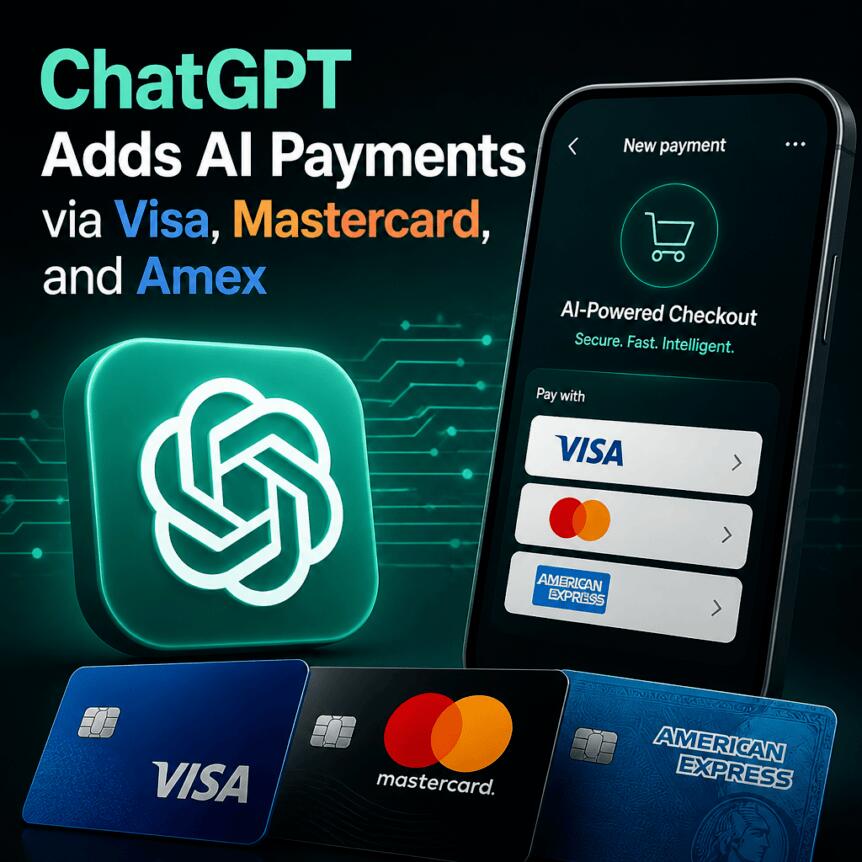
OpenAI has introduced a new “ChatGPT wallet” feature that lets users authorize AI agents to make purchases inside ChatGPT using existing card payment networks. Announced in a Friday update, t
OpenAI has introduced a new “ChatGPT wallet” feature that lets users authorize AI agents to make purchases inside ChatGPT using existing card payment networks. Announced in a Friday update, the wallet is designed to work with American Express, Mastercard, and Visa, aiming to move agentic behavior beyond recommendations and toward actual checkout execution.
Instead of exposing a shopper’s real card details to merchants or to the AI system, OpenAI says payment networks generate tokenized card credentials for each approved transaction. Users authorize payments through biometric verification—such as facial recognition or fingerprint checks—before purchases are processed.
Key takeaways
- OpenAI’s ChatGPT wallet enables purchase authorization inside ChatGPT using American Express, Mastercard, and Visa rails.
- Each authorized transaction uses tokenized credentials, with OpenAI saying merchants and AI agents do not receive users’ actual card details.
- Biometric verification is built into the authorization flow, aligning agent payments with established consumer security expectations.
- The rollout begins with ChatGPT Pro subscribers in the US for eligible cards, with broader automation planned later.
- Agentic commerce is being pursued by major tech and payments players, alongside crypto-focused payment infrastructure builders.
How OpenAI’s in-ChatGPT checkout is intended to work
OpenAI’s feature centers on a wallet experience inside ChatGPT. According to OpenAI, users can grant permission to AI agents to purchase items through payment networks, with authorization gated by biometric verification.
Once a purchase is approved, OpenAI says the underlying payment networks issue tokenized card credentials specific to that transaction. This approach is meant to reduce the amount of sensitive payment data that ever needs to be handled by the AI application itself, and it also aims to prevent merchants or AI agents from receiving raw card information.
For investors and product teams, the practical importance is that the feature tries to reuse existing payment plumbing rather than requiring merchants to adopt a new payment standard. If it works as intended, agent-to-merchant checkout could become easier to roll out across everyday online stores without forcing large-scale changes at the merchant level.
Rollout scope and what changes next
OpenAI states that the service is currently being rolled out to ChatGPT Pro subscribers in the US, limited to users with eligible cards issued in the country. The initial release also emphasizes transaction-by-transaction authorization.
OpenAI says it plans to expand the capability by supporting purchases within preset spending limits and other restrictions, so that users can set guardrails in advance rather than approving every transaction. While OpenAI does not provide additional technical details in the announcement, the product direction is clear: reduce the friction of repeated approvals while keeping user-controlled boundaries around what an agent can spend and when.
For users, this raises a straightforward trade-off to watch. The more automation expands, the more important it becomes to understand how limits, permissions, and fraud controls behave in edge cases—such as price changes, substitutions, or multi-step purchasing flows.
Why agentic payments are emerging as the next battleground
The wallet announcement arrives during a broader push by AI companies to shift from passive assistance—like product suggestions or summaries—into active execution. Rather than stopping at recommending what to buy, agents increasingly aim to complete tasks that typically happen at a checkout page.
OpenAI also notes it is working with payment processors and fraud prevention firms to support AI purchases through existing checkout systems. That emphasis matters because agentic commerce adds new risk patterns: systems that can initiate transactions create a larger surface area for fraud, mistakes, or unwanted purchases if authorization controls are not robust.
Payment providers and AI firms alike appear to be racing to solve the same integration challenge: enabling autonomous or semi-autonomous transaction flows while keeping security and customer protections intact.
Competition: tech, payments, and crypto infrastructure for AI agents
OpenAI’s entry puts pressure on other initiatives aimed at enabling AI-initiated transactions. The announcement cites a wider landscape of efforts across major platforms and payments networks.
Google, for example, introduced its Agent Payments Protocol in 2025, while Visa and Mastercard have launched initiatives intended to support AI-initiated payments. The shared theme is that enabling agent payments likely requires more than a single product feature; it depends on interoperability between AI applications, payment networks, and merchants’ checkout experiences.
Crypto companies are also building adjacent infrastructure. The announcement notes that Coinbase introduced its x402 protocol in 2025 to enable autonomous stablecoin payments for digital services. Circle, meanwhile, launched its Agent Stack in May to let agents hold and spend USDC within predefined limits. Other providers, such as Crossmint, are said to be pursuing a different route by pairing stablecoin wallets with traditional card networks.
These approaches highlight a central asymmetry in the market. Traditional card rails offer widespread merchant coverage, while stablecoin-based systems can offer different programmability and settlement characteristics. The emerging question for builders and businesses is which model delivers the most practical route to safe, scalable agentic checkout—especially when users expect familiar purchasing experiences.
Scale expectations and the numbers behind the push
Agentic commerce is also being framed as a major growth opportunity. According to an April report from Juniper Research—cited in OpenAI’s announcement—global agentic commerce transaction value is expected to reach $1.5 trillion by 2030, up from an estimated $8 billion in 2026. The report also positions payments infrastructure as a critical enabler for that expansion.
For readers tracking the space, those forecasts underline why partnerships and standards are becoming strategic. If agentic commerce grows as projected, the winners will likely be companies that can integrate quickly with existing payment ecosystems while also proving they can manage fraud and authorization at scale.
As OpenAI begins with a limited US rollout for ChatGPT Pro subscribers, the next signals to watch are whether tokenization and biometric authorization hold up smoothly in real purchases, how quickly OpenAI expands beyond per-transaction approvals to preset spending limits, and whether adoption spreads to more users and regions without adding meaningful friction to checkout.
This article was originally published as ChatGPT Adds AI Payments via Visa, Mastercard, and Amex on Crypto Breaking News – your trusted source for crypto news, Bitcoin news, and blockchain updates.