Key Takeaways CVX shares are currently trading near $201, approaching the record peak of $210 A 25-year Venezuelan oil development agreement was unveiled by President Trump US energy firms ar
Key Takeaways
- CVX shares are currently trading near $201, approaching the record peak of $210
- A 25-year Venezuelan oil development agreement was unveiled by President Trump
- US energy firms are projected to deploy more than $100 billion in Venezuela
- Chevron stands as the primary beneficiary, with a potential expansion announcement expected imminently
- Morgan Stanley elevated its CVX price target to $218 from $210
Shares of Chevron are hovering near the company’s record valuation of $210, currently changing hands around $201. Market participants are focused on a transformative Venezuelan energy partnership that could significantly impact the corporation’s trajectory.
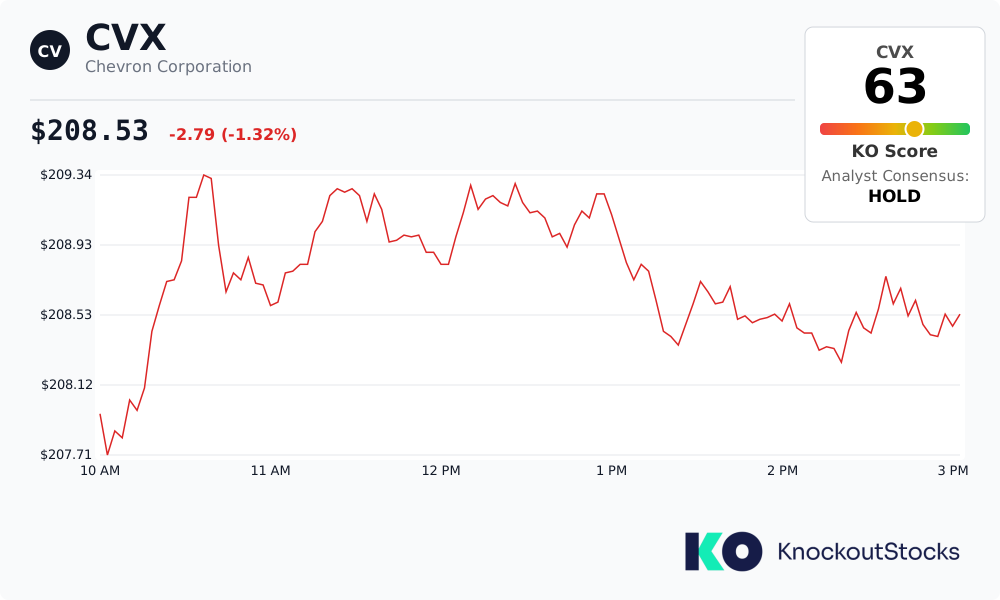 Chevron Corporation, CVX
The White House revealed a multi-decade pact enabling American energy corporations to exploit Venezuelan petroleum reserves. The initiative targets an increase in Venezuela’s daily crude production to 1.5 million barrels.
US-based energy firms are anticipated to commit upwards of $100 billion to Venezuelan operations. Tax revenues flowing to the Venezuelan treasury from this arrangement are projected to exceed $209 billion.
Chevron remains the sole major American energy player with existing Venezuelan operations. The company maintains three collaborative ventures with PdVSA, Venezuela’s national oil enterprise, positioning it advantageously for expansion opportunities.
Reports from the New York Times suggest Chevron may unveil plans this week to extend operations into two supplementary heavy-crude fields. Halliburton could also see increased business from expanded oilfield services demand in the region.
Obstacles to Consider
The agreement faces notable hurdles. Venezuelan political figures from multiple parties have voiced opposition to the framework.
Bringing the additional fields into production will demand billions in capital expenditure. There’s uncertainty around whether crude prices will remain favorable when enhanced production capacity materializes.
Oil prices remain at elevated levels currently. Brent crude stands at $88 per barrel while West Texas Intermediate trades at $83, providing favorable conditions for Chevron’s current profitability.
The company’s latest quarterly results revealed total profits reaching $12 billion for Q2, a substantial increase from $2.4 billion during the comparable year-ago period. Cumulative year-to-date earnings climbed to $14.2 billion versus $5.9 billion previously.
Total revenue has surged to $67 billion on a year-to-date basis. These impressive financial metrics have prompted Wall Street analysts to revise their projections upward.
Morgan Stanley analyst Devin McDermott adjusted his price objective from $210 to $218. TD Cowen’s Jason Gabelman increased his forecast from $200 to $205, while Bernstein’s Bob Brackett established a fresh target of $209.
Additional bullish coverage comes from Bank of America, Jefferies, and Royal Bank of Canada.
The primary downside risk for Chevron continues to be commodity price volatility. Should diplomatic relations between Washington and Tehran improve, crude values could face downward pressure, negatively affecting revenue generation.
Currently, the Venezuelan partnership maintains Chevron’s position as among the most closely monitored energy sector equities as 2026 enters its final stretch.
The post Chevron (CVX) Price Targets Climb on Major Venezuela Oil Agreement appeared first on Blockonomi.