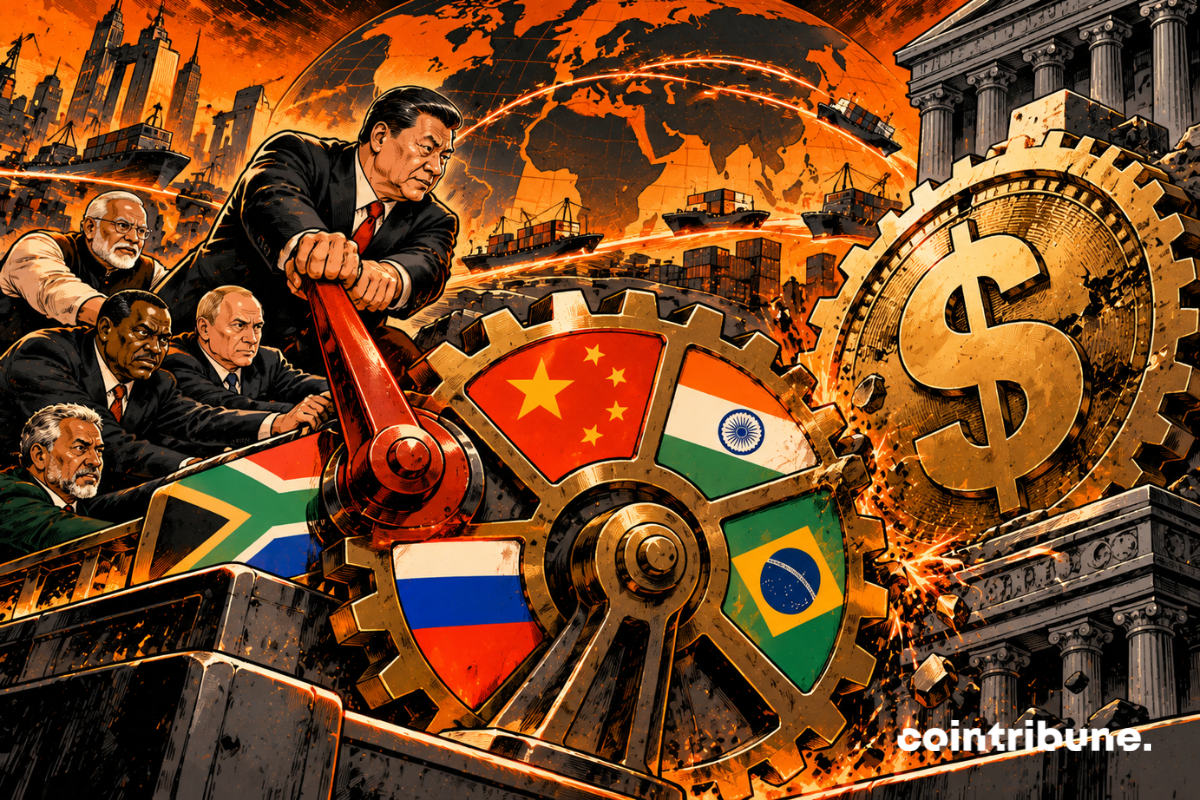
In 2027, China will take over the presidency of the BRICS. Thus, it will have the possibility to revive initiatives aimed at reducing dependence on the dollar. Beijing would favor payments in
In 2027, China will take over the presidency of the BRICS. Thus, it will have the possibility to revive initiatives aimed at reducing dependence on the dollar. Beijing would favor payments in local currencies and the interconnection of financial systems, however no official roadmap is defined for the replacement of the American currency.
In brief
- China will take over the BRICS presidency in 2027 and could revive dedollarization initiatives.
- Beijing should favor payments in local currencies and the interconnection of financial systems.
- The BRICS do not currently consider creating a common currency to replace the dollar.
- Divergent interests among members limit the scope of a coordinated monetary offensive.
- The 2027 summit will say whether China manages to turn these discussions into concrete infrastructures.
What Beijing could put on the table in 2027
During the next year, China will host the 19th BRICS summit. Xi Jinping made the promise to work with other member countries for the opening of a “third golden decade” of cooperation following the New Delhi meeting. The Chinese president notably mentioned artificial intelligence, governance reform, and the digital industry, without mentioning a common currency project.
However, Sergei Ryabkov, the Russian Deputy Foreign Minister, thinks the Chinese presidency would give new momentum to the alliance’s financial projects. He declared:
Disruptive technologies, with artificial intelligence at their core, supply chains, the modern payment and finance system, as well as logistical issues should be central to the Chinese presidency.
Russia confirms that it will support these priorities. Various dossiers would thus advance under Beijing’s leadership :
- The interconnection of fast payment systems used by member countries ;
- Settlement of a greater share of trade in national currencies ;
- Compatibility between central bank digital currencies ;
- Financing in local currencies by the New Development Bank.
Your 1st cryptos with CoinbaseThis link uses an affiliate program.
These arrangements could bypass the dollar in certain transactions without seeking to replace it globally.
The BRICS advance without creating a common currency
Such a gradual strategy was confirmed by the New Delhi summit in September 2026. The final declaration further encourages the use of local currencies for trade and investment, while acknowledging that no single solution fits all members. It also wants the BRICS Payment Task Force to study better compatibility among their payment infrastructures.
This direction does not correspond to the creation of a “BRICS dollar”. Furthermore, India has dismissed the existence of a common currency project. New Delhi favors bilateral agreements that allow, for example, settling some imports immediately in rupees, yuan, or dirhams.
Sanjay Malhotra, Governor of the Reserve Bank of India, confirmed last August that various solutions remain under study. He therefore explained: “different options are on the table, but they are still at the discussion stage, including central bank digital currencies and the interconnection of fast payment systems”.
This distinction is crucial. Using more national currencies reduces the demand for dollars for certain commercial transactions. However, a common currency would require shared monetary rules, an issuing institution, and mechanisms to manage economic imbalances among participants.
Internal divisions will limit the offensive against the dollar
China has many reasons to promote the internationalization of the yuan. Increased use of its currency could reduce its companies’ exposure to American sanctions and consolidate Beijing’s influence on global South trade flows. Russia and Iran, already subject to Western restrictions, also have an interest in developing alternative circuits.
However, not all BRICS share the same urgency. India, the United Arab Emirates, and Brazil maintain significant financial relations with the United States. They want to reduce the costs of international payments without turning the group into a monetary alliance explicitly hostile to Washington.
BRICS decisions also rely on consensus. The New Delhi declaration, adopted despite divergences among several members, illustrates the necessity to find formulations acceptable to all. This rule reduces the likelihood that a radical dollar replacement project will be quickly adopted.
The Chinese presidency could therefore accelerate dedollarization in the most concrete sense: more exchanges in local currencies and better connected payment systems. However, the scenario of a common currency capable of directly competing with the dollar remains distant. The challenge of the 2027 summit will be to see if Beijing transforms current discussions into infrastructures usable at a large scale.