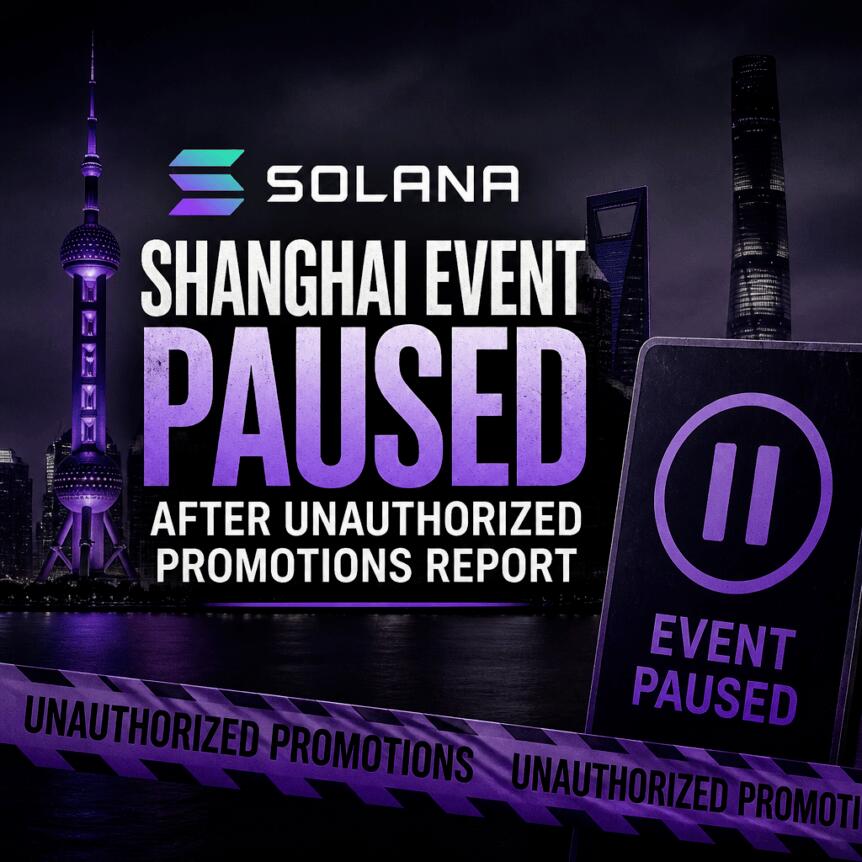
China’s central bank confirmed regulatory intervention against Solana’s Shanghai promotional campaign and announced an investigation into those involved. The October shutdown followed promine
- China’s central bank confirmed regulatory intervention against Solana’s Shanghai promotional campaign and announced an investigation into those involved.
- The October shutdown followed prominent advertising, a newly publicized Shanghai office and reports of police at the event venue.
- China’s February 2026 rules provide distinct enforcement mechanisms covering advertising, online promotion and assistance to prohibited offshore cryptocurrency services.
Solana’s ambitious return to mainland China’s technology scene ended in regulatory intervention after its advertising campaign in Shanghai attracted scrutiny from the country’s central bank.
On November 6, the People’s Bank of China (PBOC) confirmedthat authorities had stopped the Solana Accelerate China 2026 activities and would investigate entities and individuals involved in promoting the blockchain network.
The campaign had placed Solana branding on Citigroup Tower in Shanghai’s Lujiazui financial district, while executives publicized a new office and a four-city developer tour.
The central bank’s intervention exposes a vulnerability for overseas cryptocurrency projects: even where the underlying protocol operates internationally, advertising contracts, event arrangements and domestic affiliates remain subject to Chinese law. Foresight News
From Shanghai’s Skyline to Regulatory Intervention
On October 14, Solana’s official X account shared footage of its branding illuminating Citigroup Tower. Executives also promoted the network’s new Shanghai office, attracting attention in a country where cryptocurrency trading services have faced extensive restrictions since 2021.
The promotional push was followed by a sudden disruption.
On October 16, attendees arriving at the Shangri-La Hotel for the Shanghai opening of Solana Accelerate China reported police officers at the venue. The gathering was postponed, with organizers initially citing logistical difficulties.
Solana Foundation President Lily Liu subsequently said registrations had increased fourfold, exceeding the attendance limit filed with local authorities. The explanation focused on event capacity rather than cryptocurrency enforcement.
Binance co-founder Changpeng Zhao also questioned whether organizers had adequately understood China’s local restrictions. Reports connected his reaction to a similar disruption involving a Solana event in Shenzhen in October 2025.
The November PBOC statement adds official regulatory context to the Shanghai shutdown.
It identifies Solana’s promotional activities as violating the February cryptocurrency notice, although it does not establish that the organizers’ earlier capacity explanation was deliberately misleading.
How the February Rules Reach Offshore Projects
China’s February 6 regulatory notice, issued by eight government authorities, replaced the corresponding 2021 notice while maintaining the prohibition on unauthorized virtual-currency financial activities.
Its provisions also address the services that allow cryptocurrency businesses to reach mainland customers.
Three sections are particularly relevant:
- Section III(7) restricts internet companies from providing commercial displays, marketing, paid traffic referrals and related online services for cryptocurrency businesses.
- Section III(8) directs market supervision authorities to investigate unlawful advertising involving virtual currencies and real-world asset tokenization.
- Section VI(18) establishes potential liability for domestic entities or individuals that knowingly, or that should have known, they were assisting overseas operators illegally providing cryptocurrency services to mainland customers.
The provisions are not interchangeable. An advertising violation and liability for assisting an offshore operator involve different conduct and legal assessments. Criminal responsibility is not automatic.
The PBOC official specifically described SOL as a virtual currency and cited Solana’s technical support for assets including USDT. Authorities treated the promotion of that ecosystem as prohibited cryptocurrency marketing.
This is a regulatory interpretation of Solana’s activities, not a blanket determination that all blockchain software development is unlawful.
Where the Legal Exposure Falls
The following comparison separates activities expressly addressed by China’s rules from those requiring an assessment of their actual purpose.
CHINA CRYPTO REGULATION
Where Enforcement Risk Falls
Activity-based assessment under the February 2026 notice
PROHIBITED FINANCIAL ACTIVITY
Crypto trading and token fundraising
Domestic exchange services, token financing and other activities prohibited by the notice.
Exposure: Operators and relevant service providers
ADVERTISING ENFORCEMENT
Public crypto promotional campaigns
Unlawful virtual-currency advertisements can be investigated under Section III(8).
Exposure: Advertisers and participating local businesses
CASE-DEPENDENT ASSESSMENT
Developer events and technical workshops
Risk depends on whether the gathering promotes prohibited financial services, alongside applicable local event requirements.
Exposure: Organizers and relevant commercial partners
DIFFERENT REGULATORY TREATMENT
Enterprise blockchain infrastructure
Non-crypto software applications are not automatically prohibited; regulated tokenization may require specific authorization.
Exposure: Technology operators and regulated entities
Source: PBOC and seven other Chinese authorities, February 6, 2026. Categories summarize regulatory exposure, not definitive legal rulings on individual projects.
What the Investigation Means for Solana
The PBOC has not publicly named the companies under investigation, announced penalties or disclosed the campaign’s financial costs.
Nor has the statement established restrictions on SOL trading outside mainland China or direct interference with the blockchain’s globally distributed validators.
The more immediate exposure concerns business relationships that depend on Chinese counterparties. An offshore foundation can develop software internationally, but domestic advertising placements, promotional services and commercial operations remain within the reach of mainland regulators.
For investors, that distinction limits what can reasonably be inferred from the announcement. The disruption could affect Solana’s local business-development efforts, but there is no disclosed evidence connecting the investigation to a measurable change in global SOL liquidity.
China’s notice also preserves limited exceptions for certain approved real-world asset tokenization activities conducted through designated financial infrastructure. Those exceptions do not extend to unrestricted public-token issuance or trading.
The February framework therefore draws a boundary around financial activity rather than banning every application of distributed-ledger technology. Overseas projects seeking mainland partnerships must evaluate what their products do, how they are marketed and which local entities provide support.
China’s central bank has identified domestic cryptocurrency dealers and mainland affiliates of overseas issuance and trading platforms as continuing enforcement priorities. The Solana investigation demonstrates how that approach can reach commercial promotion before authorities establish any direct involvement in cryptocurrency trading.
The post China’s Solana Crackdown Exposes Risks for Offshore Crypto Firms appeared first on ETHNews.

 https://t.co/ctqzJdIfQy