Key Takeaways Semiconductor stocks drove the Nasdaq to a 1.5% decline on Thursday, with Nvidia and Broadcom leading losses The S&P 500 retreated 0.5% while the Dow Jones Industrial Average sh
Key Takeaways
- Semiconductor stocks drove the Nasdaq to a 1.5% decline on Thursday, with Nvidia and Broadcom leading losses
- The S&P 500 retreated 0.5% while the Dow Jones Industrial Average shed 0.2%, equivalent to 105 points
- Bitcoin tumbled beneath the $63,000 threshold after new U.S. military action against Iran
- Fresh allegations from Trump regarding Chinese electoral meddling intensified pressure on risk-sensitive assets
- Friday trading in Asia saw steep declines, with Japan’s Nikkei plummeting nearly 3%
Thursday’s trading session on July 16 saw the Nasdaq Composite sink 1.5%, driven primarily by weakness in semiconductor equities. The broader S&P 500 declined 0.5%, while the Dow Jones Industrial Average posted a modest 0.2% loss, translating to a 105-point drop.
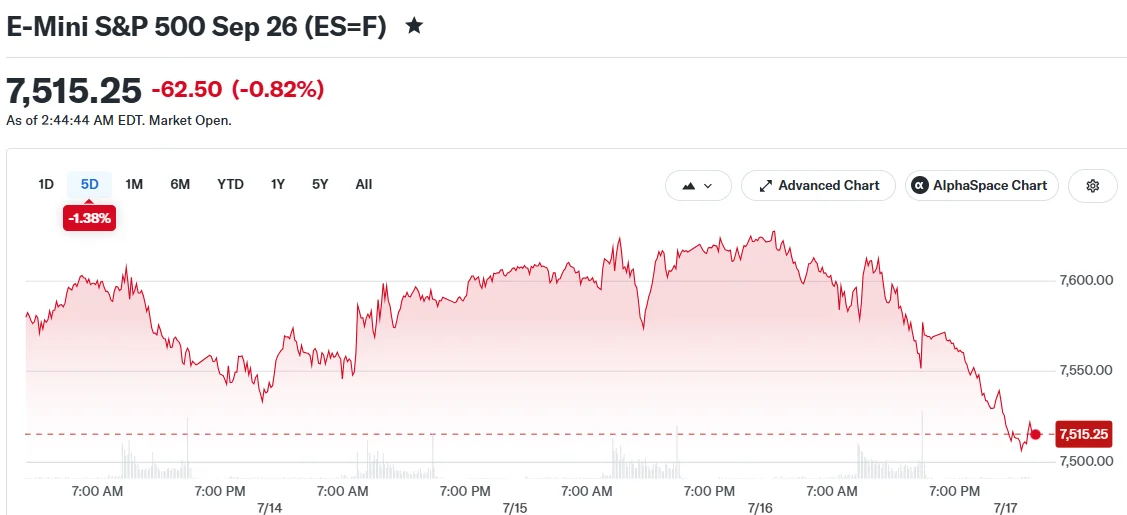 E-Mini S&P 500 Sep 26 (ES=F)
Chip manufacturers including Nvidia and Broadcom were primary contributors to the market’s downward pressure. Banking giant Goldman Sachs and industrial heavyweight Caterpillar also contributed to the Dow’s weakness.
Mega-cap technology companies Amazon and Alphabet further intensified the S&P 500’s decline. However, an interesting divergence emerged: internal breadth data revealed that advancing issues outnumbered declining ones within both the Dow and S&P 500.
The equal-weighted S&P 500 managed to finish in positive territory, and the S&P 500 ex-technology held essentially unchanged. These dynamics clearly identify the technology sector as the epicenter of Thursday’s market stress.
The concentration of market leadership in a handful of tech giants has characterized recent rallies. This narrow leadership is now showing signs of fatigue, creating downward momentum for the headline indices.
Cryptocurrency Markets Retreat as Geopolitical Risks Intensify
Bitcoin breached the $63,000 support level on Friday following renewed U.S. military operations targeting Iran. The digital asset had already declined approximately 1.4% during Thursday’s session from levels near $65,000.
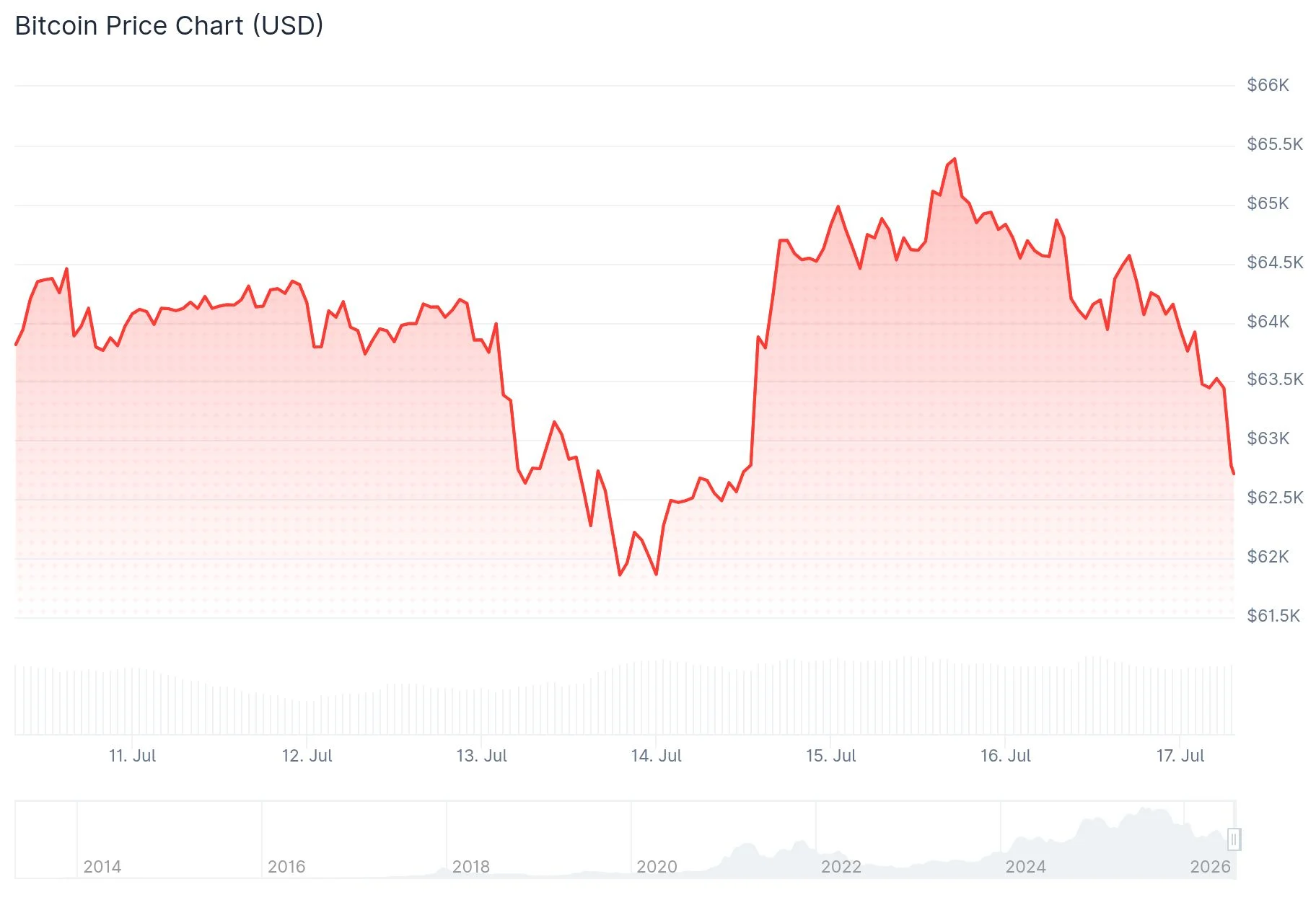 Bitcoin (BTC) Price
As of the latest market data, Bitcoin was hovering just beneath its 50-day simple moving average—a technical threshold closely monitored by traders as a barometer of near-term trend strength.
Reports from Iran’s semi-official Fars news agency indicated that American airstrikes destroyed five bridges located in southern Hormozgan province. Additionally, a missile reportedly impacted Iran’s Chabahar maritime control facility.
Despite the military escalation, crude oil markets displayed remarkable stability. West Texas Intermediate crude maintained its position around $79 per barrel, showing minimal reaction to the geopolitical developments.
Asian equity indices experienced significant selling pressure during Friday’s session. Japan’s Nikkei 225 crashed nearly 3%, reaching its weakest level in more than a month. Australia’s ASX 200 fell 0.5%, while Nasdaq futures indicated an additional 0.8% decline.
In a late Thursday development, President Trump authorized the public release of intelligence assessments alleging Chinese interference in the 2020 U.S. presidential election. The claims suggested Beijing acquired access to 220 million American voter records. China’s diplomatic representatives swiftly rejected these accusations.
These allegations have sparked apprehension regarding the trajectory of U.S.-China diplomatic relations, particularly with a scheduled meeting between Trump and Chinese President Xi Jinping approaching in September.
The Australian dollar, frequently employed as a barometer for China-related risk sentiment, weakened against the U.S. dollar following the announcement. Market strategists suggest the timing of these accusations could introduce complications into diplomatic preparations for the autumn summit.
“Trump’s decision to level fresh, sweeping accusations against Beijing weeks ahead of that meeting introduces a new source of friction risk,” said Eamonn Sheridan, Chief Asia-Pacific Currency Analyst at InvestingLive.
Any additional degradation in U.S.-China diplomatic relations threatens to amplify selling pressure across risk assets, including Bitcoin, in upcoming trading sessions.
The post Chip Sector Rout Sends Nasdaq Tumbling 1.5% Amid Geopolitical Turbulence appeared first on Blockonomi.