As crypto scams continue draining millions from victims, law enforcement agencies are increasingly leaning on stablecoin issuers to help freeze stolen funds before they disappear. Now, that g
As crypto scams continue draining millions from victims, law enforcement agencies are increasingly leaning on stablecoin issuers to help freeze stolen funds before they disappear.
Now, that growing dependence has landed Circle in the middle of an unusual legal battle after Wisconsin prosecutors accused the company of refusing to comply with the court order aimed at recovering stolen USDC..
The dispute isn’t about whether Circle froze the funds. I did. Instead, prosecutors argue the stablecoin issuer stopped short of helping return the assets, while Circle insists the court demanded something its technology simply cannot do.
A Frozen Wallet Becomes A Courtroom Battle
The case stems from Walworth county resident who lost more than 381K USDC in a Telegram pig-butchering scam after transferring funds into a self custodial Ethereum wallet controlled by an alleged scammer.
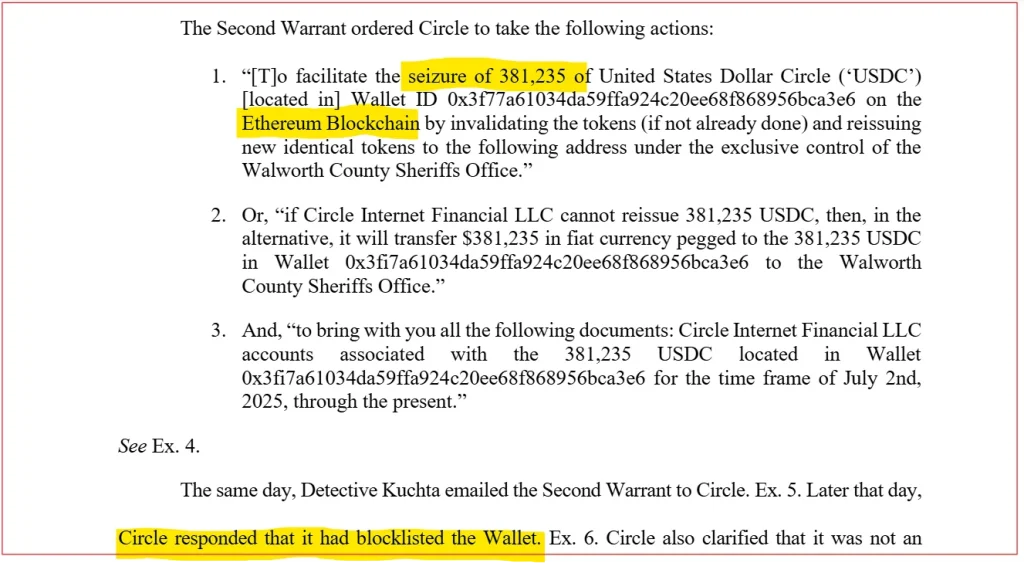
Following a court warrant in August 2025, Circle blocklisted the wallet, preventing the stolen USDC from being transferred or redeemed. However, prosecutors later sought a second order directing Circle to either “burn and reissue” the frozen tokens into a wallet controlled by the sheriff’s office or compensate the victim with $381,235 in cash.
When Circle declined to comply, Wisconsin prosecutors filed a criminal contempt complaint against the company.
Circle Says The Court Ordered The Impossible
Circle argues the dispute isn’t about refusing to cooperate but about technical limitations built into blockchain infrastructure.
According to court filings, the company maintains it does not control the private keys of externally owned wallets and therefore cannot unilaterally destroy, transfer, or reissue USDC held by third parties. While Circle can freeze tokens through its blocklist mechanism, it says that capability does not extend to rewriting ownership on a public blockchain.
The company also contends that issuing replacement USDC or paying cash while the original tokens remain frozen on-chain could force it to back the same assets twice, creating problems for the stablecoin’s one-to-one reserve model.
Growing Frustration From Law Enforcement
The Wisconsin complaint follows broader concerns from state prosecutors over the pace of crypto investigations.
According to officials, stablecoin transactions can move across wallets within seconds, often much faster than investigators can obtain court orders. Prosecutors have argued that delays in freezing assets significantly reduce the chances of recovering victim funds.
Circle, however, has maintained that it freezes USDC only after receiving lawful legal process, saying the policy is designed to protect users from arbitrary or politically motivated interference.
The Ruling Could Shape Stablecoin Recovery Rules
Circle has asked the court to dismiss the complaint, arguing Wisconsin lacks jurisdiction over both the company and the disputed assets. It also says it has been working with the U.S. Department of Justice to establish a federal framework for compensating victims through formal asset forfeiture proceedings.
If the case proceeds, the court may ultimately decide whether judges can compel stablecoin issuers to perform actions that blockchain architecture may not technically permit.
For
Circle Payments

Circle Payments

Circle is a peer-to-peer fintech solution platform that is leading in blockchain-based financial technologies. Circle makes money by trading digital currencies like Bitcoin and others with the help of blockchain technology while making financial transactions. Company Details Founders: Jeremy Allaire, Sean Neville Founded: October 2013 Headquarters: Boston, Massachusetts, United States Key Features: Provides an open developer platform allowing businesses to integrate programmable money solutions into their applications. Supports cross-border payments with near-instant settlements. Offers tools for businesses to manage liquidity, hold USDC as treasury assets, and convert funds between fiats and digital assets. Transactions are settled instantly reducing delays and optimizing cash flow for businesses.
[email protected] SolutionPayment solution

, the outcome could become one of the most closely watched legal tests of where judicial authority ends and blockchain code begins.

 USDC$ 0.9998(0.00%)