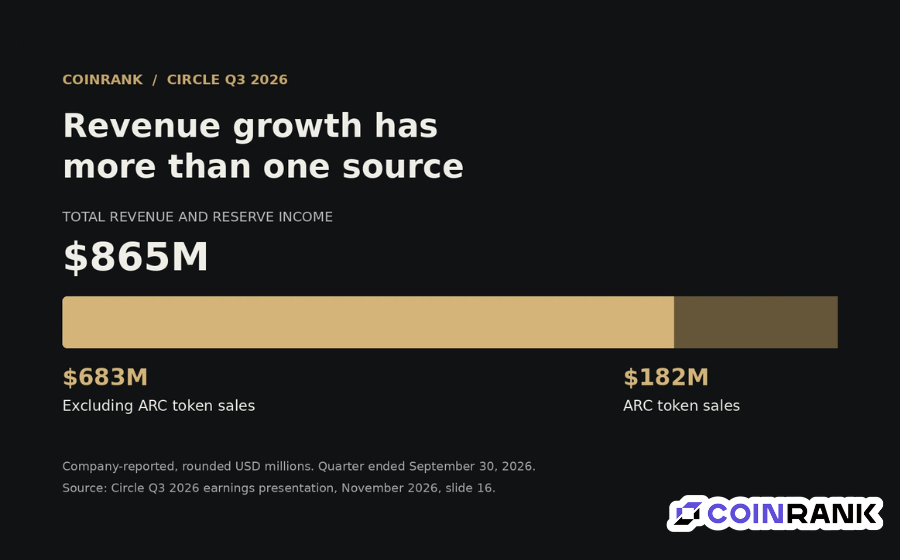
ARC token sales contributed to Circle’s headline growth. Read that contribution separately from reserve income and payment activity. USDC circulation, onchain transfers and annualized payment
- ARC token sales contributed to Circle’s headline growth. Read that contribution separately from reserve income and payment activity.
- USDC circulation, onchain transfers and annualized payment volume measure different things.
- The next test is whether payment activity supports sustained service revenue, beyond a stronger headline quarter.
Circle’s latest results raise a practical question for anyone tracking stablecoin adoption: how much does an issuer’s revenue growth tell us about people and businesses using its payment network?
The answer requires separating the business into parts. Circle’s November 4 release reports approximately $865 million in total revenue and reserve income for Q3 2026, up 17% year over year. Yet reserve income declined. Its new ARC token revenue contribution and its payment-network activity need their own explanations. Circle Q3 results
ARC TOKEN SALES CHANGE THE REVENUE COMPARISON
Circle’s earnings presentation separates the headline amount into $683 million excluding ARC and $182 million from ARC token sales. The company reported approximately $740 million in total revenue and reserve income for the same quarter a year earlier. The $683 million excluding ARC is below that prior-year total, even though the $865 million headline is above it. That makes the composition of growth central to reading the quarter. Circle presentation, slide 16
A token sale and a payment service have different commercial drivers. Demand for a network token does not establish that customers are repeatedly paying to use a transfer service. Equally, separating the contribution does not make that revenue invalid or prove it cannot recur.
Circle describes token sales as event-based revenue. The useful question is whether later reports show a durable mix of repeat customers, activity and monetization. A headline growth percentage alone cannot answer it. This distinction matters when comparing stablecoin businesses whose revenue sources differ.
MORE USDC DID NOT OFFSET A LOWER RESERVE RETURN
Circle reports average USDC circulation of $73.3 billion, up 8% year over year. Its reserve return rate fell 61 basis points to 3.5%, while reserve income fell 8% to approximately $658 million. These figures cover the quarter ended September 30 and come from company reporting, including unaudited financial statements. Circle Q3 results
Reserve income depends on both balances and the return those reserves earn. More tokens in circulation can therefore coexist with lower reserve income. Counting tokens without considering the yield environment leaves out a major part of the business model.
For readers assessing adoption, that also means a weaker reserve-income quarter need not imply that fewer customers are using a stablecoin. Financial performance and usage are connected, but the relationship runs through more than one variable.
PAYMENT VOLUME AND ONCHAIN TRANSFERS NEED DIFFERENT LABELS
🔍 Circle’s presentation gives two activity figures that should remain separate:
- $13.9 trillion of USDC onchain transaction volume in Q3: identified as unadjusted data from Visa Onchain Analytics.
- $41.3 billion of annualized Circle Payments Network (CPN) payment volume: calculated using the trailing 30 days at quarter-end.
The second is a run-rate measure, not the amount processed during the full quarter. The first does not isolate commercial payments. Neither figure, by itself, is revenue. Circle presentation, slides 5 and 7
The transfer mechanism also matters: native and bridged USDC move across networks differently, but neither mechanism alone establishes the commercial purpose of a transfer.
For a payment provider, recurring business use is more informative than a large aggregate transfer total. A useful assessment would connect activity to the purpose of transactions, customers who keep using the service and the fees earned from serving them. Without compatible definitions, dividing one headline volume by another produces a ratio with little explanatory value.
WATCH WHETHER PAYMENT USE BECOMES SUSTAINED SERVICE REVENUE
🚩 The next reports should help answer 3 concrete questions:
- Does payment activity remain strong across later measurement windows?
- How much revenue comes from ongoing services rather than token sales?
- Do changes in reserve returns or distribution costs explain shifts in earnings?
These questions separate payment adoption from the economics of issuing a stablecoin. They also leave room for both outcomes: a network can gain practical use while interest-related income weakens, or report stronger financial results without equivalent growth in recurring payment services.
Circle’s Q3 disclosures offer a way to test those possibilities. The stronger headline is a starting point; the revenue mix and measurement periods determine what it can actually tell readers.
Looking for the latest scoop and cool insights from CoinRank? Hit up our Twitter and stay in the loop with all our fresh stories!
〈Circle Q3 2026 ARC Revenue & USDC Payment Metrics〉這篇文章最早發佈於《CoinRank》。