Circle’s euro stablecoin, EURC, passed €400 million in circulation on August 17, with supply more than doubling over the past year, the company said. Circle’s own audited reserve reports give
Circle’s euro stablecoin, EURC, passed €400 million in circulation on August 17, with supply more than doubling over the past year, the company said. Circle’s own audited reserve reports give a firmer reference point. An attestation covering December 31, 2024, put EURC circulation at €80,705,696 that day. From there to today, the token has grown nearly fivefold.
Why Circle, and Almost No One Else
That growth didn’t come from product choice alone. On August 13, Patrick Hansen, Circle’s head of EU strategy and policy, said:
“Most stablecoin issuers in the EU cannot provide custody of their own tokens on behalf of clients. This severely limits the range of services they can offer.”
According to Hansen, 14 issuers operating under MiCA lack the authorization to custody their own tokens or process automated payouts for corporate clients directly. Only Circle and Société Générale-Forge hold both the e-money token license and the crypto-asset service provider license at once. DeFiLlama data puts current circulation at roughly 408 million tokens, with a market cap near $472 million.
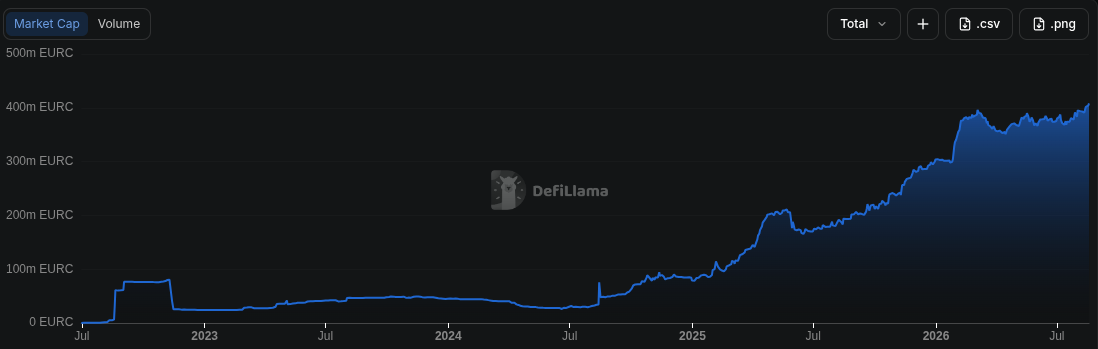
Circle DeFiLlama data
That two-license requirement constrains EURC’s competitors on distribution, not on product. An issuer can back its stablecoin one-to-one and still be unable to offer institutional custody without CASP authorization. That gap is a structural reason EURC’s circulation number keeps climbing.
Circle’s own stock tells a different story over the same period. CRCL closed at $74.59 on August 17, up 4.18% on the day. But its market cap sits 45.2% below its 52-week high. That’s not for lack of underlying growth. Circle’s second-quarter revenue reached $701 million, up 7% year-over-year, while USDC’s onchain transaction volume surged 151% to $14.8 trillion, growing far faster than supply itself. EURC’s supply has more than doubled this year on top of that. Circle’s equity valuation still hasn’t fully priced in any of it.
A Market MiCA Has Already Reshaped Once
MiCA’s compliance requirements have already reshaped this market once. Tether discontinued its EURT token, citing regulatory challenges. EURS and EURA also exited, while EUROP, EURQ, EURI and EURAU entered as newly compliant issuers. The euro stablecoin market’s total value more than doubled, growing roughly 2.3 times between June 2025 and June 2026, according to one dataset.
One claim about that consolidation doesn’t hold up: that compliance costs caused competitor stablecoins to depeg. On May 26, 2026, StablR’s euro token, EURR, dropped to $0.548. That wasn’t a compliance failure. Attackers exploited a 1-of-3 multisignature wallet to mint $13.5 million in unbacked tokens.
The European Commission opened a formal review of MiCA on May 20, 2026, examining reserve composition rules and equivalence regimes for non-EU issuers. Hansen said the review “does not signal MiCA’s failure,” noting that periodic reviews were built into the regulation from the start. Whether that review changes who can hold a custody license, not whether EURC keeps growing, is what will determine if its current lead lasts.