A few weeks ago, CL8Y DEX was a public, non-economic soft launch, a place to test infrastructure, not yet a place to trade real value. Today it is one of the most active decentralized exchang
A few weeks ago, CL8Y DEX was a public, non-economic soft launch, a place to test infrastructure, not yet a place to trade real value.
Today it is one of the most active decentralized exchanges on Terra Classic.
This is an update on what has changed since launch, and the milestones the project has reached along the way.
As always with community content: none of this is financial advice, figures move constantly, and you should verify everything independently. DYOR.
CL8Y DEX is being built for Terra Classic by Ceramic, the open-source developer behind the wider CL8Y ecosystem.
It did not begin with a token sale or a marketing push.
It began with a non-economic soft launch: live code, real contracts, no economic pairs, a way to prove the infrastructure in public before putting capital at risk.
That approach says a lot about how the project is being built. Infrastructure first. Claims second.
Since then, the DEX has progressed from that soft launch to live economic trading pairs, a growing feature set, and measurable on-chain volume.
Here is what has actually shipped.
The first and most important milestone was simple: real trading went live.
CL8Y DEX moved from non-economic testing to economic pairs on Terra Classic, backed by real liquidity and real order flow.
That transition turned the project from a proof of concept into a working venue, one where capital can actually be deployed, routed, and recycled.
Everything that follows was built on top of that foundation.

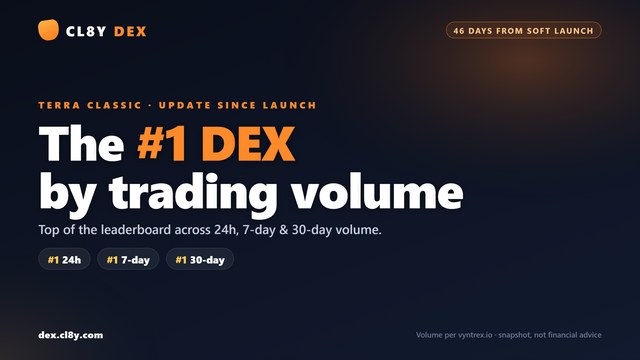
The headline milestone: within roughly 46 days of economic launch, CL8Y DEX reached the top of the Terra Classic DEX rankings by trading volume, and it has held and widened that lead since.
According to the independent DEX leaderboard on vyntrex.io (live figures as of 2026-10-06):
#1 by 24-hour volume - roughly $8.8K, around 12× the next DEX (~$0.7K)
#1 by 7-day volume - roughly $23.1K, around 2.7× the next DEX (~$8.7K)
#1 by 30-day volume - roughly $64.7K, close to double the next DEX (~$37.9K)
Roughly $248.9K in tracked liquidity (#2 on the chain)
For context, the protocols CL8Y DEX has moved ahead of in terms of volume have been in operation for years.
And this is not a single-day spike. Over the past week, the lead has grown, not faded: 30-day volume has risen from around $46K at the end of September to roughly $64.7K, and 7-day volume from about $9K to $23K.
An important honesty note, because it matters:
This milestone is about trading volume; CL8Y DEX currently leads the 24-hour, 7-day, and 30-day windows. On liquidity (TVL), CL8Y DEX sits #2, behind Terraswap, so this is a volume claim, not a “#1 on everything” claim.
One honest caveat on the 24-hour figure: single-day volume is the most volatile measure, and on CL8Y DEX it is lifted by active automated market-making that keeps its books and pools live. The 7-day and 30-day figures are the more durable signal. Rankings on a small, fast-moving chain change daily, so treat any single snapshot as exactly that: a snapshot.
Reaching the top of a volume leaderboard so quickly as a brand-new venue is the clearest external signal so far that the design is working.
Since launch, CL8Y DEX has grown into a complete trading environment rather than a single-function swap interface. Live today:
Automated market-maker (AMM) pools
An on-chain limit-order book - place, cancel, and replace orders on-chain
Multi-hop routing across supported markets
Best-execution routing, so swaps are checked against the available book by default rather than as an opt-in
Compatible wrapped and CW20 assets that can trade internally
Tiered fee discounts tied to CL8Y holdings
Community-token creation and migration tools
Each of these was shipped and iterated on in public. This is a trading stack being assembled piece by piece, not a template fork.
The CL8Y fee-discount system is live and tied directly to how much CL8Y a trader holds and registers.
The default swap fee is 1.8% for most pairs. Registered holders receive progressively larger discounts:
75 CL8Y → 35% off (effective swap ~1.17%)
200 CL8Y → 50% off (~0.90%)
500 CL8Y → 60% off (~0.72%)
1,500 CL8Y → 75% off (~0.45%)
3,500 CL8Y → 85% off (~0.27%)
7,500 CL8Y (Tier 9) → 95% off - an effective swap fee of just 0.09%
Maker limit-order placement follows a separate, deeper schedule, falling from 0.90% at the standard pair fee all the way to 0% at Tier 9. A book taker pays half of the applicable effective fee on the filled amount.
Effective fees assume the default 1.8% base fee; pairs with a different base fee scale proportionally. Traders must keep the required CL8Y balance and registration to retain a tier. Actual costs depend on asset, pair, route, order type, and structure.
One of the DEX's core design choices is support for internal trading between compatible wrapped and CW20 assets.
On Terra Classic, where the on-chain tax rose from 0.5% to 1.5% in August 2026, repeatedly triggering that tax on every internal trade can make arbitrage, grid trading, and market making uneconomical.
CL8Y DEX lets compatible wrapped assets trade internally without repeatedly incurring the native tax on every eligible internal trade. Tax may still apply when assets enter or leave their wrapped form, depending on the route. The goal is not to eliminate the tax; it is to avoid taxing internal activity until it becomes unviable.
A deliberate framing on wrapping, because it is easy to misread:
Wrapping is a tool to trade, not a place to store wealth. The intended flow is wrap → trade → unwrap, not wrap-and-hold. Backing differs by asset, and traders should understand the backing and redemption terms of any wrapped asset before holding it rather than simply trading through it.
CL8Y DEX now lets anyone create or migrate a community token directly through the platform.
A basic token can be created with no platform charge (network gas still applies). The creator sets name, symbol, decimals, supply, treasury, manager wallet, and initial buy/sell tax rates within the contract's limits.
Optional paid features, each 50 UST1, include minting within a cap, wallet-to-wallet tax, split treasury, auto-liquidity, extra exemptions, adjustable-rates-later, and launch guards (max-wallet, cooldown, trading toggle).
Projects with an eligible existing CW20 token can migrate into the community-token template with no platform fee: the in-place process preserves balances and supply, disables the old minter, and moves future upgrade authority to CMM governance.
Crucially, these protocol payments are routed to the Collateral Management Module (CMM), so using the advanced token tools contributes directly to the wider UST1 ecosystem rather than to a private wallet.
CL8Y Bridge provides the cross-chain foundation, moving supported assets between networks and helping bring external liquidity onto Terra Classic.
The bridge brings assets in; the DEX gives them a productive market once they arrive. Together, they allow liquidity to reach Terra Classic from outside the chain rather than relying solely on what is already here.
CL8Y DEX is open source under the GNU AGPLv3 license, and its full development history is publicly inspectable.
As of August 2026, the repository held more than 1,600 commits.
As of 6 October 2026, that figure has passed 2,350 commits, with work continuing on the main integration branch, and commits landing on the same day as this update.
That is the kind of milestone that does not make headlines but matters most: steady, visible, verifiable progress that anyone can audit rather than take on trust.
Since the economic launch, the set of tradable markets has expanded beyond the initial pairs to include wrapped majors, stable-oriented pairs, and newly created community tokens listed directly through the platform's own tooling.
These markets are supported by active, automated liquidity and market-making, which helps keep books and pools live and is part of why the venue ranks where it does on volume.
(The exact list of live pairs and routes evolves continually; always check dex.cl8y.com for the current markets.)
All of this feeds a longer-term goal: the infrastructure needed to support a credible stable-value system around USTR.
A repeg mechanism needs more than tokenomics. It needs liquidity, cross-chain access, trading venues, price discovery, and real on-chain activity.
CL8Y Bridge connects liquidity across networks.
CL8Y DEX provides the markets and trading infrastructure.
CL8Y gives traders a reason to use it through lower fees.
Token tools route protocol fees into the CMM.
USTR represents the longer-term monetary layer intended to build on top.
Infrastructure first. The monetary layer is designed to stand on it, not the other way around.
The project remains under active development. Supported pairs, liquidity routes, and individual features will continue to evolve, and nothing here should be read as a finished product or a guarantee of future performance.
The direction, though, is consistent with how the project started: ship infrastructure in public, let the on-chain activity speak, and build the monetary layer on a foundation that already works.
CL8Y DEX did not start with promises. It started with a soft launch, then quietly took the top volume spot on Terra Classic in 46 days, and the codebase shows the work is still going every day.
This is community-contributed content, not financial advice. Figures are point-in-time snapshots that change constantly; rankings, fees, backing, and features should all be verified independently before acting. DYOR.