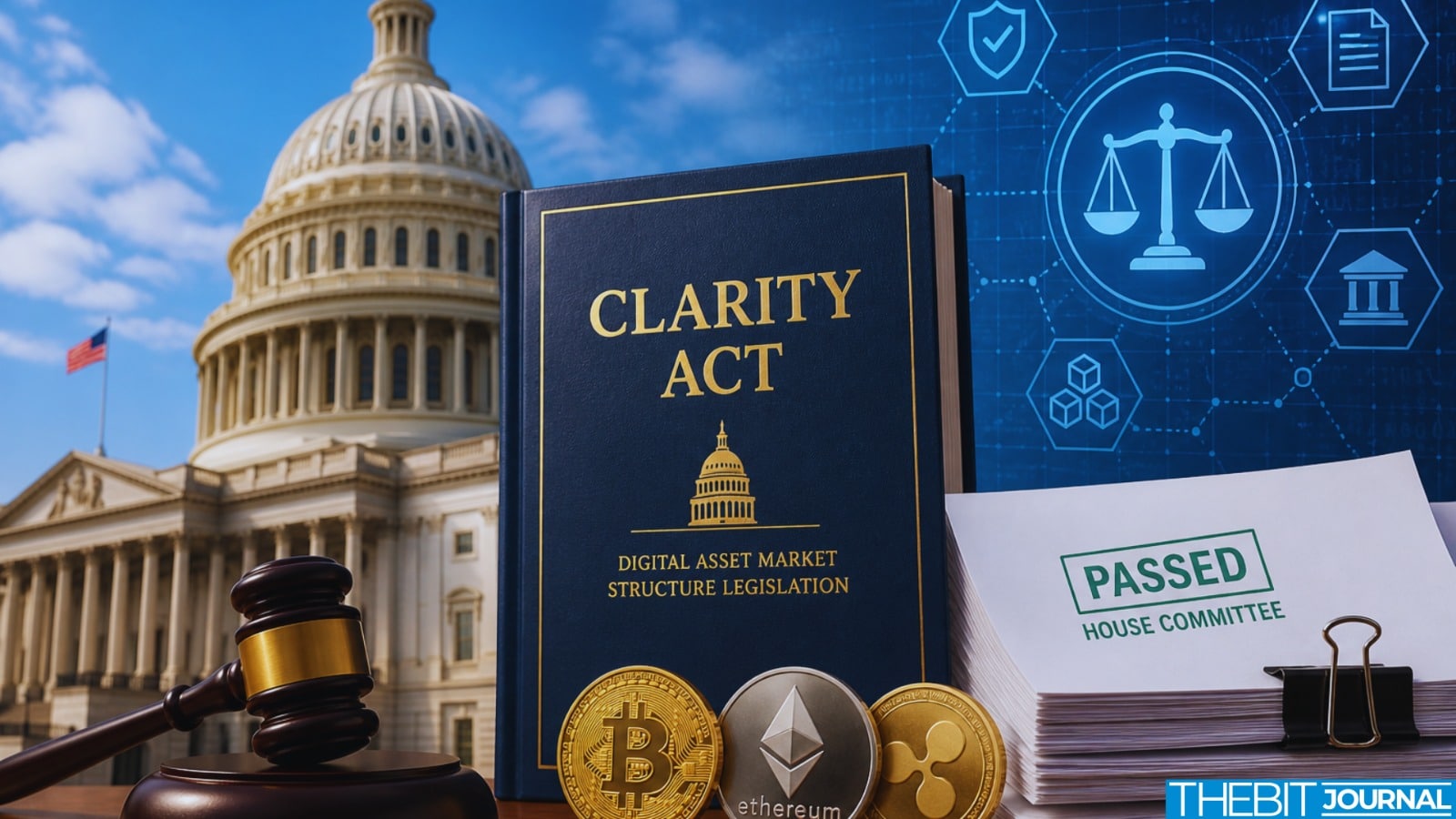
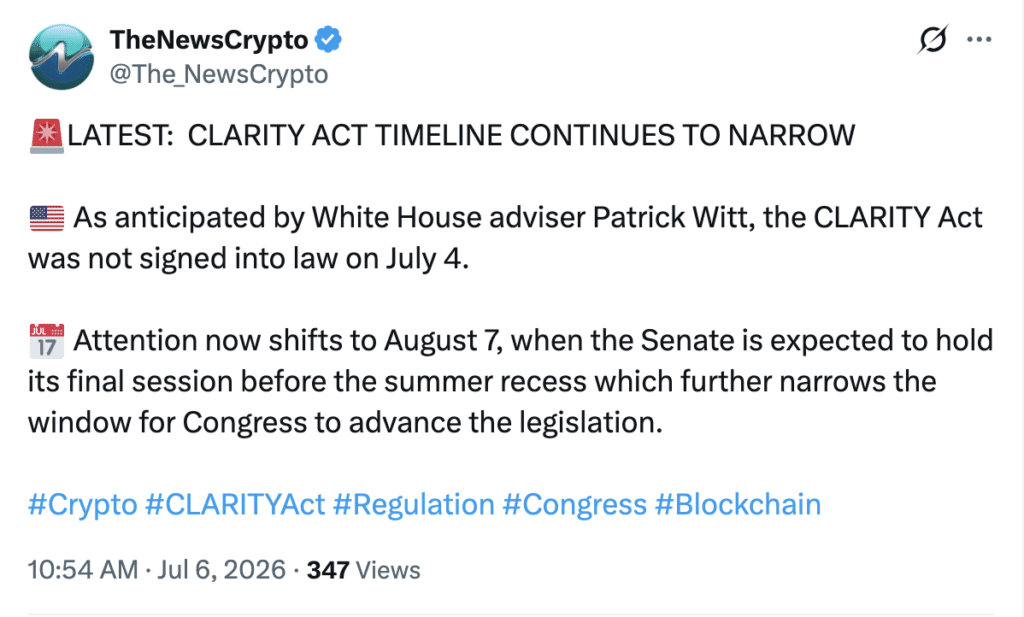
The CLARITY Act remains one of the most closely watched pieces of crypto legislation in the United States. After missing its anticipated July 4 milestone, lawmakers are now racing against the
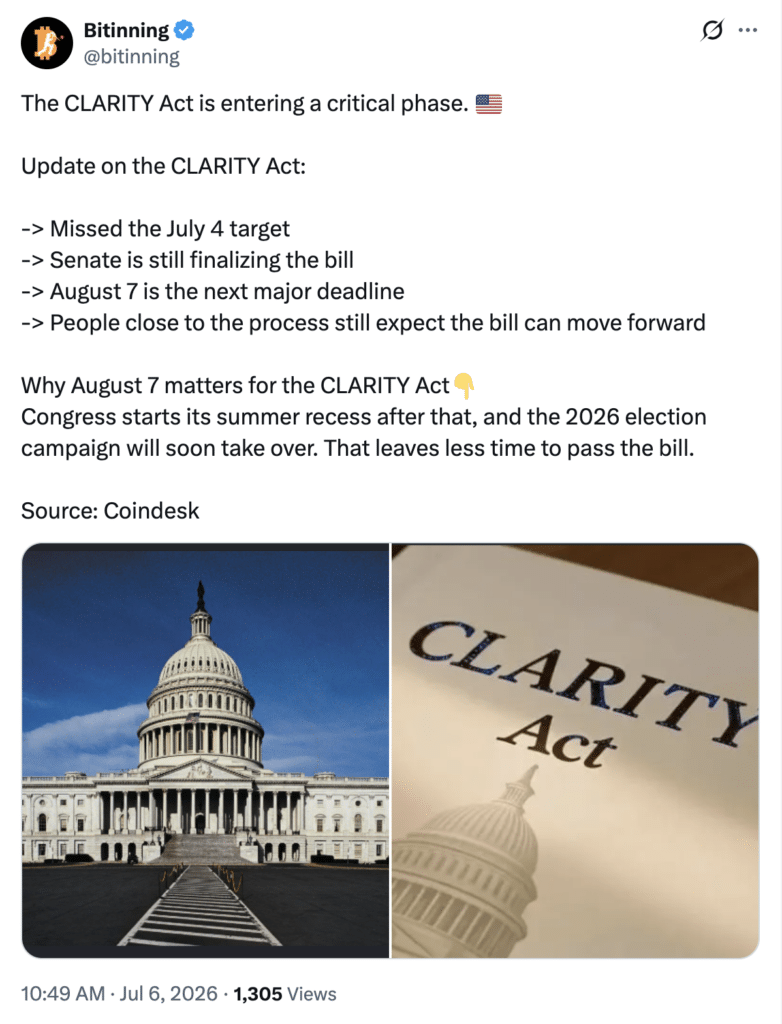
The CLARITY Act remains one of the most closely watched pieces of crypto legislation in the United States. After missing its anticipated July 4 milestone, lawmakers are now racing against the clock before the Senate’s August 7 recess. The bill has already cleared the House of Representatives and advanced through the Senate Banking Committee, yet one critical hurdle remains, a full Senate vote.
As debates over U.S. crypto regulation continue, industry leaders, investors, and blockchain innovators are watching every development, knowing the legislation could reshape the future of digital asset oversight.

CLARITY Act Deadline Moves to Aug. 7 After July 4 Target Falls Short 5
Why the CLARITY Act Missed the July 4 Deadline
Many supporters hoped Congress would move quickly enough to finalize the CLARITY Act before Independence Day. Instead, negotiations slowed as Senate committees worked through competing versions of the legislation. Banking and Agriculture Committee staff continue reconciling differences over jurisdiction, enforcement powers, and compliance standards.
Those unresolved details prevented lawmakers from bringing the measure to the Senate floor before July 4. This delay has fueled questions about why the CLARITY Act missed the July 4 deadline, although supporters argue the extra time could produce a stronger and more balanced framework for the digital asset industry.
CLARITY Act Deadline Moves to Aug. 7 After July 4 Target Falls Short 6
The Race Toward the August 7 Senate Deadline
Attention has now shifted to the approaching Senate recess, making the next several weeks especially important. The CLARITY Act faces August 7 as its next major milestone, giving negotiators limited time to finalize language and build enough political support for passage. Staff members from both committees continue reviewing technical provisions that determine how federal agencies will oversee cryptocurrencies.
This latest CLARITY Act Senate update highlights growing pressure on lawmakers who want to avoid delaying one of the country’s most significant crypto market structure bill proposals until later in the legislative calendar.
CLARITY Act Deadline Moves to Aug. 7 After July 4 Target Falls Short 7
SEC and CFTC Jurisdiction Remains the Biggest Debate
One of the largest questions surrounding the CLARITY Act involves deciding which regulator should oversee different categories of digital assets. The legislation seeks to clarify SEC and CFTC crypto rules, reducing years of uncertainty that has complicated innovation and enforcement. Under the proposed framework, many digital assets meeting decentralization standards could fall under the Commodity Futures Trading Commission instead of the Securities and Exchange Commission.
Supporters believe clearer regulatory boundaries would strengthen digital asset regulation, encourage responsible innovation, and reduce costly legal disputes throughout the cryptocurrency industry.
Law Enforcement Support Boosts the Bill’s Momentum
Recent backing from several law enforcement organizations has strengthened confidence in the CLARITY Act, although important concerns remain unresolved. Supporters argue the proposal improves transparency while preserving tools needed to investigate financial crimes involving blockchain technology. Even so, some senators continue pushing for stronger anti-money laundering provisions, stricter ethics standards, and additional consumer protections before supporting the measure.
These unresolved debates have become central to the broader discussion surrounding crypto legislation and the future of cryptocurrency regulation USA, particularly as policymakers seek a balance between innovation and accountability.
Vote Math Could Decide the Bill’s Future
Legislative details alone will not determine whether the CLARITY Act succeeds. Senate leaders must also secure enough bipartisan votes to move the proposal across the finish line. Although many lawmakers support providing clearer rules for digital assets, disagreements over regulatory authority and compliance requirements continue influencing negotiations. Political timing may prove just as important as policy substance.
If Senate leaders fail to gather sufficient support before the August recess, the measure could face additional delays, increasing uncertainty across the digital asset ecosystem and leaving market participants waiting for long-overdue regulatory clarity.
How the CLARITY Act Affects Crypto Investors
For investors, the CLARITY Act represents far more than another legislative proposal. Clearer regulations could reduce uncertainty that has weighed on digital asset markets for years. A well-defined framework may encourage institutional participation, improve investor confidence, and create more consistent compliance standards for exchanges and blockchain companies.
While the legislation does not guarantee higher cryptocurrency prices, many analysts believe regulatory certainty could support long-term market stability. This explains how the CLARITY Act affects crypto investors and why every CLARITY Act latest Senate update continues to attract widespread attention.
CLARITY Act Deadline Moves to Aug. 7 After July 4 Target Falls Short 8
What Happens if the CLARITY Act Fails to Pass?
A common question across the crypto industry is what happens if the CLARITY Act fails to pass. Without comprehensive legislation, regulatory uncertainty would likely continue as multiple federal agencies interpret existing laws differently. Crypto companies could face additional compliance costs, while investors may encounter inconsistent protections across platforms.
Ongoing legal disputes over digital asset classifications could also slow innovation in the United States. Many industry experts argue that postponing a comprehensive framework risks allowing other jurisdictions to move ahead in establishing clearer digital asset regulations.
Why the CLARITY Act Matters for the Future of U.S. Crypto Regulation
The CLARITY Act has become one of the defining proposals shaping the next chapter of U.S. crypto regulation. Unlike previous legislative efforts, the bill focuses on establishing clear responsibilities for federal regulators while creating a consistent legal framework for digital assets. Supporters believe this approach could strengthen market confidence, encourage responsible innovation, and improve consumer protections.
As the U.S. Senate crypto bill August 2026 deadline approaches, lawmakers face increasing pressure to deliver the regulatory certainty that investors, blockchain developers, and financial institutions have sought for years.
Conclusion
The coming weeks could determine the future of the CLARITY Act and the direction of American cryptocurrency regulation. Although the legislation missed its July 4 target, the August 7 Senate deadline now serves as the next major milestone for lawmakers. Important questions surrounding regulatory authority, ethics provisions, anti-money laundering measures, and bipartisan support remain unresolved.
Even so, the bill continues to stand at the center of the national conversation on digital asset oversight. Market participants should closely monitor legislative developments because the outcome could significantly influence the future of blockchain innovation, regulatory certainty, and the broader cryptocurrency industry in the United States.
Appendix: Glossary of Key Terms
CLARITY Act: A proposed U.S. law designed to establish a comprehensive regulatory framework for digital assets and clarify oversight responsibilities.
Digital Asset Market Clarity Act: The formal name associated with the proposed legislation that aims to improve regulatory certainty for cryptocurrencies.
SEC: The Securities and Exchange Commission, responsible for regulating securities markets and certain digital assets.
CFTC: The Commodity Futures Trading Commission, the federal agency overseeing commodity and derivatives markets.
Crypto Market Structure Bill: Legislation intended to define how cryptocurrency markets should operate under federal law.
Digital Asset Regulation: Federal rules governing the issuance, trading, custody, and oversight of cryptocurrencies and blockchain-based assets.
Frequently Asked Questions About CLARITY Act
What is the CLARITY Act?
The CLARITY Act is proposed federal legislation that seeks to establish a clear regulatory framework for digital assets and define the responsibilities of the SEC and CFTC.
Why did the CLARITY Act miss the July 4 deadline?
The bill was delayed because Senate negotiators are still reconciling differences between the Banking and Agriculture Committee versions before a full Senate vote.
When is the next deadline for the CLARITY Act?
The legislation now faces an important Senate deadline before lawmakers begin their August 7 recess.
How could the CLARITY Act affect crypto investors?
A clearer regulatory framework could increase investor confidence, encourage institutional adoption, and reduce legal uncertainty across the cryptocurrency market.
Has the CLARITY Act become law?
No. The bill has passed the House of Representatives and advanced through the Senate Banking Committee, but it still requires approval by the full Senate before moving further in the legislative process.
ReferencesCrypto/news
TheNewsCrypto-X Post
Bitinning-X Post
DisclaimerThis article is for informational purposes only and should not be considered financial, investment, or legal advice. Cryptocurrency markets are highly volatile, and readers should conduct independent research and consult qualified financial professionals before making any investment decisions. Although no cryptocurrency prices are discussed in this article, market conditions can change rapidly.
Read More:CLARITY Act Deadline Moves to Aug. 7 After July 4 Target Falls Short">CLARITY Act Deadline Moves to Aug. 7 After July 4 Target Falls Short