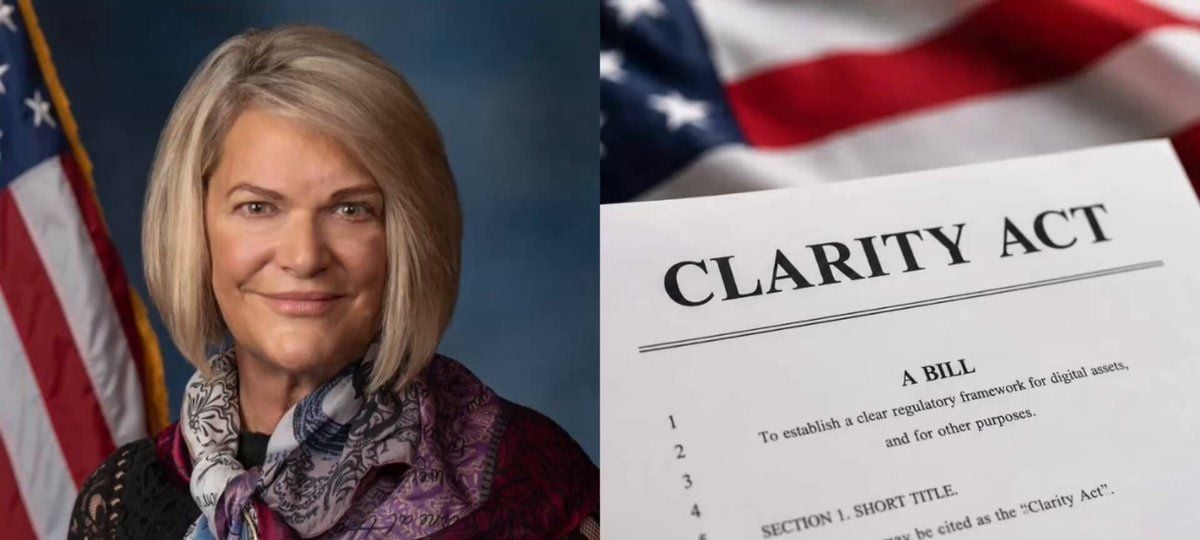
Lummis Raises the Alarm on Regulatory Inaction @SenLummis is stepping up her warnings over Washington's failure to advance a federal digital asset framework. In a post on X, the Wyoming Repub
Lummis Raises the Alarm on Regulatory Inaction
@SenLummis is stepping up her warnings over Washington's failure to advance a federal digital asset framework. In a post on X, the Wyoming Republican said the absence of clear rules is already costing the United States its seat at the table on global standards. "Every month without clear digital asset rules is a month another country writes them for us," she wrote. "That's not a risk. It's already happening."
The senator's target is the Digital Asset Market Clarity Act, formally known as the CLARITY Act (H.R. 3633). The bill establishes a regulatory framework for digital commodities, defined as digital assets that rely upon a blockchain for their value. At its core, the CLARITY Act draws explicit lines between digital commodities and securities, assigning CFTC jurisdiction over one category and SEC jurisdiction over the other.
The bill already cleared the House with a comfortable bipartisan majority of 294 to 134 , and the Senate Banking Committee advanced it by a vote of 15 to 9 in May 2026. But a full Senate floor vote has yet to be scheduled, and the chamber has a very limited legislative window before lawmakers leave for their August recess, leaving only about four weeks in mid-to-late July for floor action.
The Global Competition Argument
Lummis frames the delay not merely as a policy failure but as a strategic one. The European Union already has its Markets in Crypto-Assets (MiCA) framework up and running, Singapore has been rolling out the regulatory red carpet for digital asset firms for years, and without a coherent U.S. framework, international regulatory standards risk being set without American input at the table. Treasury Secretary Scott Bessent has made a similar case, framing the bill as a national security issue and arguing that the U.S. should write the global rules for digital assets rather than follow someone else's.
The path forward still has obstacles. To become law, the bill must be reconciled with the Senate Agriculture Committee's version, pass a 60-vote Senate floor vote, be reconciled with the House-passed version, and be signed by the President. A full Senate vote hinges on three unresolved fights: stablecoin yield, DeFi oversight, and an ethics provision aimed at officials profiting from crypto. If the bill fails to pass before August, analysts warn that its chances of becoming law this year could decline sharply, potentially delaying meaningful crypto market structure legislation until 2027 or beyond.
For Lummis, the cost of waiting is already being measured in lost influence. Her position is straightforward: the longer Congress stalls, the more other governments fill the void.
SourcesCLARITY Act (H.R. 3633) – Congress.govU.S. Crypto Policy Tracker: Legislative Developments – Latham & WatkinsThe Facts: The CLARITY Act – U.S. Senate Banking Committee