A Narrowing Window for Landmark Crypto Legislation The Digital Asset Market Clarity Act, widely known as the CLARITY Act, is approaching a critical juncture in Washington. Lawmakers are worki
A Narrowing Window for Landmark Crypto Legislation
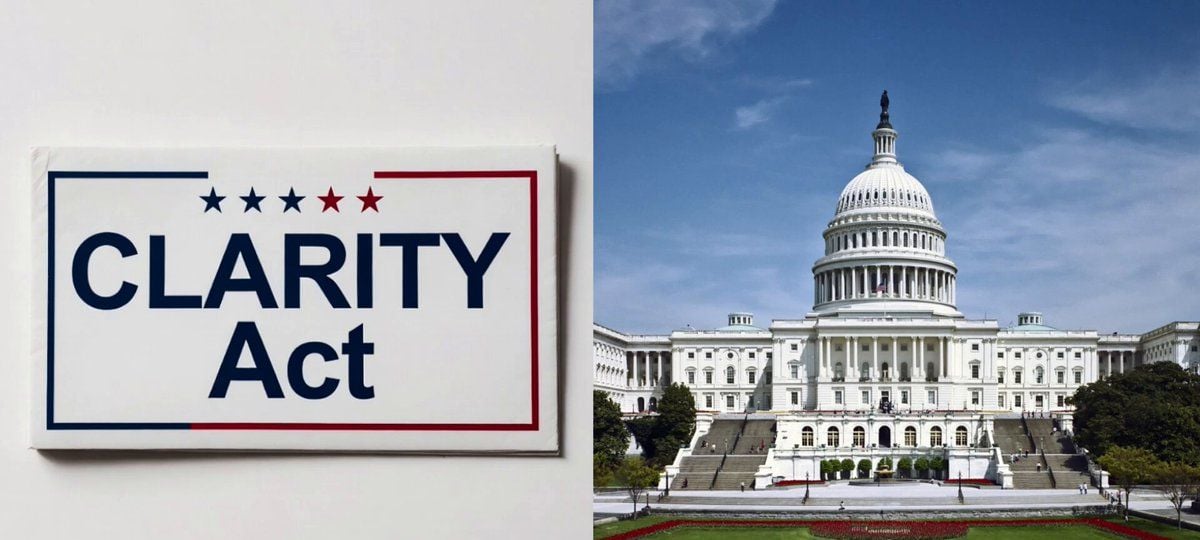
The Digital Asset Market Clarity Act, widely known as the CLARITY Act, is approaching a critical juncture in Washington. Lawmakers are working against a White House target of July 4 to move the bill into law, but the path to that deadline is far from clear.
The bill would give the Commodity Futures Trading Commission (CFTC) a central role in regulating digital commodities and related intermediaries, while preserving certain aspects of Securities and Exchange Commission (SEC) authority over primary market crypto transactions. In short, it draws a hard line between two regulators that have long competed over the same turf. The SEC and CFTC have often treated the same asset differently, leaving companies to guess which rulebook applied and litigate the answer years later.
The House passed the CLARITY Act 294-134 on July 17, 2025, the most comprehensive crypto bill ever to clear a chamber of Congress.The bill then took its biggest step forward in the Senate, clearing the Senate Banking Committee on May 14, 2026, in a 15-9 bipartisan vote.All 13 Republicans supported the bill, joined by Democrats Ruben Gallego and Angela Alsobrooks.
Key Hurdles Remain Before a Full Senate Vote
A full Senate vote now hinges on three unresolved fights: stablecoin yield, DeFi oversight, and an ethics provision aimed at officials profiting from crypto.Journalist Eleanor Terrett has described hitting the July 4 deadline as "logistically impossible," pointing to the work still required to merge competing Senate texts and secure enough bipartisan support.
The bill will need 60 votes to overcome a filibuster on the Senate floor, a threshold that requires meaningful Democratic crossover. Ryan Rasmussen, analyst at Bitwise, recently said full passage before July 4 appears "very unlikely," and prediction market Polymarket puts the odds of the bill becoming law in 2026 at around 50-60%, down from roughly 75% in May.
Key sponsors remain publicly optimistic despite the obstacles. Sen. Tim Scott, chairman of the Senate Banking Committee, said the CLARITY Act will pass before the August recess, describing its passage as "coming, period."Sen. Cynthia Lummis has warned that failure to pass the bill before the recess could delay meaningful crypto legislation for years. Galaxy Digital CEO Mike Novogratz, who has been engaging directly with senators on the bill, said he had spent 10 hours meeting with eight Democratic and six Republican senators, adding that everyone "left, right wants to get this done," and that the bill was down to three remaining issues he believes are solvable.
The stakes for the US crypto industry are significant. The lack of a unified regulatory framework has resulted in what many stakeholders describe as "regulation by enforcement," creating legal uncertainty, constraining the participation of traditional financial institutions, and pushing innovation abroad. Whether lawmakers can resolve the outstanding disputes before Congress heads into recess will determine whether that changes in 2026 or gets pushed well into the future.
Sources:CLARITY Act Explained: SEC and CFTC Crypto Rules in 2026 (Datawallet)Crypto Legislation: An Overview of H.R. 3633, the CLARITY Act (Congress.gov / CRS)CLARITY Act News: Will it Pass by July 4? (CoinPedia)