CLARITY Act News Today: Coinbase CEO Said Congress To Pass Crypto Bill The CLARITY Act News Today is drawing significant attention as the United States moves closer to establishing a comprehe
CLARITY Act News Today: Coinbase CEO Said Congress To Pass Crypto Bill
The CLARITY Act News Today is drawing significant attention as the United States moves closer to establishing a comprehensive regulatory framework for digital assets.
After clearing the House of Representatives, the legislation is now in the Senate, where negotiations over ethics provisions have become the final hurdle before a possible vote.
Recent bipartisan discussions, White House involvement, and statements from lawmakers indicate that progress is being made, although disagreements remain over enforcement and conflict-of-interest rules.
With Coinbase, crypto investors, and blockchain companies closely watching developments, the outcome of these negotiations could shape the future of cryptocurrency regulation and institutional adoption in the United States.
What Is the Latest CLARITY Act News Today?
Bipartisan Senate negotiations are actively continuing this week, with lawmakers from both parties working to close the gap on outstanding provisions.
Ethics rules remain the single biggest obstacle to the bill's floor vote. White House crypto adviser Patrick Witt is still leading the administration's side of the discussions, signaling continuity in the negotiating process.
Senator Cynthia Lummis' office has indicated that recent conversations with the White House were productive and moved the process forward. Updated ethics language is expected to be released within days.
Alongside the ethics debate, negotiators are also working through DeFi-related provisions that could shape how decentralized platforms are regulated going forward.
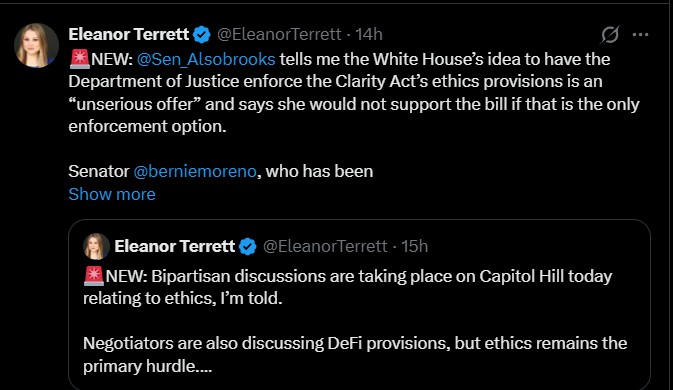
Source: EleanorTerrett X
Latest CLARITY Act Development
Development
Current Status
Senate Ethics Negotiations
Ongoing bipartisan discussions
White House Role
Supporting negotiations and bill passage
Patrick Witt
Continues serving as top crypto adviser
Ethics Language
Expected to be released shortly
DeFi Provisions
Under active discussion
Current Stage
Senate negotiations before floor vote
Why Ethics Provisions Have Become the Biggest Challenge
The core disagreement centers on enforcement authority. The current proposal would place the Department of Justice in charge of enforcing the bill's ethical rules, rather than giving that power to state attorneys general as many Democrats have preferred.
Senator Angela Alsobrooks, one of two Democrats who helped advance the bill out of committee in May, has publicly pushed back on the DOJ-only approach, describing it as an offer she does not consider serious enough to support. Her continued backing of the legislation depends on stronger ethics safeguards being written into the final text.
The proposal circulating among lawmakers would also bar top federal officials, including the President, Vice President, and members of Congress, from issuing digital assets while in office.
These ethics rules are designed to head off conflicts of interest. This concern has intensified following scrutiny of Trump-linked ventures such as World Liberty Financial and recent financial disclosures tied to the President's crypto holdings.
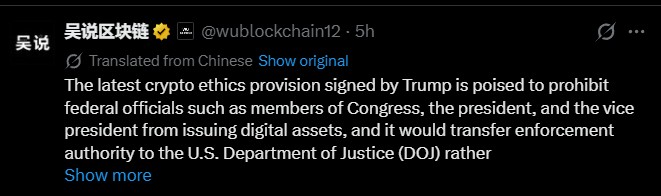
Source: Wu Blockchain X
Proposed Ethics Rules Under the CLARITY Act
Proposed Rule
Impact
Federal officials cannot issue digital assets
Reduces conflict-of-interest concerns
DOJ becomes primary enforcement agency
Centralized federal oversight
Ethics package negotiated with White House
May help secure Senate votes
DeFi provisions included
Expands crypto regulatory clarity
Stronger ethics safeguards
Key requirement for bipartisan support
Coinbase and Crypto Industry Increase Pressure
Industry voices are amplifying the urgency around a Senate vote. Coinbase CEO Brian Armstrong has publicly urged Congress to move quickly, warning that continued regulatory uncertainty could push the company to consider expanding its operations outside the United States.
The bill already cleared the House by a wide 294-134 margin, giving it a strong foundation heading into the Senate. The White House has echoed that urgency, encouraging senators to reach an agreement before their recess. Broader industry sentiment holds that regulatory certainty, once achieved, could unlock fresh innovation and investment in the sector.
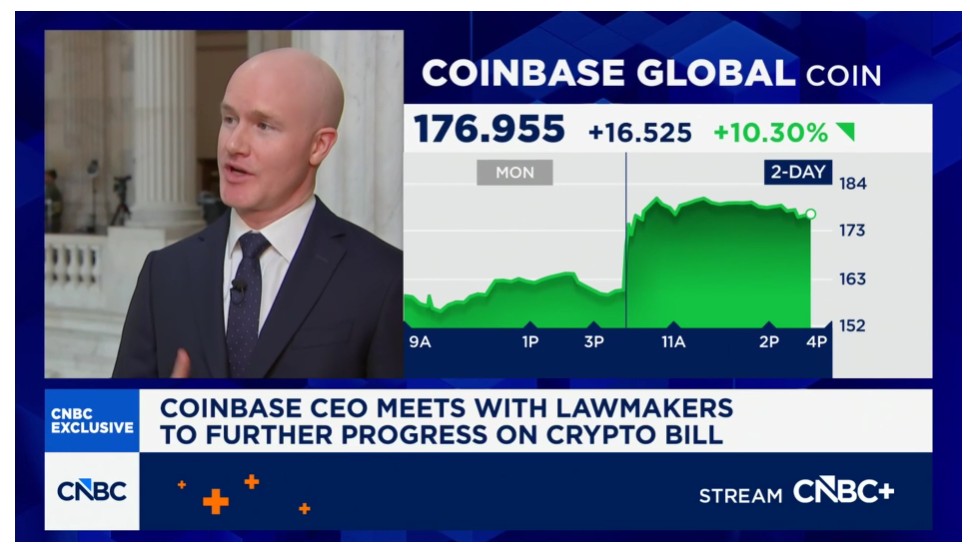
Source: CNBC Coinbase Interview
Complete Timeline of the CLARITY Act
Early 2026: Brian Armstrong temporarily withdrew support over stablecoin yield restrictions.
Following Months: Lawmakers negotiated compromises on disputed provisions.
May 2026: Senate Banking Committee advanced the CLARITY Act with bipartisan backing.
July 2026: House previously approved the bill by a 294-134 vote.
July 21, 2026: White House reportedly agreed on an ethics package and shared draft language with Senate Republicans.
July 21, 2026: Bipartisan negotiations continued on ethics and DeFi provisions.
July 22, 2026: Debate intensified over DOJ enforcement versus state attorneys general.
July 22, 2026: Coinbase CEO urged Congress to pass the legislation before the Senate recess.
Coming Days: Updated ethics language expected to be released.
Next Step: Senate negotiations conclude, followed by a possible floor vote if consensus is reached.
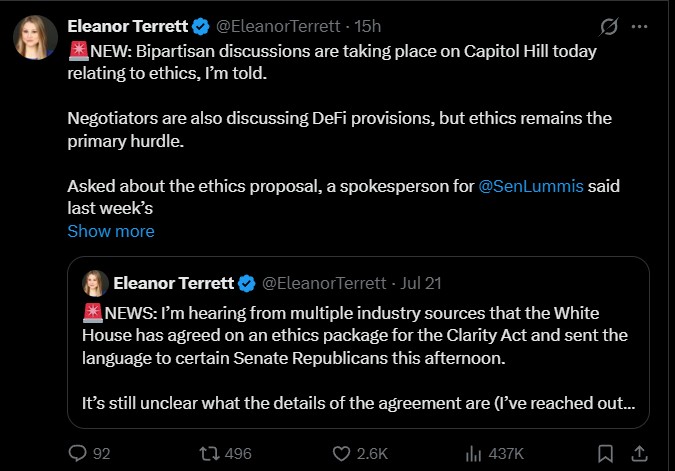
Source: EleanorTerrett X Post
Why the CLARITY Act Matters for the Crypto Market
A finalized US Crypto bill would create clearer operating rules for crypto companies and reduce the regulatory uncertainty that has long shadowed the industry. Clearer rules may encourage institutional investors to engage more confidently with digital assets, while also supporting continued innovation in blockchain technology.
Passage could strengthen the United States' competitive standing in the global digital asset race, and it carries particular significance for DeFi projects and exchanges that have operated in a regulatory gray area. That said, any effects on the market are likely to unfold gradually rather than produce an immediate shift once the bill is signed.
Conclusion
The latest CLARITY Act News Today suggests that the legislation is closer than ever to reaching the Senate floor, but its future still depends on resolving disagreements over enforcement. Bipartisan negotiations, White House engagement, and industry support indicate growing momentum, while concerns from several Democratic lawmakers continue to shape the final language.
If lawmakers reach consensus in the coming days, the United States could move significantly closer to establishing a unified regulatory framework for digital assets. Until then, investors, exchanges, and blockchain developers will continue monitoring updates, as the final version could influence the US crypto regulation landscape for years to come.
Please Note: Information compiled from reporting by crypto journalist Eleanor Terrett, Wu Blockchain, Jordain Carney, and CNBC's interview with Coinbase CEO Brian Armstrong, covering Senate negotiations dated July 21–22, 2026.
YMYL Disclaimer: This article is based on developments reported as of July 22, 2026, and reflects a rapidly evolving legislative situation. Details, timelines, and provisions may change as Senate negotiations continue. Readers should verify current status through official congressional sources before making decisions.