CLARITY Act News Today: JPMorgan Warns as US Senate Vote Odds Decline The latest CLARITY Act news puts fresh pressure on the U.S. Senate. Treasury Secretary Scott Bessent wants an immediate f
CLARITY Act News Today: JPMorgan Warns as US Senate Vote Odds Decline
The latest CLARITY Act news puts fresh pressure on the U.S. Senate. Treasury Secretary Scott Bessent wants an immediate floor vote after thousands of hours of bipartisan negotiation, even as JPMorgan flags falling odds of passage this year.
Between political friction, AML debates, and a looming August recess, this roundup breaks down where the bill stands, who supports it, and what happens next for crypto regulation.
At a Glance
CLARITY Act Status: Vote still pending
Bessent’s Demand: Vote immediately
Senate Progress: Thousands of hours of bipartisan talks completed
Committee Progress: Banking and Agriculture Committees advanced provisions
Key Disputes: DeFi, stablecoin yield, ethics, disclosures and AML rules
Passage Odds: 37% on Kalshi, 26% on Polymarket
SEC Backup: Paul Atkins says the SEC could act through rulemaking
Next Step: Negotiations and a possible vote after the summer recess
Bessent Urges Senate to Vote on CLARITY Act Now
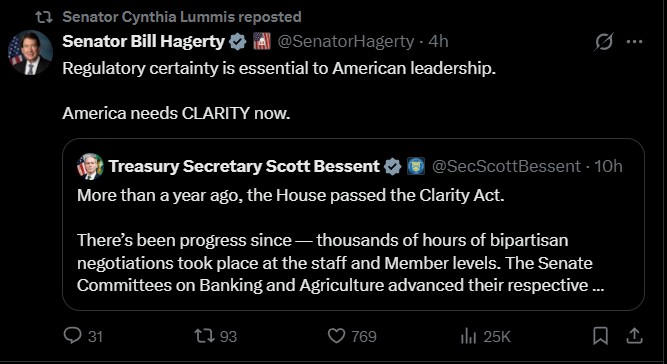
The biggest piece of CLARITY Act news this week comes from Treasury Secretary Scott Bessent, who is calling on the Senate to bring the bill to a vote without further delay. Bessent argued that Senate Republicans have already produced a floor-ready version of the legislation, and that further stalling only serves political posturing.
He was sharply critical of Democratic lawmakers he says are obstructing progress for political reasons, framing the standoff as a test of whether Congress will support American leadership in digital assets or push the industry offshore.
Source: Cynthia Lummis X Post
CLARITY Act Advances After Thousands of Hours of Senate Talks
This news doesn't come out of nowhere. The bill cleared the House of Representatives more than a year ago, and since then staff and senators have logged thousands of hours of bipartisan negotiation.
The Senate Banking Committee and the Agriculture Committee have each advanced their respective portions of the bill, a step that typically signals real legislative momentum.
Following that committee work, Republicans finalized a version they consider ready for a full floor vote. Bessent's statements this week were meant to spotlight that readiness and push leadership to schedule a vote before delays push it further into the fall calendar.
Development
Latest Update
Why It Matters
House passage
Passed in July 2025
Started the Senate legislative process
Senate negotiations
Thousands of hours completed
Shows progress toward a final bill
Banking Committee
Advanced relevant provisions
Moves the bill closer to Senate consideration
Agriculture Committee
Advanced relevant provisions
Important for CFTC-related oversight
Senate vote
Still pending
Key hurdle for the legislation
Passage odds
37% Kalshi, 26% Polymarket
Shows declining market expectations
SEC fallback
Rulemaking possible
Could provide partial regulatory clarity
Possible next step
Vote may slip beyond summer recess
September could become important
Why Are Senate Democrats Holding Up the CLARITY Act?
Not everyone agrees the bill is ready. Unresolved disagreements continue to center on ethics standards, enforcement mechanisms, stablecoin yield rules, decentralized finance oversight, and disclosure requirements tied to illicit finance protections. These sticking points have kept a bipartisan consensus out of reach.
Supporters of swift passage, including Senator Bill Hagerty and Senator Cynthia Lummis, have framed continued delay as a political choice rather than a substantive one. Lummis argued that opposing the bill isn't a statement against the current administration, but a vote to keep consumers inside a system already known to be flawed.
Bessent Defends CLARITY Act Consumer and AML Safeguards
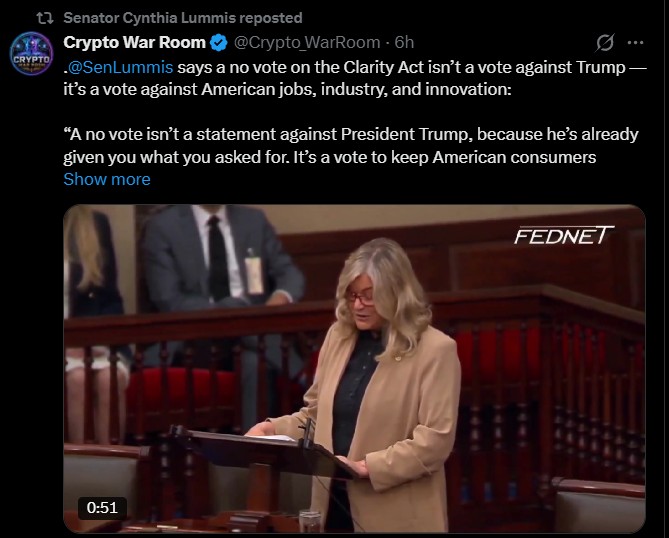
A recurring theme in this cycle is Bessent's rebuttal to claims that the bill is weak on consumer protection. He pointed to Titles II and III, which he says would meaningfully raise regulatory and compliance obligations for digital asset intermediaries, bringing their standards closer to those already required of banks and broker-dealers.
Bessent's argument is aimed at critics who claim the bill lacks safeguards against illicit finance. He maintains the opposite is true, and that stronger oversight of intermediaries is built directly into the bill's core structure.
Source: Official X Post
Blockchain Regulatory Certainty Act Draws Law Enforcement Support
Tied to the CLARITY Act news today is the Blockchain Regulatory Certainty Act, which addresses whether non-custodial software developers must register under the Bank Secrecy Act.
According to Bessent, the measure simply codifies a policy the Treasury Department has held across multiple administrations: developers who never take custody of user funds aren't subject to registration requirements.
Notably, law enforcement groups that once opposed this provision, including the Fraternal Order of Police, have since shifted to supporting it.
JPMorgan Warns CLARITY Act Delay Could Hurt Crypto Adoption
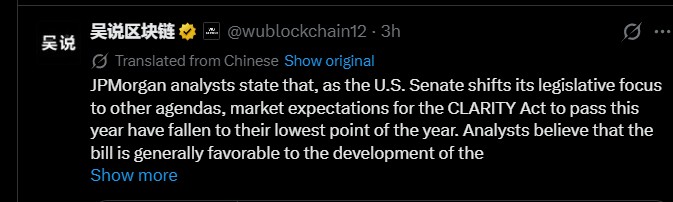
Away from Capitol Hill, JPMorgan analysts have added market-based news of their own. Prediction markets now show passage odds around 37% on Kalshi and 26% on Polymarket, the lowest levels recorded in 2026, as the Senate shifts attention to other priorities ahead of recess.
JPMorgan considers the bill broadly positive for crypto, but flagged provisions that could drag on institutional participation, including language letting DeFi platforms trade tokenized securities and derivatives outside SEC and CFTC jurisdiction, and light AML obligations for some crypto entities. The bank warned that delay risks pushing tokenization activity toward traditional finance rather than public blockchain networks.
Source: Wu Blockchain X
SEC Chair Paul Atkins Signals Regulatory Action if Congress Fails
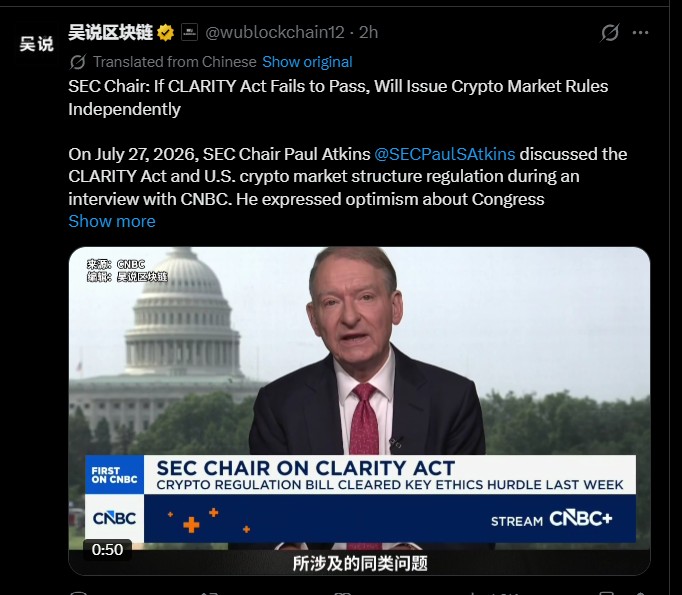
SEC Chair Paul Atkins has added his own perspective to this cycle. In a CNBC interview, Atkins said the SEC remains optimistic about passage and is supporting lawmakers with technical guidance. He confirmed that if Congress cannot act, the agency is prepared to address market structure issues through independent rulemaking.
Atkins noted that SEC rulemaking isn't a substitute for legislation. Durable certainty, he argued, ultimately requires statutory law rather than agency rules that can shift between administrations.
Source: CNBC Interview X Post
What Happens Next in August?
With the Senate's summer recess approaching, bipartisan revisions are expected to continue behind the scenes, but a formal votes now looks likely to slip into September.
Whether the bill passes before or after recess will shape near-term institutional adoption, regulatory clarity for digital asset intermediaries, and broader questions about U.S. leadership in crypto. Expect more CLARITY Act news as the Senate calendar firms up.
Timeline
July 2025: U.S. House passes the CLARITY Acts.
2025–2026: lawmakers engage in thousands of hours of bipartisan negotiations.
July 27, 2026: SEC Chair Paul Atkins says the SEC could pursue rulemaking if Congress fails to act.
July 30, 2026: JPMorgan warns that declining passage odds could hurt the crypto market outlook.
July 30, 2026: Treasury Secretary Scott Bessent calls for an immediate vote.
July 31, 2026: US Senate vote remains pending as lawmakers work through disagreements.
August 2026: Senate faces its summer recess, potentially delaying the vote.
September 2026: A vote could become more likely after lawmakers return.
Conclusion
This round shows a crypto bill 2026 caught between momentum and gridlock. Bessent's push, JPMorgan's warnings, and Atkins' rulemaking backup plan point to the same reality: the industry wants certainty, but the Senate's timeline remains uncertain.
With recess approaching and a possible September vote, the coming weeks will decide whether it becomes law or slips further into 2026.
Disclaimer: This article is for informational purposes only and does not constitute financial, legal, or investment advice. Cryptocurrency markets and regulations are volatile and subject to change; always conduct independent research.