Momentum for the CLARITY Act in the US Senate has cooled sharply after a brief optimism spike on Polymarket. Odds that the bill would become law this year climbed the day before, then fell ag
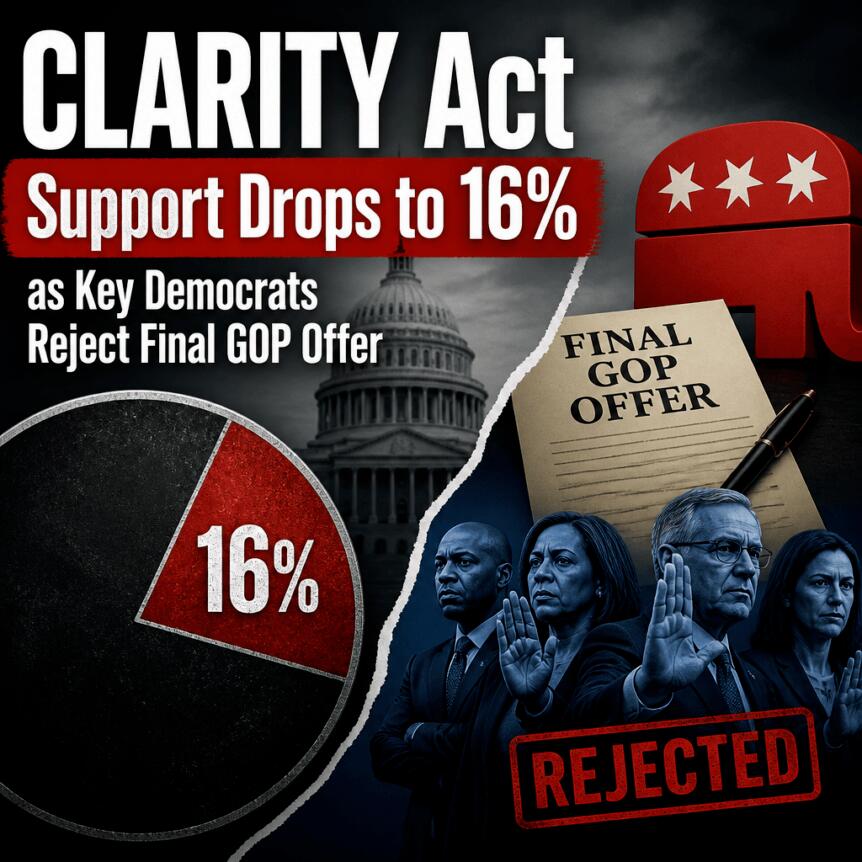
Momentum for the CLARITY Act in the US Senate has cooled sharply after a brief optimism spike on Polymarket. Odds that the bill would become law this year climbed the day before, then fell again on Monday as Democrats raised concerns that the latest Republican proposal still does not satisfy their conditions—particularly around ethics enforcement.
Republicans have reportedly offered revised language that expands ethics provisions, and Polymarket had earlier reflected that shift with odds rising to around 35%. By Monday, however, traders saw the prospects weaken, with the odds dropping as low as 16%. The outcome matters not just for legislative timing: the CLARITY Act would influence how the US Securities and Exchange Commission (SEC) and the Commodity Futures Trading Commission (CFTC) divide oversight responsibilities across the crypto market.
Key takeaways
- Polymarket odds for the CLARITY Act passing this year fell sharply again on Monday, after having spiked earlier.
- Democrats involved in negotiations reportedly said the revised Republican ethics language is still insufficient.
- Republicans need 60 votes to advance the bill; a failed vote could delay legislation that affects SEC–CFTC jurisdiction.
- Separate opposition is coming from tribal gaming interests and multiple banking trade groups, citing both prediction-market concerns and stablecoin loopholes.
Why Polymarket’s odds reversed
Polymarket traders initially responded positively to a newly revised Republican proposal, viewing added ethics provisions as a step toward agreement. The event page tied to the claim that the act would be signed into law in 2026 showed odds reaching about 35% following the disclosure of the updated text, as covered earlier by Cointelegraph in reporting on “US Republicans send final CLARITY Act offer to Democrats” (https://cointelegraph.com/news/us-republicans-send-final-clarity-act-offer-to-democrats).
But as reservations about that revised language surfaced among Democrats, confidence cooled. The Polymarket odds slid again during Monday trading, indicating that market participants began pricing in a lower probability that the bill could clear the procedural hurdle required to move toward a floor vote.
Senator Mark Warner—who is described in negotiations coverage as being involved in the talks—reportedly indicated that the revised ethics provision did not go far enough. Separately, reporting referenced in the original coverage points to Democrats preparing a counterproposal on Monday, suggesting that talks had not yet reached the kind of consensus needed to lock down support.
Ethics provisions remain the sticking point
Much of Monday’s shift appears tied to how Democrats interpret the revised ethics terms. Punchbowl News’ Brendan Pedersen reported that Senator Raphael Warnock said Democrats should not advance legislation that fails to address corruption risks happening “in real time,” a formulation that underscores a broad enforcement concern rather than a narrow drafting dispute.
Pedersen also reported remarks from Senator Ruben Gallego that the latest ethics offer left “much to be desired,” and that he intended to work on a counterproposal. In addition, the reporting cited that staff for Senator Elizabeth Warren circulated talking points arguing that the proposed state attorney general enforcement mechanism could be overridden by a determination from White House ethics officials.
According to Politico’s Jasper Goodman, Democrats sent their counterproposal to Republican negotiators, citing three people with knowledge of the matter. At the same time, the negotiations do not have unanimous Democratic buy-in: Politico reported that Senator Kirsten Gillibrand privately urged colleagues to support the procedural motion, implying that while opposition is growing, there may still be enough support among certain members to prevent the measure from collapsing outright—unless the wider math fails.
On the other side, Republican Senator Cynthia Lummis said President Donald Trump had accepted two significant ethics provisions and claimed there was “nothing left to give.” This sets up a familiar tension in legislative bargaining: Democrats may view the remaining gaps as core to enforcement credibility, while Republicans may view further changes as unnecessary or politically costly.
Opposition broadens beyond party lines
The uncertainty around procedural success is compounded by objections from groups outside Congress. The original coverage highlighted opposition from a coalition of 18 state attorneys general, adding another layer of political risk around the bill’s ethics and enforcement framework.
Tribal gaming interests are also weighing in. The Indian Gaming Association urged member tribes to press senators to vote against the bill, arguing that its proposed decentralized finance changes do not address Indian Country’s concerns regarding prediction markets. The association’s key request was explicit language clarifying that federal commodities law does not preempt tribal or state gaming laws, including protections under the Indian Gaming Regulatory Act. The call was issued through an alert urging senators to vote “no” on the CLARITY Act (https://indiangaming.org/urgent-tribal-action-alert-call-your-senators-today-vote-no-on-the-clarity-act/).
Banking trade groups also criticized the revised text. Eight banking groups said the latest version did not close what they described as loopholes enabling stablecoin rewards that function like deposit interest. They further argued that the proposed regulatory “circuit breaker” would activate only after substantial deposit flight from community banks had already occurred—an objection that frames the mechanism as too slow to prevent harm rather than too strict to be workable.
Meanwhile, crypto industry advocacy groups pressed senators to move the bill forward. In a statement released Monday, Blockchain Association CEO Summer Mersinger argued that the industry had made significant concessions to build bipartisan support and urged a yes vote. Her reasoning, as reflected in the source coverage, emphasized clearer rules, consumer protections, and deterrence of illicit activity, along with concerns that uncertainty could push jobs and innovation abroad.
What happens next for Senate voting
The next test is whether Republicans can secure the 60 votes needed to advance the bill. If that support falls short on Tuesday, the legislation could stall, extending the timeline for any SEC–CFTC jurisdiction framework that the CLARITY Act would establish. That makes Monday’s negotiations signals particularly important: when Democrats describe the ethics package as still inadequate, it can rapidly undermine the coalition needed to reach the procedural threshold.
For now, readers should watch two developments closely: whether Democrats’ counterproposal gains traction with Republicans, and whether external opposition—from state attorney general groups, tribal organizations, and banking trade groups—translates into additional voting pressure. If the ethics dispute continues to widen rather than narrow, Polymarket’s swing suggests traders will likely keep treating passage as less likely, even if supporters argue that a final push is still possible.
This article was originally published as CLARITY Act Support Drops to 16% as Key Democrats Reject Final GOP Offer on Crypto Breaking News – your trusted source for crypto news, Bitcoin news, and blockchain updates.