The Coinbase Bitcoin Premium Index has remained negative for 40 consecutive days, signaling persistently weak spot buying pressure from U.S.-based traders even as Bitcoin continues to attract
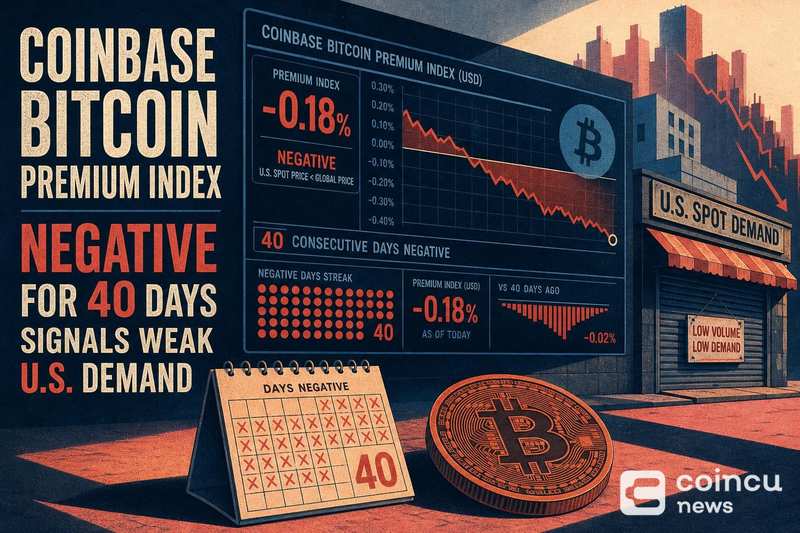
The Coinbase Bitcoin Premium Index has remained negative for 40 consecutive days, signaling persistently weak spot buying pressure from U.S.-based traders even as Bitcoin continues to attract demand from other regions and through alternative instruments.
The streak, first flagged in a CryptoQuant Quicktake analysis, represents one of the longest sustained periods of negative U.S. spot demand on record. The Coinbase Premium Index measures the price difference between Bitcoin on Coinbase, the dominant U.S. exchange, and other global trading venues. A negative reading means U.S. buyers are consistently paying less than their offshore counterparts. For related coverage, see Coinbase Bitcoin Premium Index Negative for 19 Days: What -0.0401% Means.
The metric matters because Coinbase serves as the primary venue for U.S. institutional and retail spot purchases, including the custodial infrastructure behind several spot Bitcoin ETFs. When the premium turns negative, it suggests that net buying pressure on the largest American exchange is trailing global demand. For related coverage, see Coinbase Bitcoin Premium Index Stays Negative for 44 Days, Latest Reading at -0.1089%.
What 40 Straight Negative Days in the Coinbase Premium Index Confirms
How traders interpret a negative premium
A negative Coinbase Premium Index does not mean Bitcoin's price is falling. It means that, relative to other exchanges, Coinbase is seeing softer buying activity. Traders use this as a proxy for U.S. institutional appetite because large allocators, ETF market makers, and compliant funds route orders through Coinbase. For related coverage, see IOSG: How One Coin Went From Coinbase to Upbit in Just 28 Days.
The CryptoQuant analysis tied the 40-day negative streak to PCE-driven risk aversion, suggesting that U.S. macro conditions, not exchange-specific issues, are suppressing domestic demand. The earlier stretch of 19 consecutive negative days at -0.0401% foreshadowed this longer deterioration.
Why Coinbase matters as a U.S. spot barometer
Coinbase processes the majority of regulated U.S. spot Bitcoin volume. It also serves as the custodian for multiple spot Bitcoin ETF issuers, including BlackRock's iShares Bitcoin Trust. When institutional buyers step back from the market, it shows up first in the Coinbase premium. For related coverage, see Crypto Fear and Greed Index Falls to 21 as Extreme Fear Returns.
The index has since extended beyond 40 days, with the reading reaching -0.1089% at the 44-day mark, confirming that the trend deepened rather than reversed after the initial milestone.
Why the Signal Points to Soft U.S. Spot Demand, Not an Automatic Market Breakdown
What the index captures
The Coinbase Premium Index captures relative buying pressure between U.S. and non-U.S. venues. It reflects how aggressively American traders are bidding for Bitcoin compared to global markets. A sustained negative reading indicates that price discovery is being driven offshore rather than domestically.
This distinction matters because Bitcoin rallied past $80,000 during a period when the Coinbase premium was already negative, as CoinDesk reported. That rally occurred without strong U.S. spot demand, suggesting offshore buyers and derivatives markets were the primary drivers.
What the index misses
The Coinbase premium does not account for ETF creation and redemption flows that occur through authorized participants, which may route through Coinbase's institutional arm but do not always appear in the spot order book. It also does not capture over-the-counter transactions or futures-based positioning.
Offshore exchanges, perpetual futures markets, and stablecoin-denominated pairs all contribute to Bitcoin's price formation outside the Coinbase premium's measurement window. A negative premium can coexist with rising prices when these alternative demand channels are active.
Bitcoin Market Context While the Coinbase Premium Stays Underwater
Price action versus demand quality
The divergence between Bitcoin's price performance and the Coinbase premium highlights a growing gap between headline price action and U.S. demand quality. Bitcoin's rally above $80,000 without corresponding U.S. spot demand suggests that the current price level is being supported by international flows and leveraged positioning rather than fresh American institutional capital.
This pattern raises questions about the sustainability of the rally if macro conditions continue to suppress U.S. risk appetite. TheStreet reported on analyst warnings about prolonged demand absence extending beyond 46 days, framing it as a structural concern rather than a temporary dip.
Risk sentiment and macro pressure
The CryptoQuant analysis specifically linked the negative premium streak to PCE inflation data reinforcing risk aversion among U.S. investors. Personal Consumption Expenditure readings influence Federal Reserve rate expectations, which in turn affect institutional willingness to allocate to risk assets like Bitcoin.
Periods of extreme fear in the Crypto Fear and Greed Index have coincided with stretches of negative Coinbase premium, reinforcing the connection between broader risk sentiment and U.S.-specific demand weakness.
Which Catalysts Could Turn the Coinbase Premium Positive Again
Macro prints that matter
A sustained move back above zero in the Coinbase Premium Index would require a shift in U.S. macro conditions. Cooler inflation readings, particularly in PCE data, could ease rate expectations and encourage institutional re-entry into risk assets. A dovish pivot from the Federal Reserve would likely be the strongest single catalyst.
Renewed inflows into spot Bitcoin ETFs like BlackRock's offering would also register as positive Coinbase premium pressure, since ETF creations route through Coinbase's custodial and trading infrastructure.
Flow signals to watch next
Traders monitoring for a reversal should watch for consecutive days of positive premium readings, not just a single session. A brief spike above zero during a volatile session does not constitute a trend change. The 40-day negative streak suggests that only a sustained shift in U.S. institutional behavior will flip the metric.
Large spot purchases by ETF authorized participants, corporate treasury buyers, or sovereign-adjacent funds would likely be the first signal. These flows are visible in on-chain data as large transfers from Coinbase to cold storage wallets associated with known institutional custodians.
FAQ: Coinbase Premium Index, Bitcoin Demand, and the Next Signal to Watch
What is the Coinbase Bitcoin Premium Index?
The Coinbase Bitcoin Premium Index measures the price difference between Bitcoin on Coinbase and on other major global exchanges. A positive reading means U.S. buyers are paying more, indicating strong domestic demand. A negative reading means U.S. buyers are paying less than global counterparts.
Is a negative Coinbase Premium Index bearish for Bitcoin?
Not automatically. Bitcoin rallied past $80,000 while the Coinbase premium was negative, showing that offshore and derivatives-driven demand can sustain prices independently. However, a prolonged negative premium suggests the rally lacks U.S. institutional support, which historically has been a key driver of sustained bull markets.
What should traders watch for next?
The key reversal signals are consecutive positive premium readings over multiple days, renewed spot Bitcoin ETF inflows through Coinbase, and softer U.S. inflation data that could shift Federal Reserve rate expectations. A single positive session is insufficient to confirm a trend change after a 40-day negative streak.
Disclaimer: This article is for informational purposes only and does not constitute financial or investment advice. Cryptocurrency and digital asset markets carry significant risk. Always do your own research before making decisions.
The post Coinbase Bitcoin Premium Index Negative for 40 Days Signals Weak U.S. Demand was initially published on Coincu.