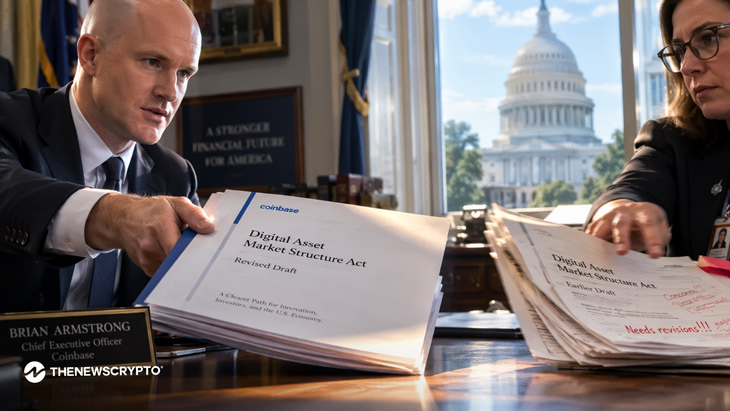
Brian Armstrong rejects blame for the CLARITY Act’s Senate failure and says WSJ is preparing a story blaming him. Armstrong says Coinbase opposed the January draft but later supported the rev
- Brian Armstrong rejects blame for the CLARITY Act’s Senate failure and says WSJ is preparing a story blaming him.
- Armstrong says Coinbase opposed the January draft but later supported the revised bill after lawmakers addressed its key concerns.
Coinbase CEO Brian Armstrong has pushed back against an upcoming Wall Street Journal story that he says is preparing to blame Coinbase and him personally for the failure of the CLARITY Act to advance in the U.S. Senate.
“Here we go again!” Armstrong wrote in a recent X post. He said the WSJ is “working on a story blaming Coinbase and me personally for the CLARITY Act not passing,” and accused the newspaper of repeatedly taking a hostile position toward the legislation.
Armstrong also defended Coinbase’s decision to oppose an earlier version of the bill in January, saying the draft still had major problems involving DeFi, tokenization, CFTC authority and stablecoin rewards.
“At the time, the bill had major issues that would have harmed crypto,” Armstrong wrote. He also argued that support for the legislation was divided and that the bill was not in a position to pass.
According to Armstrong, Coinbase then worked with lawmakers and other parties to change the legislation. He explained that all four areas he had raised in January were eventually addressed in the version that went through the Senate Banking Committee roughly four months later.
“The final draft of CLARITY that went to the Senate was great, and I strongly supported it,” Armstrong wrote.
What Led Coinbase to Oppose the Bill
The dispute centers on the fact that the version Coinbase opposed in January was later revised.
In January, Coinbase withdrew its support for the version scheduled for a Senate Banking Committee markup. The committee had planned to consider the legislation on January 15. But the markup was postponed after Coinbase raised objections to the draft.
Armstrong described the January version as a “de facto ban on tokenized equities” and raised concerns about penalties for DeFi developers, CFTC spot-market authority and restrictions involving stablecoin rewards.
Later, the legislation then went through months of negotiations between senators, regulators and industry groups.
In early May, senators Thom Tillis and Angela Alsobrooks reached a compromise on stablecoin rewards. The revised language prohibited rewards that were economically or functionally equivalent to bank-deposit interest while allowing certain rewards tied to genuine platform activity.
Armstrong responded to the agreement with a short message: “Mark it up.”
The revised bill advanced through the Senate Banking Committee on May 14 in a 15-9 vote. Coinbase then continued to support the legislation, including provisions covering digital-asset classifications, SEC and CFTC jurisdiction, self-custody, consumer protections and anti-money-laundering requirements.
The bill ultimately failed to advance in the Senate on September 15. Senators voted 49-50 against moving forward, falling short of the 60 votes required for the procedural step. Following the vote, Armstrong called the result disappointing and said the SEC and CFTC could still establish crypto rules using their existing authority.
In a separate recent interview, Armstrong said the Senate had taken Coinbase’s earlier concerns as feedback and revised the legislation. He argued that the four issues were fixed in the latest version and attributed the bill’s failure to other disagreements.
Armstrong called the outcome “a missed opportunity for the US to lead.”
His response puts the focus back on the difference between the January draft and the version that reached the Senate vote. Coinbase opposed the earlier draft, but later backed the revised legislation after lawmakers changed the provisions it had objected to.
Highlighted Crypto News:
a16z-Backed Linera Shuts Down Operations as Funding Runs Dry