Coldcard Seed Generation Defect: What the Report Confirms Crypto news update: Coinkite has published a full postmortem on the Coldcard seed generation defect. From March 29, 2021 to July 30,
Coldcard Seed Generation Defect: What the Report Confirms
Crypto news update: Coinkite has published a full postmortem on the Coldcard seed generation defect. From March 29, 2021 to July 30, 2026, the wallet firmware built recovery seeds with a weak software random generator, the report says. Attackers then rebuilt private keys offline and stole funds.
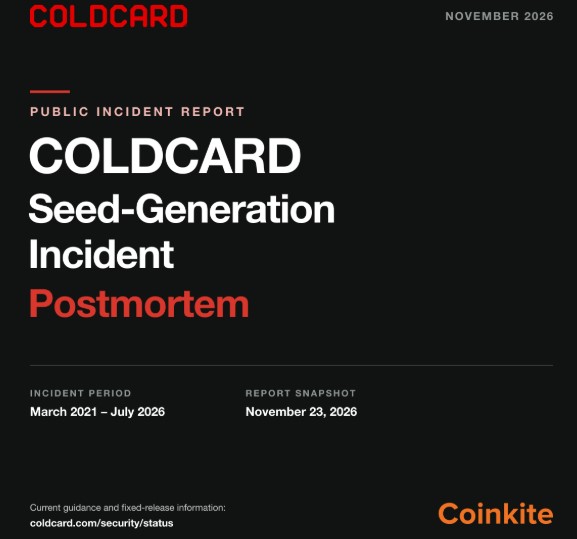
Coinkite announced the report on November 24, 2026. The 18-page document is dated November 23 and follows an accident-report format. The company said no device was remotely accessed or taken over.
Date
Event
Mar 29, 2021
Firmware v4.0.1, the first signed release with the defect
Jul 29, 2026
Unexpected transactions from affected seeds begin.
Jul 30, 2026
Users find thefts; Coinkite identifies the defect.
Jul 31, 2026
Fixed firmware published for all supported tracks
Oct 15, 2026
Keylabs publishes its independent review.
Nov 23-24, 2026
Postmortem dated and announced
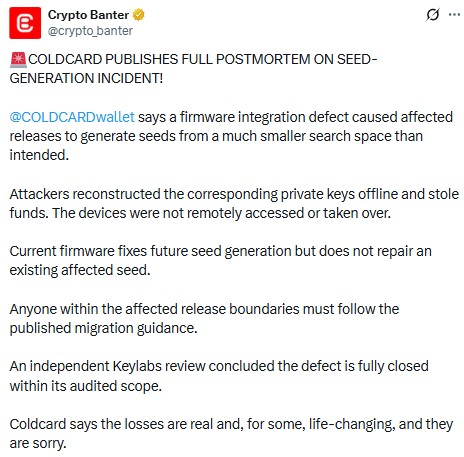
Crypto Banter also covered the news.
How the Coldcard Seed Generation Defect Slipped Through
A firmware setting switched off the intended hardware random number generator (RNG) path. A weak check in libNgU, a cryptographic wrapper library, accepted that setting. Key generation then used MicroPython's Yasmarang software generator instead of the chip's hardware generator, according to the Keylabs review.
Nothing failed visibly. The seed words looked normal, and the weak generator could pass the statistical tests Keylabs examined. Entropy, the measure of how unpredictable a recovery phrase is, was far lower than intended.
Earlier checks missed the problem. Coinkite said its release tests confirmed the hardware RNG code was present, not that seed creation actually reached it. The report lists at least 15 independent reviews between 2021 and 2026, including two paid third-party reviews, and none identified the defect.
Coinkite estimates about 40 bits of effective entropy on Mk2 and Mk3 devices and about 72 bits on Mk4, 5, and Q models, against a 128-bit target. The report says the 72-bit figure has not been independently established.
Theft Reports and Losses Linked to Weak Seeds
According to the full postmortem, Coinkite counted about 300 loss-related support tickets from 242 accounts as of November 18, 2026. That is roughly 0.21% of its estimated user base. The company is non-custodial, so it sees only reported losses, and the true total is likely higher.
The report also cites Galaxy Research, which reported 1,778.84 BTC stolen from more than 8,600 addresses on August 14, 2026. Coinkite warns that tickets, accounts, seeds, and addresses count different groups and cannot be added together.
Who found and exploited the flaw is unknown. The report says law enforcement is investigating, and it treats AI-assisted discovery as a plausible hypothesis, not an attribution.
Coinkite called the losses real and, for some customers, life-changing, and apologized. It asked anyone holding the stolen funds to return them through [email protected].
Hardware wallet security has drawn scrutiny before, and the Keystone data breach was a separate incident. Coinkite said it is still evaluating options to help affected customers.
Fixed Firmware, Keylabs’ Findings, and Open Items
The Security Status page lists 5.6.3 for Mk4 and Mk5 and 1.5.3Q for Q as current standard releases. New seeds now need user input, such as dice rolls, mixed with hardware sources. Build-time and boot-time checks reject a wrong RNG path.
Keylabs, the independent reviewer, concluded on October 15, 2026, that the Coldcard seed generation defect is fully closed within its scope: Mk5 5.6.2 and 5.6.3 and Q 1.5.2Q and 1.5.3Q. Edge releases and other firmware components were outside that review, and the 72-bit estimate was not independently confirmed.
What Owners of Affected Wallets Should Do Right Now
Updating firmware does not repair a recovery phrase already created on affected firmware. Check your release track:
Track
Affected seeds
Minimum fixed release
Mk2/Mk3
4.0.1 to 4.1.9
4.2.0
Mk4/Mk5 standard
Before 5.6.0
5.6.0
Mk4/Mk5 Edge
Before 6.6.0X
6.6.0X
Q standard
Before 1.5.0Q
1.5.0Q
Q Edge
Before 6.6.0QX
6.6.0QX
Install verified fixed firmware, generate a new phrase, verify its backup, and move funds, following the official migration guide. Passphrase wallets must migrate too.
Wallets built with at least 50 fair, private dice rolls through Add Dice Rolls, never recorded or exposed, were not weakened.
A strong passphrase or multisig setup adds a barrier but does not repair an affected phrase.
Never share seed words, passphrases, or dice rolls. Treat unsolicited recovery or compensation offers as likely impersonation.
Three of the report's 15 recommendations remain open: more independent reviews, including Edge, restoring control of the company X account, and a decision on compensation. Readers can follow the Coldcard seed generation defect through the Security Status page and the latest crypto news updates.
Disclaimer: This article is for information only and is not financial advice. Crypto and leveraged derivatives carry a high risk of loss. Do your own research and consult a licensed adviser before trading.