COLDCARD Wallet Hack: Attack Patterns, Recovery Update and BTC Price Roughly 594 BTC has already left affected devices in the ongoing COLDCARD Wallet Hack, and on-chain investigators now coun
COLDCARD Wallet Hack: Attack Patterns, Recovery Update and BTC Price
Roughly 594 BTC has already left affected devices in the ongoing COLDCARD Wallet Hack, and on-chain investigators now count four separate attacker patterns behind the theft.
The COLDCARD team continues to issue an urgent security advisory from July 31, 2026, pushing affected users to migrate funds without delay.
Separately, Chainalysis is tracking each attacker's moves in real time, and the on-chain trail is already producing useful clues.
COLDCARD Wallet Hack Update: What Happened and Who Is Affected Now
A random number generation flaw slipped into COLDCARD firmware during a 2021 code migration. The bug used a predictable software generator instead of the device's hardware source, weakening seeds on several affected models for almost five years.
The flaw cut the search space to roughly 40 bits on Mk2 and Mk3 devices and about 72 bits on later models, a range attackers with enough computing power can brute-force.
This COLDCARD exploit update points to a key-generation failure in specific firmware versions, not a break in Bitcoin's underlying cryptography. That distinction matters for anyone weighing this event against other hardware wallet exploit cases from past years.
Chainalysis COLDCARD Wallet Hack Tracking: Four Distinct Attacker Patterns
According to Chainalysis report, independent attackers are draining victims through different on-chain routes, and each strategy leaves its own fingerprint:
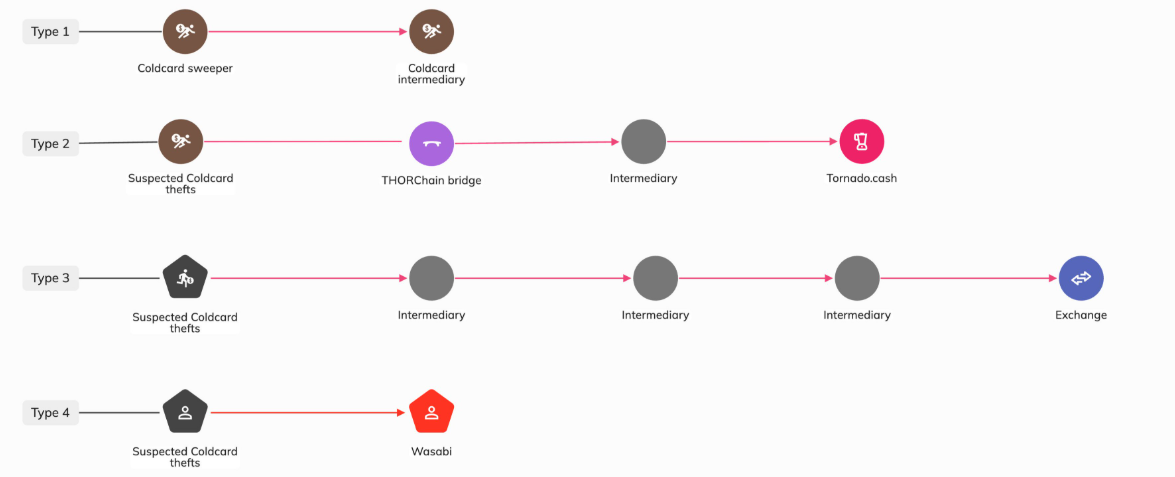
Type 1:Funds move from victim wallets into an attacker wallet, then into one consolidation wallet holding $35M that has sat untouched, suggesting the holder is simply waiting.
Type 2: Stolen coins cross into other chains before landing in mixing services such as Tornado Cash.
Type 3:Funds pass through several intermediary addresses before reaching centralized exchanges, a route that carries real exposure to freezes.
Type 4: Other funds move straight into mixing services such as Wasabi Wallet to blur the trail.
Every one of these paths still leaves a record. Chainalysis says it will continue to match wallet clusters and timing patterns, and each transfer narrows the list of exchanges and services that could eventually flag the funds.
Inside the Five-Year RNG Flaw: Losses Reached Over $130 Million
Galaxy Research data shows around 1,596 BTC has been stolen from nearly 7,300 addresses across three major attack waves and 14 smaller incidents.
Current findings from Galaxy Research
Confirmed losses: Around 1,596 BTC stolen from ~7,300 addresses
Confirmed Value: More than $100 million
Fourth wave: Still under investigation
Possible total losses: Up to 2,055 BTC (around $130 million) if fourth wave is confirmed
The report also highlights how dormant funds are most affected. Long-term holders with average inactivity of 3.18 years, were affected by major facing major thefts.
Following this pattern, many of the long-term holders are now moving their coins towards exchanges from self-custody.
The current figures come from on-chain transaction patterns rather than confirmed individual victims, so final losses could shift as the review continues.
Bitcoin Price Reaction: BTC Today and Holders Movements
BTC price today trades near $64,667, holding above its $63K level for almost 3 straight days now. Market cap sits at $1.29 trillion, while daily trading volume sits near $22.3 billion.
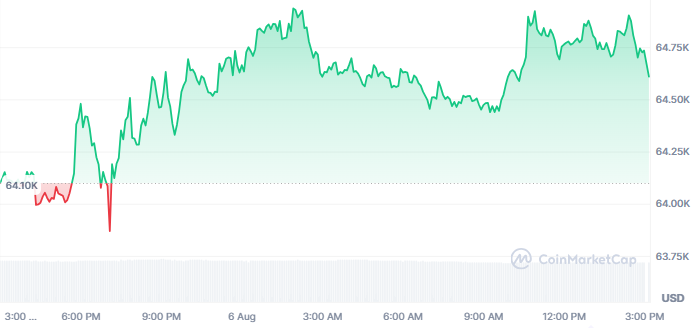
Source: CoinMarketCap Official
The ColdCard BTC exploit points to a key-generation failure in specific firmware versions, not a break in Bitcoin's underlying cryptography.
Because of that, a rapid selloff wasn't triggered, but the long-term holder activity matched the dormancy pattern observed in the attacks.
Glassnode reported that roughly 119,000 BTC, dormant for more than a year, moved within three days, a figure close to 200 times the size of the COLDCARD BTC theft itself.
Only about 10% of that dormant supply reached exchanges, which points toward wallet migration rather than a broad sell-off.
COLDCARD Recovery Steps: How to Secure Remaining Funds
Updating firmware alone will not repair an already-generated seed. Only a fresh seed created on patched firmware protects funds going forward, and that single step sits at the center of the user security update for now.
For anyone holding an affected device, the Coinkite recovery path stays simple:
Check the official advisory for the exact device model and firmware version
Upgrade to patched firmware before taking any other action
Generate a brand-new seed rather than reusing the old one
Move funds to the new seed in careful, tested steps
Share the advisory with less-online holders who may have missed it
COLDCARD news today centers on migration, not panic. Anyone holding an affected device gains the most by following the official advisory and treating this COLDCARD recovery process as routinehardware or cold wallet maintenance rather than a crisis reaction.
As Chainalysis keeps tracing the four attacker patterns, coverage of this ongoing Bitcoin hack will likely turn on how much of the $35M consolidation wallet ever moves, and whether the remaining stolen BTC ends up frozen, laundered, or simply left in place.
Disclaimer: This article is for informational purposes only and does not constitute financial or investment advice. Crypto markets carry significant risk. Always do your own research before making any investment decisions.