How Does ContraCop Tokenomics Define CCP Supply and Allocation? Before buying any crypto token, most people ask the same three questions. How many tokens exist? Who gets them? And when can th
How Does ContraCop Tokenomics Define CCP Supply and Allocation?
Before buying any crypto token, most people ask the same three questions. How many tokens exist? Who gets them? And when can those holders sell? ContraCop tokenomics answers these in the project’s whitepaper, and this guide explains the details in simple language.
Key Takeaways
The total supply is 1,000,000,000 CCP, with 40% planned for the public presale and 25% for the liquidity pool.
CCP is designed as a utility token for audits, monitoring, security tools and API access. It is not equity, ownership or a guaranteed income product.
Team, advisor and treasury tokens are tied to lock-ups and milestone-based releases, but the final terms may change before launch.
What Is ContraCop Protocol?
ContraCop Protocol is a crypto security project that builds AI security tools for the digital asset space. Its platform covers smart contract audits, live monitoring, token analytics and wallet intelligence, and it also offers API access for enterprise clients. Its official website presents the product, and its whitepaper explains the token model behind it.
Everything below comes from those two sources. The whitepaper states that the model may be updated before launch after legal, technical, security and market review, so the figures reflect the proposed structure.
Source: official website.
What Is the ContraCop CCP Token?
CCP is intended to work as a utility token inside the ContraCop ecosystem. Users would spend it, or hold it for access, across the platform’s security features.
The whitepaper is careful about what CCP is not. It should not be presented as equity, ownership, guaranteed income or a guaranteed investment product. Any staking, reward, revenue-sharing or burn feature must pass legal, regulatory, technical and governance review first.
Supply and Sale Summary
The first thing to check in any token model is the supply. This is how the CCP token tokenomics summary looks in the whitepaper.
Item
Detail
Total token supply
1,000,000,000 CCP
Total tokens for sale
800,000,000 CCP
Price range
USD 0.0071 to USD 0.0128 per CCP
Accepted currencies
USDT and USDC
One detail needs a careful read. The summary lists 800,000,000 CCP for sale, while the allocation table below assigns 400,000,000 CCP to the public presale. Readers should confirm the exact sale quantity in the official sale documentation.
ContraCop Tokenomics: Total Supply and Allocation
The official whitepaper splits the 1 billion tokens across five categories. Each one has a stated purpose and a vesting note.
Category
Share
Tokens
Purpose
Release and vesting notes
Public Presale
40%
400,000,000 CCP
Community allocation during the ICO or pre-sale stage
Terms subject to official sale documentation
Liquidity Pool
25%
250,000,000 CCP
Supports market liquidity after launch
Lock-up recommended, subject to the deployment plan
Ecosystem and Staking
15%
150,000,000 CCP
Ecosystem incentives, possible staking or loyalty, security researcher programs
Vesting and eligibility controls recommended
Team and Advisors
10%
100,000,000 CCP
Long-term contributor alignment and advisory support
Multi-year linear vesting recommended, with an initial lock-up
Marketing and Development
10%
100,000,000 CCP
Product growth, campaigns, partnerships, developer tooling, operations
Budgeted release milestones and treasury oversight recommended
The public presale holds the largest share. That favours community access, since no single insider category is bigger than the public portion.
What Is CCP Token Used For in the ContraCop Ecosystem?
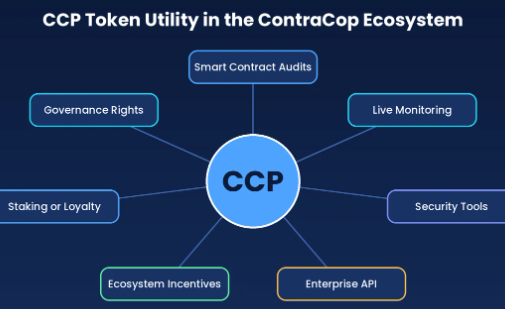
The whitepaper lists seven intended uses. Together they define ContraCop token utility.
Utility area
Intended use
Important note
Premium smart contract audits
Access or payment for enhanced audit packages and reporting
Subject to pricing, availability and legal review
Live monitoring sessions
Watchlists, alerting periods and monitored asset sessions
Monitoring does not guarantee prevention of loss
Premium security tools
Advanced scanners, token analytics, wallet intelligence, report exports
Scope depends on the product release schedule
Enterprise API access
Payment or credential for partner platforms and clients
Enterprise contracts may use separate terms
Ecosystem incentives
Rewards for community, developer and security researcher participation
Programs need anti-abuse and eligibility controls
Staking or loyalty
Possible access tier, loyalty or governance mechanism
Only where legally permitted and technically approved
Governance rights
Proposals, voting or ecosystem signals
Subject to legal and technical limits if implemented
The smart contract audit and monitoring rows connect directly to rug pull protection, a worry that keeps many buyers cautious. The whitepaper is honest here: monitoring helps users watch assets, but it does not promise that losses will be prevented.
ContraCop CCP Staking and Governance
Staking and governance are the two features with the most conditions attached. The whitepaper says staking or loyalty access may be offered only where legally permitted and technically approved.
Governance rights follow the same rule. If they are implemented, parameters stay subject to legal and technical constraints. Holders should not assume voting power until the project confirms it.
ContraCop Team and Advisors Vesting Schedule
Vesting matters because early insiders could otherwise sell soon after launch. The whitepaper sets aside 10% of supply, or 100,000,000 CCP, for the team and advisors.
It recommends multi-year linear vesting with an initial lock-up. In simple terms, tokens would unlock gradually over several years after a waiting period, which reduces short-term sell pressure.
Liquidity and Market Making
Liquidity decides how easily a token can be bought and sold. The whitepaper recommends a lock-up for the 25% liquidity pool, so those tokens cannot be pulled out quickly.
It also calls for clear lock-up commitments, prudent market making discussions and no misleading listing claims. That last point protects buyers from inflated promises about exchange listings.
Treasury and Anti-Dump Principles
Treasury releases are meant to be milestone-based, documented and covered by internal controls. Anti-dump measures include vesting, sale limits where feasible and transparent allocations.
Burn Mechanism
The whitepaper treats burning as optional. If a burn mechanism is introduced, it should be defined clearly in the smart contracts and disclosed before it activates.
Checks Before Buying Any Token
Read the final sale documents, not only summaries or social posts.
Confirm the lock-up and vesting terms for liquidity, team and advisors.
Treat words like “recommended” and “subject to” as plans, not guarantees.
Never rely on monitoring or audits alone as proof of safety.
Final Thoughts
ContraCop tokenomics sets out a clear structure: 1 billion CCP, a large public share, locked liquidity and gradual vesting for insiders. Its strength is the open admission of limits, since many features depend on legal and technical approval.
The model can still change before launch. Anyone researching it should compare this guide with the latest version of the whitepaper and the official website.
Disclaimer: This article is for information only and is not financial advice. Crypto assets carry risk, so research carefully before making any decision.