Why Are OCC Payment Stablecoin Issuers in Focus Now? The OCC wants community banks to help shape payments. In a post on X, the regulator encouraged interested banks, or their subsidiaries, to
Why Are OCC Payment Stablecoin Issuers in Focus Now?
The OCC wants community banks to help shape payments. In a post on X, the regulator encouraged interested banks, or their subsidiaries, to consider applying to become OCC payment stablecoin issuers.
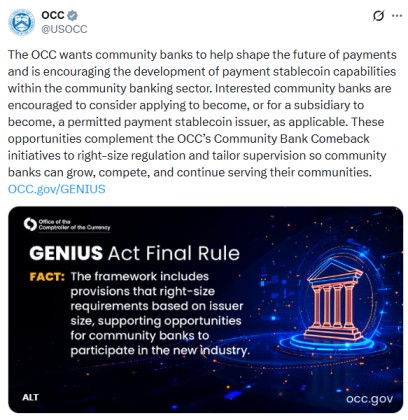
Source:Official OCC Post on X
It described the move as support for payment stablecoin capabilities inside community banking.
The call sits within the OCC payment stablecoin initiative under the GENIUS Act and its Community Bank Comeback effort to right-size regulation. It suggests smaller lenders are being invited in alongside large banks and crypto firms.
What Did the Final GENIUS Act Rule Set in Motion?
The OCC announced its final GENIUS Act rule on October 21, 2026. The rule and the GENIUS Act both take effect on January 18, 2027. This is the core GENIUS Act stablecoin news behind the community bank push.
The Federal Register notice was published on October 23, 2026. It shows the OCC reviewed about 328 comments from crypto firms, banks, trade groups, academics and individuals.
The rule sets requirements for OCC payment stablecoin issuers on reserve assets, redemption, risk management, custody and capital. Anti-money laundering and sanctions rules will follow in a separate rulemaking with the Treasury Department.
Can a Small Bank Really Become a Permitted Payment Stablecoin Issuer?
The OCC says there is a path. On community banks stablecoin issuance, its community bank fact sheet describes eligible structures, including subsidiaries, as applicable.
The same document says bank deposits can serve as reserve assets backing payment stablecoins. That keeps banks in the picture even if they never issue a coin.
The OCC also says requirements scale with size. Large issuers face a full-scope exam every 12 months, while certain small issuers qualify for an 18 to 24 month cycle.
Are Applications Open Yet?
Not yet. The OCC is not accepting applications or waiver requests. It will begin once the Office of Management and Budget gives final approval to the application forms, and a press release will announce the start.
Once filing opens, the application and waiver guidance sets a clock. The OCC will say within 30 days whether an application is substantially complete. It commits to act no later than 120 days after that point.
Waivers are narrow. A subsidiary of an insured bank with a pending application on January 18, 2027 may request one, for up to 12 months. The OCC does not expect to grant waivers to prospective issuers that are not already operating in the United States.
This is the first concern the fact sheet addresses. The OCC says the effect of stablecoin adoption on community bank deposits remains uncertain, with estimates varying widely. It says it is monitoring potential outflows.
Yield is the second pressure point. The final rule restates the ban on issuers paying holders interest or yield solely for holding or using a stablecoin.
The proposed rebuttable presumption was dropped, but the OCC prohibits arrangements it finds designed to evade the ban.
Consumer disclosure is the third. Issuers must state that payment stablecoins are not backed by the full faith and credit of the United States and are not covered by federal deposit insurance.
How Could OCC Payment Stablecoin Issuers Shape the Crypto Market?
For the wider stablecoin market update, the key date is January 18, 2027. From then, issuing a payment stablecoin in the United States generally requires approval as a permitted payment stablecoin issuer, and noncompliance carries criminal penalties.
The story sits at the crossroads of banking and crypto news. The OCC says it generally applies the same requirements to bank and nonbank issuers, which matters for US crypto regulation and competition.
Rule changes like this now show up regularly in crypto news today coverage. The sources reviewed do not name any community bank planning to apply.
Expert Take: What Could Shape the Next Phase?
The data suggests the next clear signal is the OCC press release opening applications. That announcement will start the 30 day completeness check and the 120 day decision clock.
The main uncertainty remains demand. Capital standards are described as tailored, but the fact sheet gives no figures for small banks. Compliance staffing and technology costs are also unquantified in the sources reviewed.
Deposit flows are the largest open risk, and the OCC itself calls the effect uncertain. The separate anti-money laundering and sanctions rule could also change the cost of becoming one of the OCC payment stablecoin issuers.
Conclusion
The OCC has opened a policy path, but the application door is closed for now. The rule date and review timelines are set. Demand, costs and deposit effects are not.
This OCC stablecoin news, and the wider banking and crypto news around it, will become clearer once applications open and show whether community banks join the ranks of OCC payment stablecoin issuers.
Disclaimer:This article is for information only and is not financial, legal or investment advice. Stablecoin rules and bank decisions can change quickly. Always verify details with official sources before acting.