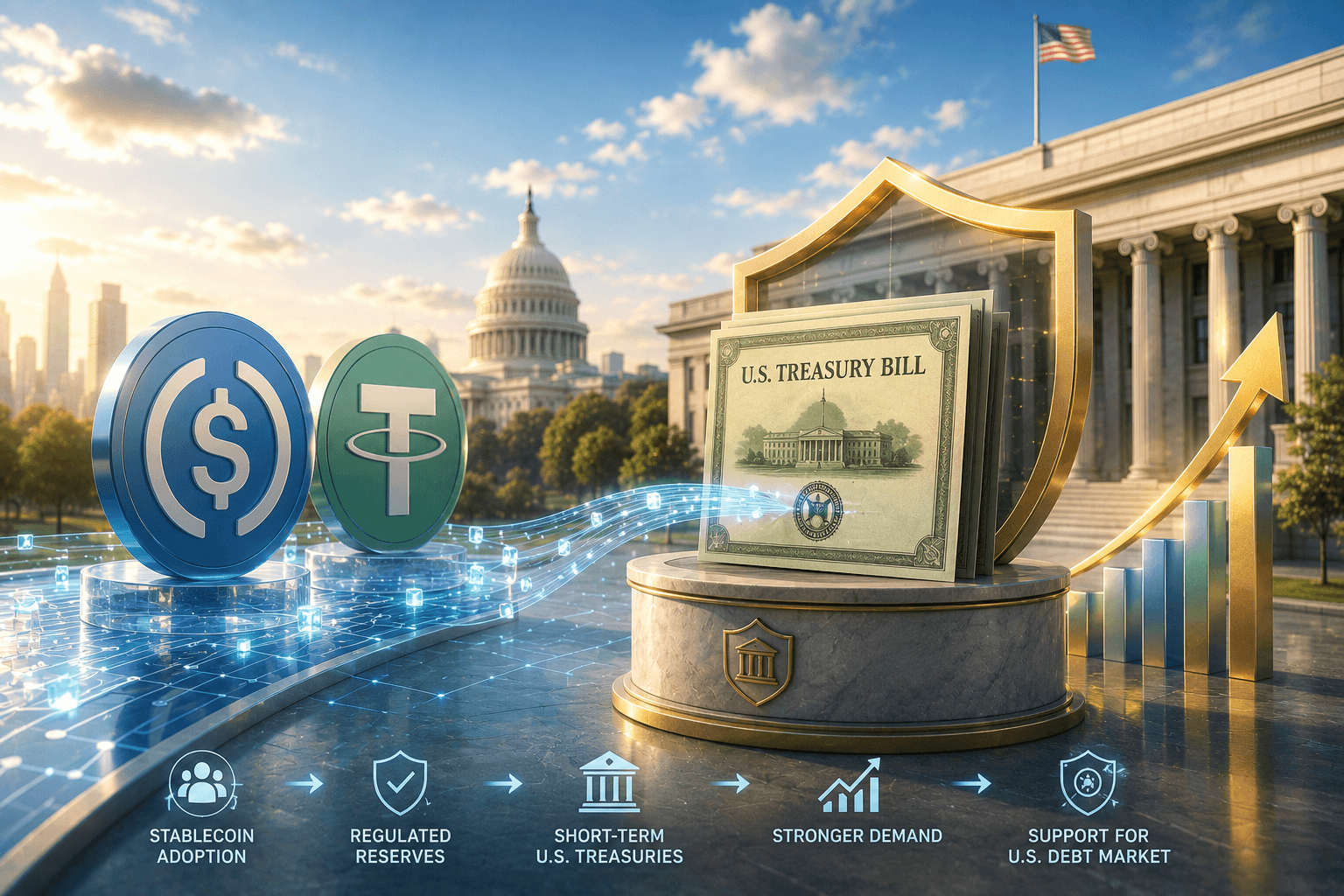
Stablecoins are becoming an unexpectedly important part of the U.S. government debt market. What began as a way for crypto traders to move digital dollars between exchanges is increasingly cr
Stablecoins are becoming an unexpectedly important part of the U.S. government debt market.
What began as a way for crypto traders to move digital dollars between exchanges is increasingly creating a new class of buyers for short-term U.S. Treasury securities.
The link is straightforward.
Dollar-backed stablecoins such as USDT and USDC need highly liquid assets behind the tokens they issue. Under the regulatory framework created by the GENIUS Act, short-term U.S. Treasuries are among the key reserve assets permitted to back regulated payment stablecoins.
If stablecoin adoption accelerates, issuers may therefore need to buy substantially more Treasury bills.
How much more is the difficult question.
Recent analysis from Brookings estimates that different stablecoin-growth scenarios could generate between roughly $400 billion and $2.3 trillion of first-round net Treasury bill demand by 2030.
That upper figure is large enough to attract attention in Washington, particularly as the U.S. government faces persistent deficits, more than $30 trillion in marketable debt and growing pressure at the long end of the Treasury curve.
But the simple story — more stablecoins equal trillions of dollars of new demand for U.S. debt — leaves out several important complications.
Stablecoins may become a major Treasury buyer.
That does not mean every dollar of stablecoin growth represents a new dollar of demand for government debt.
Stablecoins Are Already Major Treasury Buyers
Stablecoin issuers do not hold customer dollars in a vault.
The reserve assets behind leading fiat-backed tokens are generally held in cash, short-duration government securities, Treasury-backed repo arrangements and other highly liquid instruments.
At the largest issuers, the numbers are already substantial.
Tether reported approximately $184.6 billion of USDT outstanding at the end of the second quarter of 2026.
The company said its reserve portfolio remained concentrated in short-duration, high-quality liquid assets and U.S. government-backed instruments.
Tether also described itself as one of the world's largest buyers and holders of U.S. Treasuries.
Circle operates on the same basic reserve principle.
USDC had approximately $72.7 billion in circulation as of August 20.
Most of the USDC reserve is held through the Circle Reserve Fund, an SEC-registered government money market fund managed by BlackRock, with reserves including short-dated U.S. Treasuries, overnight Treasury repo and cash.
Taken together, the largest stablecoin issuers already control reserve portfolios large enough to matter in short-term funding markets.
And the market could become considerably larger.
The Stablecoin Market Is Approaching $300 Billion
Brookings estimated the global stablecoin market at roughly $270 billion as of June 2026.
More recent market estimates place the sector around $300 billion.
That is still small compared with the entire U.S. Treasury market.
But stablecoin reserves are not distributed evenly across all Treasury maturities.
Their importance is concentrated toward the short end of the curve.
That distinction matters.
The U.S. government continuously refinances Treasury bills that mature within weeks or months. A new structural buyer willing to absorb hundreds of billions of dollars in short-duration securities can therefore influence demand even without becoming dominant across the entire government bond market.
And U.S. regulation could reinforce that relationship.
How the GENIUS Act Connects Stablecoins to Treasury Bills
The GENIUS Act established the first comprehensive federal framework for U.S. payment stablecoins.
One of its most important requirements concerns reserves.
Regulated payment stablecoins must be backed one-to-one by permitted reserve assets.
Those reserves can include cash, bank deposits, short-term Treasury securities and qualifying repo arrangements, among other highly liquid assets.
For Treasury securities held directly by issuers, the framework generally focuses on debt with remaining maturities of 93 days or less.
That creates a natural connection between stablecoin growth and Treasury bill demand.
Imagine a regulated issuer creates $10 billion in new stablecoins.
The issuer simultaneously assumes a $10 billion redemption liability because holders must be able to exchange those tokens for dollars.
To safely support that liability, it needs approximately $10 billion in reserve assets.
If much of those reserves goes into Treasury bills, new stablecoin issuance effectively produces additional demand for short-term U.S. government debt.
Scale that process from billions to trillions and the potential implications become much larger.
Could Stablecoins Really Create $2.3 Trillion of Treasury Demand?
The $2.3 trillion number should not be interpreted as a prediction.
It comes from scenario modelling.
Brookings researchers Nellie Liang and Brent Neiman examined several possible paths for future stablecoin adoption and estimated how much first-round net Treasury bill demand those scenarios could generate.
Their range runs from approximately $400 billion to $2.3 trillion by 2030.
The enormous gap between the low and high scenarios tells us something important.
Nobody yet knows how large stablecoins will become.
Treasury Secretary Scott Bessent has previously suggested that the market could eventually grow into the trillions of dollars.
But adoption will depend on much more than crypto trading.
Cross-border payments, corporate treasury operations, merchant settlement, tokenized financial markets and international demand for digital dollars could all determine the final size of the sector.
If stablecoins remain primarily a cryptocurrency settlement tool, growth may be more limited.
If they become mainstream global payment infrastructure, the reserve demand generated by issuers could become dramatically larger.
Foreign Stablecoin Demand Could Matter Most
Where stablecoin growth comes from may be even more important than how large the market becomes.
Consider a U.S. investor who moves $10,000 from a money market fund into a stablecoin.
The money market fund may already have owned Treasury bills.
If it sells those Treasuries to meet the withdrawal and the stablecoin issuer then uses the $10,000 to buy similar Treasury bills, little net new demand has been created.
Ownership has simply moved from one financial vehicle to another.
Now consider a user in another country who holds savings in a local currency and converts them into $10,000 of dollar-backed stablecoins.
If those funds were previously outside the U.S. financial system, the stablecoin issuer may now use them to acquire Treasury bills.
That represents a much clearer source of additional demand.
This is why international adoption matters so much to the Treasury thesis.
Dollar stablecoins make U.S. currency accessible to users who may not have convenient access to American bank accounts.
Someone can hold a token representing dollars without opening an account with a U.S. bank.
If millions of users begin using those tokens for savings, commerce or cross-border payments, the underlying reserve system can effectively channel global demand for digital dollars into U.S. government securities.
Stablecoins Could Extend Dollarization
That creates a second strategic benefit for the United States.
Stablecoins may reinforce the international role of the U.S. dollar.
Most of the world's largest stablecoins are denominated in dollars.
When someone in another country holds USDT or USDC, they are effectively choosing a digital representation of the U.S. currency rather than their domestic currency.
As stablecoin usage spreads, digital dollarization could therefore extend into markets where access to conventional dollar banking has historically been limited.
From Washington's perspective, that could strengthen demand for both the currency and the government securities used to back those tokens.
For foreign governments, however, the same trend may look very different.
Countries with weaker currencies could see residents shift savings and payments into dollar stablecoins, reducing demand for domestic money and weakening monetary sovereignty.
That is one reason regulators outside the United States are developing their own stablecoin frameworks, central bank digital currencies and real-time payment systems.
The stablecoin-Treasury relationship is therefore not only a crypto story.
It is increasingly a geopolitical currency story.
The Treasury Twist Makes the Timing More Interesting
The stablecoin debate is arriving during an unusually sensitive period for the U.S. Treasury market.
Long-term government bond yields have recently climbed toward levels not seen in years as investors weigh large fiscal deficits, inflation risks and heavy debt issuance.
The Treasury has responded by expanding its liquidity-support buyback operations for long-dated securities.
Treasury Secretary Scott Bessent confirmed this week that the government plans to double the size of quarterly buybacks of 10- to 30-year securities beginning September 10.
The approach has been described as a form of "Treasury twist": supporting liquidity at the long end while the government's funding structure continues to rely heavily on shorter-duration borrowing.
This does not mean stablecoins are financing the Treasury's bond buybacks.
They are not.
Bessent has said the immediate buyback program can draw on the Treasury General Account, which recently held around $940 billion, meaning additional bill issuance is not necessarily required to finance every repurchase.
But the broader direction is still important.
The Treasury needs reliable demand for short-dated government debt at exactly the time when regulated stablecoins are being encouraged to hold those instruments as reserves.
That alignment explains why stablecoins have attracted attention far beyond crypto policy circles.
A $300 Billion Market Can Still Matter
Sceptics may reasonably point out that a roughly $300 billion stablecoin market is small compared with more than $30 trillion of marketable U.S. government debt.
That comparison is true but incomplete.
Stablecoins do not need to replace foreign governments, pension funds or major asset managers as Treasury buyers to become relevant.
Their influence is concentrated in short maturities.
And unlike many traditional investors, stablecoin issuers have a structural reason to hold liquid government securities.
The reserves are not primarily a directional bond trade.
They exist to support redemptions.
As stablecoin liabilities grow, reserves generally need to grow alongside them.
That creates a potentially sticky source of Treasury demand.
A hedge fund can decide that Treasury bills are unattractive and move into another asset class.
A regulated stablecoin issuer with billions of dollars of redeemable tokens has far less freedom to dramatically increase reserve risk.
That difference could make stablecoin demand unusually persistent.
Tether Shows How Profitable the Model Can Be
Reserve management is also central to stablecoin economics.
Tether reported approximately $1.5 billion in net operating profit during the second quarter of 2026.
The company said the result was led by performance from its U.S. Treasury portfolio and repo holdings.
This reveals a powerful feature of the stablecoin business model.
Users generally hold the token without receiving the yield generated by the reserve assets behind it.
The issuer receives interest from Treasury bills while maintaining a liability that is designed to remain worth one dollar.
At sufficiently large scale, the spread can produce substantial income.
That economic incentive encourages issuers to grow stablecoin circulation while maintaining large portfolios of short-duration government debt.
The GENIUS Act, however, also prevents regulated payment stablecoins from simply becoming conventional interest-bearing savings products.
That distinction may limit how much money migrates from money market funds and bank deposits solely in search of yield.
Stablecoin Growth Does Not Equal New Treasury Demand
This is the most important limitation in the bullish Treasury argument.
Suppose stablecoin supply eventually grows from $300 billion to $1 trillion.
It would be tempting to conclude that the change creates roughly $700 billion of new demand for government securities.
That is not necessarily true.
The money has to come from somewhere.
If users fund stablecoin purchases by withdrawing from money market funds that already hold Treasury bills, the net increase could be much smaller.
If they move money out of bank deposits, banks may reduce their own holdings of government securities.
If stablecoins replace physical U.S. currency held abroad, the Federal Reserve and Treasury could also lose some seigniorage benefits associated with traditional cash.
The financial system has to be evaluated as a whole.
Stablecoins can change who owns Treasury securities without increasing total Treasury demand by an equivalent amount.
This is why the Brookings estimates focus on net demand rather than simply multiplying future stablecoin market capitalization by reserve ratios.
There Is Also a Refinancing Risk
More demand for Treasury bills sounds beneficial because it could help the government borrow at lower short-term rates.
But there is a tradeoff.
Bills mature quickly.
If the government increasingly relies on short-term debt because stablecoin issuers create strong demand for it, the average maturity of federal debt could decline.
That means more debt needs to be refinanced more frequently.
When interest rates rise, short-term borrowing costs reset rapidly.
A government funded heavily through longer-dated bonds locks in borrowing costs for years.
A government funded more heavily through three-month bills repeatedly returns to the market.
Stablecoin demand could therefore make short-term government financing cheaper while simultaneously increasing rollover exposure.
That is one reason policymakers cannot treat stablecoins as a simple solution to America's fiscal problems.
Stablecoins Cannot Fix the U.S. Debt Problem
Even the most optimistic stablecoin scenario does not solve the underlying fiscal challenge.
The United States is running large deficits and needs enormous amounts of financing.
From July through December 2026 alone, the Treasury expects to borrow more than $10 billion net for every business day, according to Brookings.
A new source of Treasury demand is useful.
It does not eliminate the need to address government spending, taxation, debt-service costs or the long-term trajectory of federal borrowing.
Stablecoins can change the composition of demand.
They cannot make debt disappear.
This distinction matters because political discussions can sometimes frame stablecoin adoption as an almost effortless way to create trillions of dollars of new buyers for U.S. government bonds.
The reality is more nuanced.
What Investors Should Watch Next
Several indicators will show whether the Treasury-stablecoin thesis is actually developing.
The first is stablecoin market capitalization.
Continued growth beyond the current roughly $300 billion market would increase the reserve base available for Treasury investment.
The second is reserve composition.
USDT, USDC and future regulated stablecoins may choose different combinations of Treasury bills, repos and cash.
The third is geographic adoption.
Growth driven by international demand is more likely to represent genuinely new capital entering dollar assets than simple switching between U.S. money market products.
The fourth is GENIUS Act implementation.
The Treasury issued proposed rules on August 17, and the framework is expected to become effective in January 2027.
How regulators interpret reserve, licensing and foreign issuer requirements could significantly affect the industry's growth rate.
Finally, Treasury funding policy matters.
If Washington continues shifting issuance toward shorter maturities while stablecoin reserve demand rises, the relationship between crypto regulation and government debt management will become increasingly difficult to ignore.
Stablecoins Are Becoming Part of the U.S. Debt Story
The most important change is conceptual.
Stablecoins are no longer relevant only because they provide liquidity to cryptocurrency exchanges.
They are becoming part of payments infrastructure, global dollar distribution and the U.S. Treasury market.
A regulated dollar stablecoin is effectively two products operating simultaneously.
For the user, it is a digital dollar that can move on blockchain networks.
Behind the scenes, it can also represent demand for short-term U.S. government securities.
If the market grows into the trillions of dollars, that second function could become economically significant.
Brookings' $400 billion to $2.3 trillion range illustrates the potential scale, but also the uncertainty.
The real number will depend on where new stablecoin users come from, which financial assets they replace and how issuers structure their reserves.
Stablecoins are therefore unlikely to become a magic solution to America's debt problem.
But they could become something more realistic — a large, persistent and globally distributed source of demand for Treasury bills.
For an asset class that began as digital cash for crypto traders, that would be a remarkable transformation.
Disclaimer: This is a sponsored article and is for informational purposes only. It does not reflect the views of Crypto Daily, nor is it intended to be used as legal, tax, investment, or financial advice.