Exchange Debut Teased in New Post, Venue Still Unnamed The official @Pepetocoin X post of Nov 20, 2026, repeats the 160% staking claim and refers to a $700K giveaway that runs before a Tier 1
Exchange Debut Teased in New Post, Venue Still Unnamed
The official @Pepetocoin X post of Nov 20, 2026, repeats the 160% staking claim and refers to a $700K giveaway that runs before a Tier 1 listing.
It names no exchange. The latest presale dashboard reading shows $11,307,136.15 raised against $11,668,319, about 96.9%, with a counter at 01d 10h 53m 47s and an entry price of $0.0000001908. No Pepeto listing date appears on either.
This price prediction therefore works from holder cost levels rather than a confirmed opening.
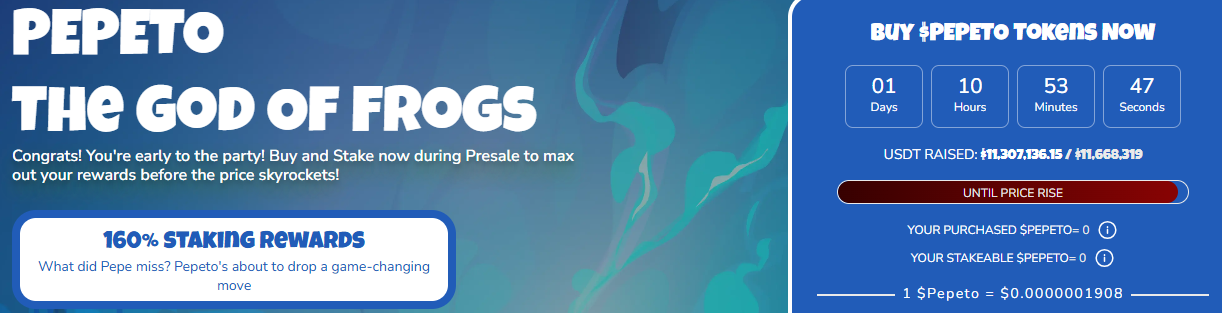
Source: Official Dashboard
Pepeto listing date: what the roadmap says and omits
Item
What is stated
What is missing
Whitepaper roadmap
Five exchange announcements across phases 1 to 3, then a staking platform release in phase 4
Any trading date
Dashboard counter
A countdown to a step up in the entry price
A link to the first trade
X post
A giveaway runs before the exchange debut
The venue and the giveaway close
Staking claim
160% for holders
Period, lock terms and payout source
The dashboard invites buyers to stake during the presale, while the whitepaper places the staking platform last.
Neither explains how accrual lines up with the first trade, which makes the Pepeto listing date the missing input for any valuation work.
Reward Math Pulls Break-Even Below the Sale Level
Staking payouts change a holder's cost basis. A buyer who put $1,000 in at the entry price would hold about 5.24 billion tokens before any yield, and every share of the 160% actually received lowers the level at which that position breaks even.
Read the table row by row: at 50% realized, a position needs only the sale level to gain 50%.
Reward realized
Tokens held
Break-even
Below sale level
Needed for +50%
0%
5.24B
$0.0000001908
0%
$0.0000002862
25%
6.55B
$0.0000001526
20.0%
$0.0000002290
50%
7.86B
$0.0000001272
33.3%
$0.0000001908
100%
10.48B
$0.0000000954
50.0%
$0.0000001431
160%
13.63B
$0.0000000734
61.5%
$0.0000001101
The payout pool sets a second limit:
Equal pools: the whitepaper allocates 30% of supply to the presale and 30% to staking.
Coverage limit: if the full presale allocation were sold and staked, the reserve could fund 100%, not 160%.
Threshold: a 160% payout fits only if 62.5% or less of presale tokens are staked, assuming yield comes only from that reserve.
Timing link: the Pepeto listing date sets how much of any payout can be realized before sellers appear.
The limits interact: the larger the share staked, the smaller the payout per token the reserve can fund, which pulls a realistic break-even back toward the entry price.
Price prediction: the opening zone by timing case
Each case assumes a different Pepeto listing date relative to accrual. Zones run from 10% below to 15% above each break-even level, an editorial assumption that holder cost bases cluster near that line.
Case
Trading starts
Reward realized
Opening zone
A
Before accrual starts
About 0%
$0.000000172 to $0.000000219
B
After partial accrual
About 50%
$0.000000114 to $0.000000146
C
After most payouts
100% or more
$0.0000000859 to $0.000000110
Case A is the primary estimate, because the roadmap puts the staking platform behind the exchange announcements and no payout schedule is public.
Case B is the main downside if the Pepeto listing date falls well after rewards begin. Case C would need a long gap. An opening above $0.000000219 would need new demand rather than cost-basis support.
A step up in the entry price before trading would not change existing break-evens, but late buyers would start from a higher base, so the zones fit them less well.
Bottom Line: Timing Sets the Cost Basis
Until the Pepeto listing date is named, every estimate here rests on how much of the 160% reaches holders first.
Three signals would narrow the range: a named venue and day, published staking terms covering period and payout source, and the next step up on the dashboard.
Without them, Case A stays the working estimate and the other cases show how far the opening could slip. Each zone is an assumption-based estimate, not a promise.
Disclaimer:This article is for informational and educational purposes only and should not be taken as financial or investment advice. Crypto markets are volatile, and details such as roles, plans, or figures mentioned here can change over time. Readers should do their own research before making any decisions based on this content.