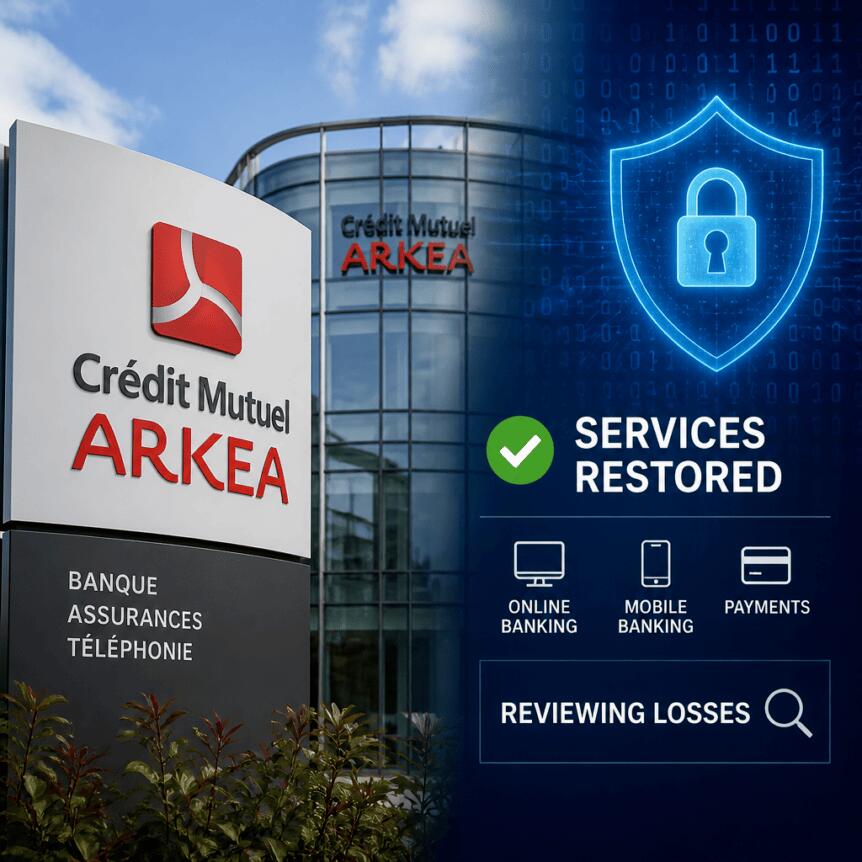
French banking group Crédit Mutuel Arkéa said that nearly all services were restored on Wednesday after a cyberattack that appears to have started with the suspected theft of funds from the b
French banking group Crédit Mutuel Arkéa said that nearly all services were restored on Wednesday after a cyberattack that appears to have started with the suspected theft of funds from the bank itself. The disruption delayed some transfers, but Arkéa said customer money was not affected.
Arkéa’s disclosure also pointed to how the incident likely unfolded: attackers gained access through a third-party service provider rather than its online banking subsidiary Fortuneo. Blockchain sleuthing that initially surfaced through reports about suspicious crypto withdrawals later helped identify Arkéa as the likely victim.
Key takeaways
- Arkéa reported that “nearly all operations” resumed on Wednesday after security checks and new safeguards.
- The bank said customer funds were unaffected, while certain transfers were delayed.
- Arkéa indicated the compromise came via an external service provider, not Fortuneo.
- Investigators linked the alleged theft to withdrawals involving major crypto exchanges, including Kraken and Crypto.com.
- Arkéa said it is still assessing financial impact and that any claimed theft totals are only approximate.
Bank services return after suspected internal theft
According to Arkéa, operations resumed after the bank completed security checks and implemented additional protections. The company framed the incident as an operational disruption rather than a breach of customer balances, adding that delays affected certain transfers.
The bank did not claim immediate clarity on the full financial outcome. It stated that it was “still assessing its financial impact,” signaling that the incident could remain an ongoing recovery and investigation effort.
Arkéa also addressed circulating estimates of the theft. In a machine translation of the bank’s remarks, it said it was not validating specific figures and could only confirm the approximate scale of the losses.
How the attackers reportedly entered the system
A key detail in Arkéa’s account is the apparent entry point. The bank said attackers accessed its environment through a service provider, not through its online banking subsidiary Fortuneo.
That distinction matters for how the incident is understood and prevented. If a third-party connection was the initial vector, the remediation focus typically shifts toward supply-chain security, third-party access controls, and the monitoring of credentials and sessions across vendor systems—areas that often fall outside a bank’s most visible internal security boundary.
Onchain investigations: withdrawals first, victim later
The trail that led to Arkéa’s identification appears to have begun outside traditional incident reporting. According to the article’s account, withdrawals from crypto exchanges were the first sign of the suspected theft.
Blockchain analytics firm Bitquery traced withdrawals from accounts at Kraken, Crypto.com and OKX before the victim was publicly named. The involvement of multiple exchanges helped investigators build a more complete flow of funds after the suspected initial transfer out of the bank.
Later, ZachXBT—an onchain investigator—reported large suspicious withdrawals while trying to estimate the theft amount. The coverage describes him flagging more than $106 million in suspicious withdrawals on Monday and then raising his estimate above $133 million on Tuesday after identifying an additional $27 million. On Wednesday, ZachXBT’s report identified Arkéa as the potential victim.
Once Arkéa confirmed that an attack had occurred, it also indicated that some funds had been frozen and that recovery efforts were underway—an acknowledgment that not all stolen value may remain accessible to attackers.
Arkéa’s account intersects with how exchanges described their own involvement. The article says Kraken and Crypto.com previously told Cointelegraph that they had restricted accounts or blocked funds connected to the suspected theft, while maintaining that their platforms remained secure.
That distinction is important for users and market participants. Restricting accounts tied to suspicious activity is one of the most common operational responses exchanges can take during theft investigations, and it differs from any claim that the exchange itself was breached.
For investors watching the broader impact of high-profile hacks, the combination of bank-side freezes and exchange-side restrictions often signals that a recovery process is already in motion—even when the ultimate total loss is still uncertain.
Still, Arkéa’s caution about not confirming reported totals underscores a tension common to these cases: blockchain investigators may identify flows and make approximate estimates quickly, while victims typically need time to reconcile internal ledgers and confirm the definitive scale of the loss.
What to watch next
With Arkéa still assessing financial impact and attackers’ entry via a third-party service provider now central to the narrative, the next developments to follow are the bank’s final loss assessment, the extent of funds recovered or frozen, and any further disclosures about which provider link was compromised and what controls were strengthened to prevent recurrence.
This article was originally published as Crédit Mutuel Arkéa Restores Services After Cyberattack, Reviews Losses on Crypto Breaking News – your trusted source for crypto news, Bitcoin news, and blockchain updates.