TLDR Brent crude surged beyond 2% to reach $106.72 per barrel while WTI hit $102.15 amid intensifying Houthi strikes targeting Saudi infrastructure Saudi officials confirmed closure of the Ea
TLDR
- Brent crude surged beyond 2% to reach $106.72 per barrel while WTI hit $102.15 amid intensifying Houthi strikes targeting Saudi infrastructure
- Saudi officials confirmed closure of the East-West pipeline following drone attacks, jeopardizing approximately 4% of worldwide crude supply
- Yemen’s Houthi forces captured Perim island, strengthening their strategic position over the Bab el-Mandeb waterway
- Diplomatic discussions between Iran and Gulf states regarding Strait of Hormuz security have been delayed without a new date
- Crude benchmarks have jumped more than 8% in seven days, breaking the $100 threshold for the first time in seven months
Oil prices jumped over 2% during Monday’s trading session following an intensified campaign of Houthi assaults targeting Saudi Arabia’s energy installations and additional strikes affecting vessels in the Strait of Hormuz, heightening concerns about potential supply shortfalls throughout the Middle Eastern region.
Brent crude benchmark futures advanced to $106.72 per barrel, as West Texas Intermediate crude climbed to $102.15. During the morning trading hours, Brent briefly touched $108.41.
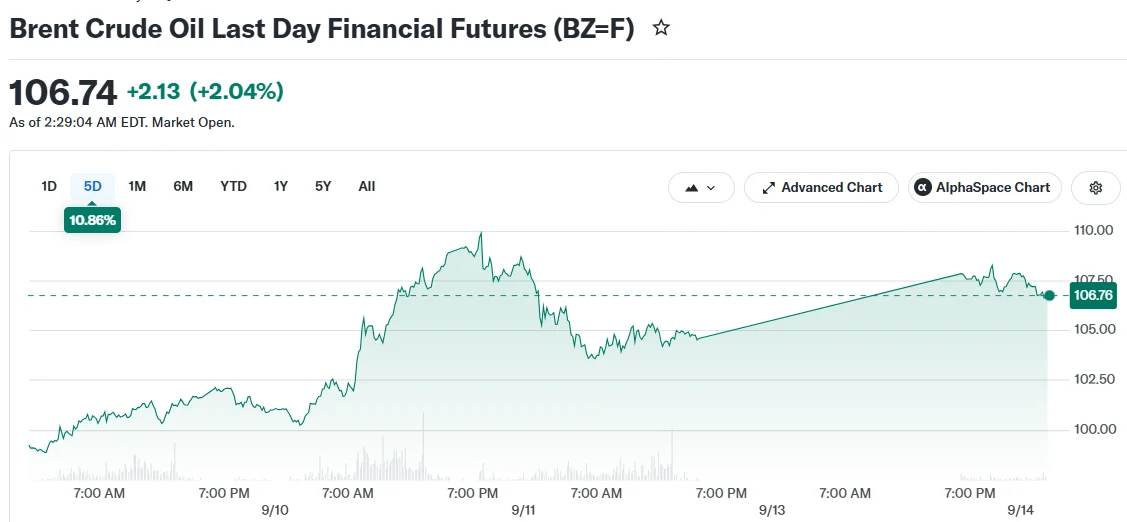 Brent Crude Oil Last Day Financial Futures (BZ=F)
Critical Saudi Export Pipeline Taken Offline
Saudi officials announced the closure of the kingdom’s East-West pipeline system following a coordinated drone assault by Houthi forces. This pipeline serves as a vital backup transport corridor, enabling Saudi Arabia to ship crude oil bypassing the Strait of Hormuz entirely.
Following the pipeline’s closure, Yanbu port facilities maintain sufficient stored crude reserves to sustain only five to seven days of continued shipments, three sources with knowledge of Saudi petroleum operations revealed.
The operational halt endangers approximately 4% of worldwide oil production. Energy analysts at ANZ cautioned that the kingdom has effectively lost its western shipping alternative should circumstances deteriorate further in the Strait of Hormuz region.
Saudi government broadcasters published video evidence depicting structural damage to residential buildings and a religious site in Jazan province’s southern region following a Houthi offensive. The militant group additionally reported conducting strikes against a Saudi military installation in an adjacent province.
Strategic Strait Faces Growing Risk
Houthi fighters established control over Perim island this past Friday, positioning themselves to conduct operations targeting vessels traversing the Bab el-Mandeb strait. This narrow waterway has been transporting between 4% and 5% of global petroleum output in recent weeks.
During the previous seven days, the organization conducted attacks on numerous high-value Saudi installations including an Aramco processing facility, petroleum storage terminals, aviation facilities, and commercial shipping. A tanker navigating the Strait of Hormuz sustained a projectile impact during the weekend, triggering an onboard blaze that necessitated complete crew evacuation.
Iranian authorities confirmed one fatality and four injured personnel aboard an Iranian-flagged commercial ship struck in waters adjacent to the Iranian coastline.
Commodity analysts from ING observed that the assaults on Saudi energy assets represented a significant intensification, although the complete scope of infrastructure damage and the anticipated duration of the pipeline’s inoperability remained undetermined.
Regional Security Discussions Shelved
Oman’s Foreign Minister Badr Albusaidi announced Sunday that scheduled negotiations between Iranian representatives and Gulf state officials addressing Strait of Hormuz security concerns had been postponed from Monday’s planned date. Energy markets had been monitoring these diplomatic efforts closely, as optimism surrounding potential dialogue had temporarily moderated crude’s upward trajectory during the prior week.
Following the indefinite postponement of these discussions, supply vulnerability through the Hormuz corridor is anticipated to remain heightened. Petroleum volumes transiting the strategic waterway had already declined substantially from pre-conflict levels following renewed tensions between Washington and Tehran during August.
Crude benchmarks have climbed more than 8% throughout the previous week, surpassing the $100 per barrel mark for the first occasion since July.
The post Crude Surges Past $106 as Yemen Rebels Strike Saudi Infrastructure, Threatening Global Supply appeared first on Blockonomi.