Crypto accounting platform Cryptio asked its customers on November 26, 2026 to revoke every API key they had connected to the service, including read-only keys. According to the company, an a
Crypto accounting platform Cryptio asked its customers on November 26, 2026 to revoke every API key they had connected to the service, including read-only keys. According to the company, an attacker used modern AI tools to break into the platform and tried to move crypto assets with customer credentials stored there. All detected attempts failed, and no loss was known at the time of the notice. Cryptio serves businesses, but the attack route concerns anyone who links a tax tool, a portfolio tracker or a trading bot to their exchange via API. It is the second incident of this kind within two weeks.
Key points at a glance
- Cryptio, November 26: According to the company, an unauthorised party tried to move crypto assets using customer credentials. So far, no money appears to have left.
- What customers should do: revoke every API key directly at the exchange or custodian, read-only keys included, and connect no new ones for now.
- Not an isolated case: about two weeks earlier, portfolio service Coinigy reported an incident in which exchange API keys may have been exposed.
- The number behind it: according to DefiLlama, three of the four largest crypto hacks in November ran through stolen keys, together almost 40 percent of the month's losses.
- Your move: review the key list at every exchange, delete anything unused and give no service withdrawal rights.
Cryptio connects companies' accounts at exchanges and custodians to their bookkeeping. The software reads transactions through API keys and reconciles them with blockchain data; it does not hold customer funds. By its own account, the firm serves more than 400 companies in over 30 countries and raised $45 million in a funding round in March, Blockonomi reports.
In its notice of November 26, Cryptio writes that an unauthorised party gained access using so-called frontier AI tools and attempted to move digital assets with part of the stored credentials. A spokesperson confirmed this to the trade outlet crypto.news. All detected attempts failed, and no loss was identified. The company took the platform offline, hired an independent firm to investigate and had the affected credentials blocked together with exchanges and custodians. Security firm SlowMist lists the case in its hack database as a third-party attack with no damage.
Customers are told to revoke each key where it was issued, in the account at the exchange or custodian. Cryptio names Fireblocks, BitGo, Anchorage, Copper, Coinbase, Kraken and Binance as examples. They should then check their accounts for unapproved transfers, withdrawals and changed users or permissions, and connect new keys only once Cryptio gives the all-clear. The last sentence of the notice matters too: Cryptio says it never asks for wallet details or API keys. Anyone who receives such a request is dealing with phishing, as The Defiant also notes.
Why the Cryptio attack matters even without a Cryptio account
Cryptio is a tool for businesses, yet the attack route is an everyday one. Many investors connect their exchange via API to a tax tool, a portfolio tracker or a trading bot. Each of these services then stores a key that matches your exchange account. If the service is attacked, that key can end up with the attacker without you having done anything wrong. Which tax tools and trackers exist and how they pull your data is shown in our comparison of crypto tax tools and portfolio trackers.
What counts is what the key is allowed to do. A read-only key shows balance and history. That is unpleasant, because it tells attackers whom a targeted phishing attempt is worth, but it moves no money. A key with trading rights allows orders, and through them balances can be shifted into thinly traded pairs that the attacker controls. A key with withdrawal rights is as good as access to the account. Cryptio itself says its accounting connection is designed around read interfaces; mainly at risk are customers who stored keys with write permissions.
Cryptio is not an isolated case. About two weeks earlier, according to Blockonomi, portfolio service Coinigy reported an incident in which its customers' exchange API keys may have been exposed; there too, the keys had to be revoked at the exchange. On November 16, exchange Lighter lost about $10.4 million after a trader's API key was reconstructed from insecure signing code. The details are in our report Lighter halts withdrawals: leaked API key costs $10.4 million.
Crypto hacks in November 2026: stolen keys are the costliest attack type
How large a role keys now play is shown by the hack database of DefiLlama. For November 2026 it lists, up to November 29 at 00:40 UTC, 45 cases with combined losses of $100.6 million. For 13 of them it gives a stolen or exposed key as the attack route, whether server, validator, API or private key. These 13 cases account for $39.2 million, or 39 percent of the losses. Among the four largest cases of the month, three fall into this group: Wagyu with $13.5 million, Chainflip with $12.0 million and Lighter with $10.4 million. Only for the largest case, Brazilian exchange Mercado Bitcoin with $40 million, is the cause still open according to DefiLlama.
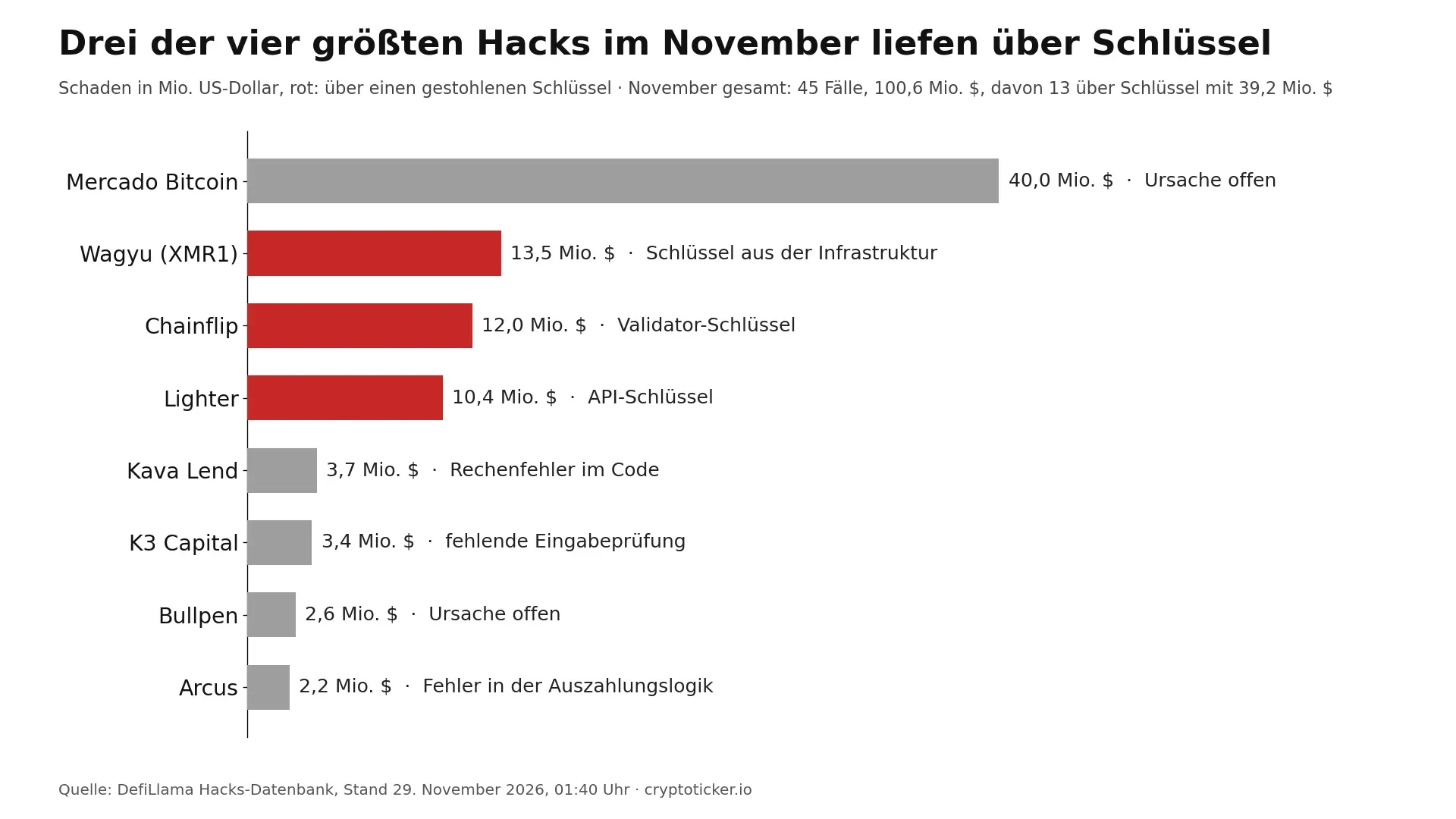
Source: DefiLlama hacks database, as of November 29, 2026, 00:40 UTC
For retail investors this holds bad news and good news. The bad news: the damage often occurs at a service you do not control. The good news: what a stolen key can do is up to you, through the permissions you give it and the number of keys that exist at all. Which permissions a tax tool really needs is explained in our guide API keys at crypto exchanges. If you do not trade your coins actively, you are better off not leaving them on the exchange anyway; which providers are authorised in the EU under MiCA is shown in our comparison of regulated crypto exchanges.
How to protect your exchange API keys from misuse
What happened: On November 26, 2026, crypto accounting firm Cryptio reported an attack in which an unauthorised party tried to move crypto assets using customers' stored API credentials. All detected attempts failed, the company has identified no loss, and the platform is offline (as of November 29).
Are you affected? Directly only if you or your company connected Cryptio to an exchange or custodian. In that case you revoke all keys, read-only keys included. For everyone else, the case is a reason to go through your own keys at tax tools, trackers and bots. DefiLlama's hack database lists no retail tax tool for November (as of November 29, 00:40 UTC).
- Open the key list: At every exchange you use, go to the API management in your account's security section and note which service holds which key.
- Revoke old keys: Delete every key you cannot assign to a service or whose service you no longer use, and do it at the exchange, because deleting it only in the tool leaves it valid.
- Cut permissions: Give tax tools and trackers read-only rights, trading rights only to a bot that needs them, and withdrawal rights to no service at all.
- IP binding and withdrawal allowlist: Where the exchange offers it, bind new keys to the service's IP addresses and switch on the allowlist for withdrawal addresses.
- Check the account, ignore requests: Review withdrawals, new devices and changed permissions over the past 30 days, and never hand over an API key in response to an email or message.
The basics of safe storage are explained in our guide how to store crypto safely, and the right devices are compared in our hardware wallet comparison.
What is still open after the Cryptio attack
Cryptio has not yet said how the attacker got in or which permissions the misused credentials had. The investigation is ongoing, there is no all-clear, and customers are told not to reconnect any keys until further notice. If you need a tax tool only once a year, you can do without a permanent key altogether: the large exchanges offer the transaction history as a CSV export, and tax tools can import it too. That way no service holds a key you might forget.

Illustration, AI-generated
We collect all current cases with status and protection advice in our Hacks & Security section. We will update this article as soon as Cryptio discloses the attack route.
(As of November 29, 2026. This article is not investment advice. Prices and fee structures change; check the terms with the provider before you buy.)