Crypto Clarity Act: How Did Regulators Fill the Gap So Quickly? When the Crypto Clarity Act failed to advance in the Senate on September 17, it looked like a genuine setback for digital asset
Crypto Clarity Act: How Did Regulators Fill the Gap So Quickly?
When the Crypto Clarity Act failed to advance in the Senate on September 17, it looked like a genuine setback for digital asset policy in the US.
But rather than waiting on Congress, the SEC, CFTC, and Federal Reserve spent the following nine days quietly rolling out a wave of regulatory actions that, taken together, cover much of the same ground the stalled legislation was supposed to address.
Here's a detailed timeline of exactly what happened, sourced directly from each agency's own filings.
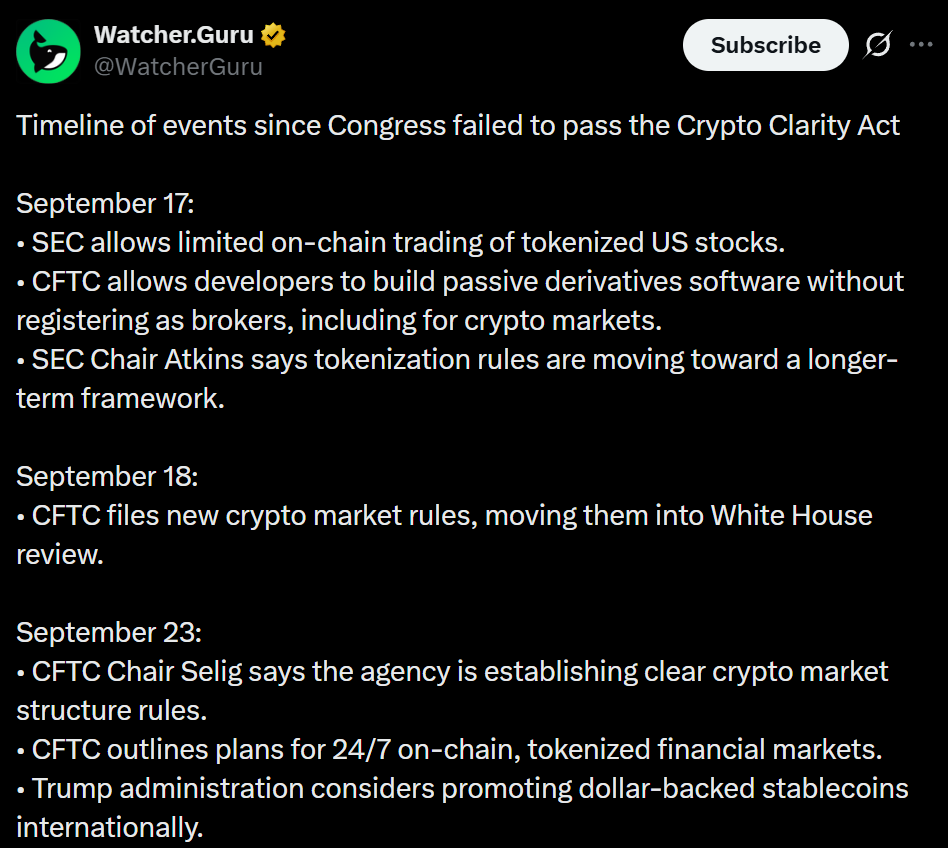
Source: X Post
September 17: The Same Day the Bill Failed
Remarkably, the SEC and CFTC didn't wait even a single day. Per theSEC's official press release, the Commission issued its "Innovation Exemption" on September 17, granting temporary, conditional relief allowing tokenized securities venues to trade tokenized National Market System stocks using permissioned automated market makers.
The exemption comes with real guardrails, including limits on trading volume, requirements that tokenized stock carry the same rights as traditional shares, and mandatory smart contract audits, and is set to expire five years after publication.
That same day,CFTC staff issued a no-action position for providers of passive software, meaning developers building trading software won't face enforcement for failing to register as introducing brokers, so long as they meet specified conditions tied to how their software connects users to registered futures commission merchants and exchanges.
September 18 Through 22: CFTC Rules Move Forward
Following that opening burst, the CFTC continued advancing new crypto market rules, sending them into White House review as part of the standard federal rulemaking process.
Then on September 22, CFTC Chairman Michael Selig delivered keynote remarks at the U.S. Treasury Market Conference, laying out the agency's broader vision.
Selig was explicit that markets are "increasingly operating across digital infrastructure through blockchain technology, stablecoins, and other innovative technologies," and that the Commission is preparing for "mass tokenization" and a shift toward 24/7, continuous trading, while stressing that this transition won't apply a one-size-fits-all approach across every asset class.
September 23 to 24: SEC Commissioner Weighs In, Fed Proposes Stablecoin Rules
On September 23, SEC Commissioner Hester Peirce delivered remarks at SIFMA's Digital Assets Conference, continuing the Commission's public engagement on how existing securities laws apply to crypto markets even without new legislation in place.
The next day, September 24, brought one of the more concrete developments in this whole stretch.
TheFederal Reserve Board officially requested public comment on two separate proposals establishing a regulatory framework for Board-supervised payment stablecoin issuers under the GENIUS Act.
The first proposal would require stablecoin issuers to fully back their tokens with reserve assets like short-term Treasury bills, alongside standardized capital and risk management requirements.
The second would create a formal application process for banks seeking to issue payment stablecoins, including business plan submissions and an appeals process.
Governor Barr also issued a separate statement alongside the release, and the public comment period runs 60 days after Federal Register publication.
What This Timeline Actually Shows
Here's a simplified breakdown of the full sequence:
Date
Agency
Action
Sept 17
SEC
Innovation Exemption for tokenized stock trading
Sept 17
CFTC
No-action position for passive software providers
Sept 18-22
CFTC
New crypto market rules sent to White House review
Sept 22
CFTC
Chairman Selig outlines tokenization and 24/7 trading vision
Sept 23
SEC
Commissioner Peirce speaks on crypto securities law application.
Sept 24
Federal Reserve
Proposes GENIUS Act stablecoin issuer framework
Why Agencies Are Moving Without Congress
The pattern here is fairly clear: regulators aren't waiting for the Crypto Clarity Act to pass before acting within their existing statutory authority.
The SEC's own press release described its tokenized stock exemption as bringing "America's capital markets into the digital age" using powers the agency already has.
Selig's speech echoed a similar theme, describing a commission actively "right-sizing regulation" and providing "clear rules of the road" rather than waiting on new statutes.
This approach mirrors what regulators have signaled before: legislation would still provide more durable, comprehensive rules than agency action alone, but in its absence, existing authority is clearly being used aggressively to fill the gap.
What Comes Next
Each of these actions still has a real process ahead of it. The SEC's Innovation Exemption is open for public comment before any permanent framework emerges.
The Fed's stablecoin proposals have a 60-day comment window once published in the Federal Register.
And the CFTC's broader rules remain under White House review before finalization.
None of this replaces what comprehensive legislation could deliver, but it does mean market participants have real, usable frameworks to work with in the meantime.
Conclusion
In the nine days following the Crypto Clarity Act's failed Senate vote, the SEC, CFTC, and Federal Reserve moved with genuine speed, issuing a tokenized stock trading exemption, a software developer safe harbor, a Treasury market speech laying out a 24/7 trading vision, and a formal stablecoin issuer rulemaking proposal, all without a single new law passing.
Whether Congress eventually revisits the legislation or these agency actions become the de facto framework for crypto markets going forward is still an open question, but for now, regulators have made clear they're not waiting around to find out.
Disclaimer
This article is for educational and informational purposes only and should not be considered financial or investment advice. Always conduct your own research before making investment decisions.
