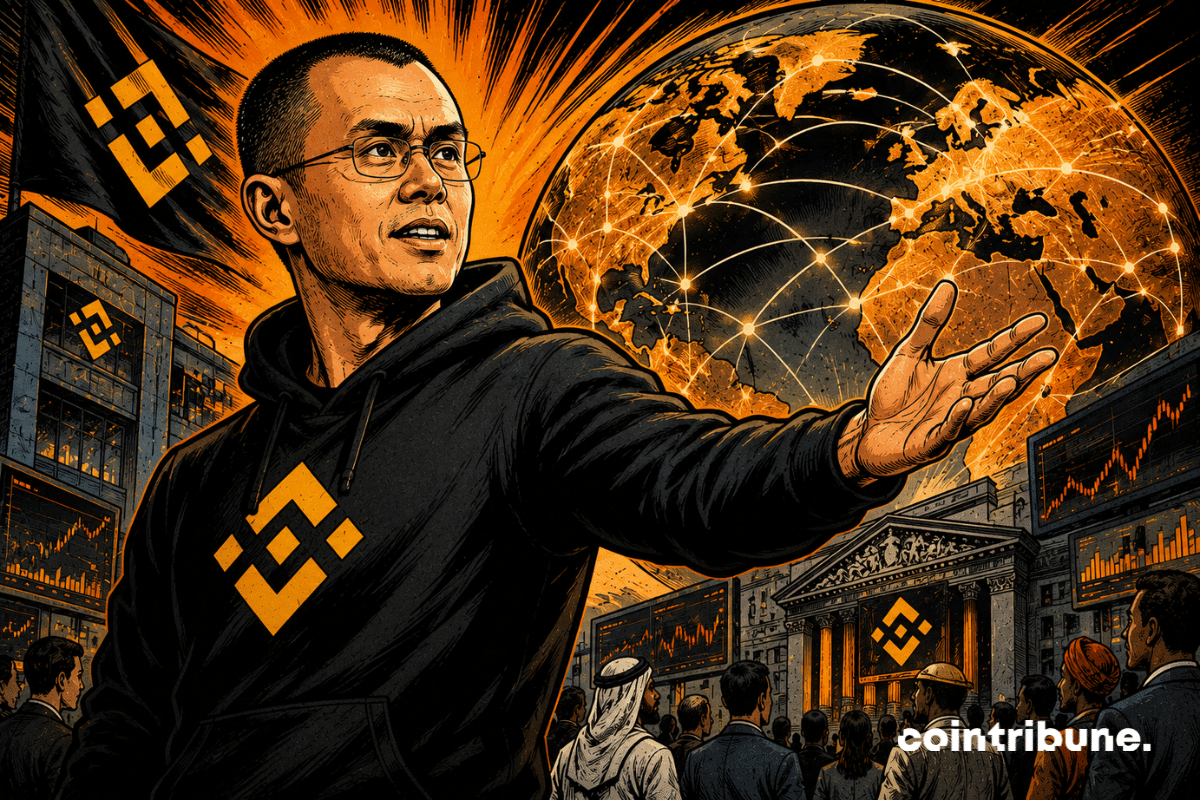
Changpeng Zhao wants to push states to tokenize their shares to make them accessible to investors worldwide. The founder of Binance envisions a market where national stablecoins, stock securi
Changpeng Zhao wants to push states to tokenize their shares to make them accessible to investors worldwide. The founder of Binance envisions a market where national stablecoins, stock securities, and crypto liquidity would circulate on the same infrastructures. But regulation could slow down this ambition.
In brief
- CZ calls on countries to tokenize their shares and currencies.
- Binance aims to become a major liquidity center for these assets.
- Regulatory challenges in Europe could slow this project.
CZ wants to globalize access to shares
Changpeng Zhao calls on governments to issue their own stablecoins and put their shares on the blockchain. According to him, this combination could attract foreign capital while increasing the digital use of national currencies. This vision already accompanies the rise of tokenized shares.
The principle seems simple. A traditional share can be represented by a crypto or a token tradable on a blockchain infrastructure. An investor situated abroad could then gain exposure to a company without going through all the usual international brokerage channels.
For CZ, countries would benefit from allowing global buyers rather than limiting their stock markets to a local audience. Tokenization would thus transform a national financial center into a market potentially open twenty-four hours a day.
Your 1st cryptos with BinanceThis link uses an affiliate program.Binance bets on its crypto market depth
CZ’s bet also relies on the power of the Binance crypto platform. Once their assets are tokenized, issuers would need a platform able to gather a large number of buyers and sellers. Binance naturally hopes to become this global entry point.
Liquidity represents a major challenge. Tokenizing a share is not enough. It is also necessary to guarantee deep order books, consistent prices, and sufficiently fast execution. Without this, the token risks remaining a little-used digital copy of the original asset.
Binance Research estimates that tokenized assets could attract hundreds of millions of additional users in the coming years. Large financial institutions are also accelerating their own tokenization projects, especially on bonds, funds, and shares.
The promise includes, however, a gray area. Some tokens really represent securities held in reserve. Others only replicate their price through a synthetic product. In this second case, the investor does not necessarily have the same rights as a classic shareholder.
They may notably be deprived of voting rights, direct access to dividends, or clear protection in case of issuer bankruptcy. The quality of asset custody, audits, and the reimbursement mechanism thus become essential.
Tokenization can simplify access, but it also adds new intermediaries. An investor must trust the token issuer, the share custodian, and the trading platform. The blockchain or crypto does not automatically remove these risks.
MiCA threatens Binance’s European ambition
The main obstacle remains regulatory. Binance is still seeking a MiCA authorization allowing it to operate in the 27 European Union countries. Its application, filed with the Greek regulator, could be rejected before the transitional period ends.
The crypto platform, however, disputes the idea of an already decided refusal. It claims to have worked with authorities for eighteen months and to have received no unfavorable official notification. Without a license by July, its access to the European market would nevertheless become seriously compromised.
This uncertainty shows the limit of CZ’s project. Global liquidity cannot bypass national rules on securities, anti-money laundering, or investor protection. Shares remain among the most closely monitored financial instruments.
CZ sees tokenization as a way to open stock exchanges to those who do not have access. But Binance will first have to convince regulators that it can manage this openness without weakening investors’ rights. Facing the pressures of MiCA, its global ambition now depends less on technology than on authorizations obtained country by country.