A delisting tends to catch you at the moment you are not paying attention. The announcement sits in an exchange's support section, often months before the day it starts to matter, and anyone
A delisting tends to catch you at the moment you are not paying attention. The announcement sits in an exchange's support section, often months before the day it starts to matter, and anyone who does not actively trade the token in question never sees it at all. That is exactly where the problem lies. Between the announcement and the point at which your balance is stuck, some venues leave three months, others half a year. Anyone who does nothing in that window ends up with a holding they can neither sell nor move.
This piece explains what happens technically, step by step, in a delisting, which of the restrictions lift again and which are final, and how to tell whether the process affects you. The running example is the exchange OKX, because two withdrawal deadlines are currently sitting side by side there and both are documented by the exchange itself. The mechanics are not confined to OKX, though: Kraken, Binance and most other platforms clear out trading pairs on the same pattern, and only the menu labels and the length of the deadlines differ.
The practical conclusion comes first, so it is clear where this is heading. The one action that protects you in every case is moving the tokens to a wallet whose keys you hold yourself. Everything else depends on how generously an exchange handles the remaining balance, and you have no say in that. Which devices are suitable and what they cost is set out in our hardware wallet comparison.
A Delisting Is Not One Date but a Chain of Four Restrictions
Read the notice “Exchange XY removes token Z” and you picture a single cut-off date. There are in fact four, and at larger exchanges they lie weeks or months apart. In the order in which they take effect: first the deposit freeze, then the trading halt for the individual pairs, after that the withdrawal freeze, and finally the transfer of the residual balance into a part of the account where the token stays visible but nothing can be done with it.
There is a reason for this sequencing. An exchange first wants to stop any more of a token it is trying to shed from coming in. Only then does it close trading, and withdrawals stay open longest because they are the one function through which users can rescue their own holdings. For you as a holder, that means the date in the headline is almost never the date that counts.
The distinction between delisting individual trading pairs and removing a token matters here. Exchanges frequently strike out single pairs first, the euro quotation for instance, and leave the quotation against a dollar stablecoin standing. Only once the last pair falls is the token effectively dead on that platform. Watch the name of the token and not the list of pairs, and you will miss the first stage.
The Deposit Freeze Cuts Off New Supply and Leaves the Holding Untouched
The first restriction is the mildest. From a set point in time, the exchange no longer accepts deposits of the token. Send some anyway and you risk the coins arriving on the blockchain without ever being credited to the account. Whether an exchange manually retrieves such late arrivals is a matter of goodwill, not a commitment.
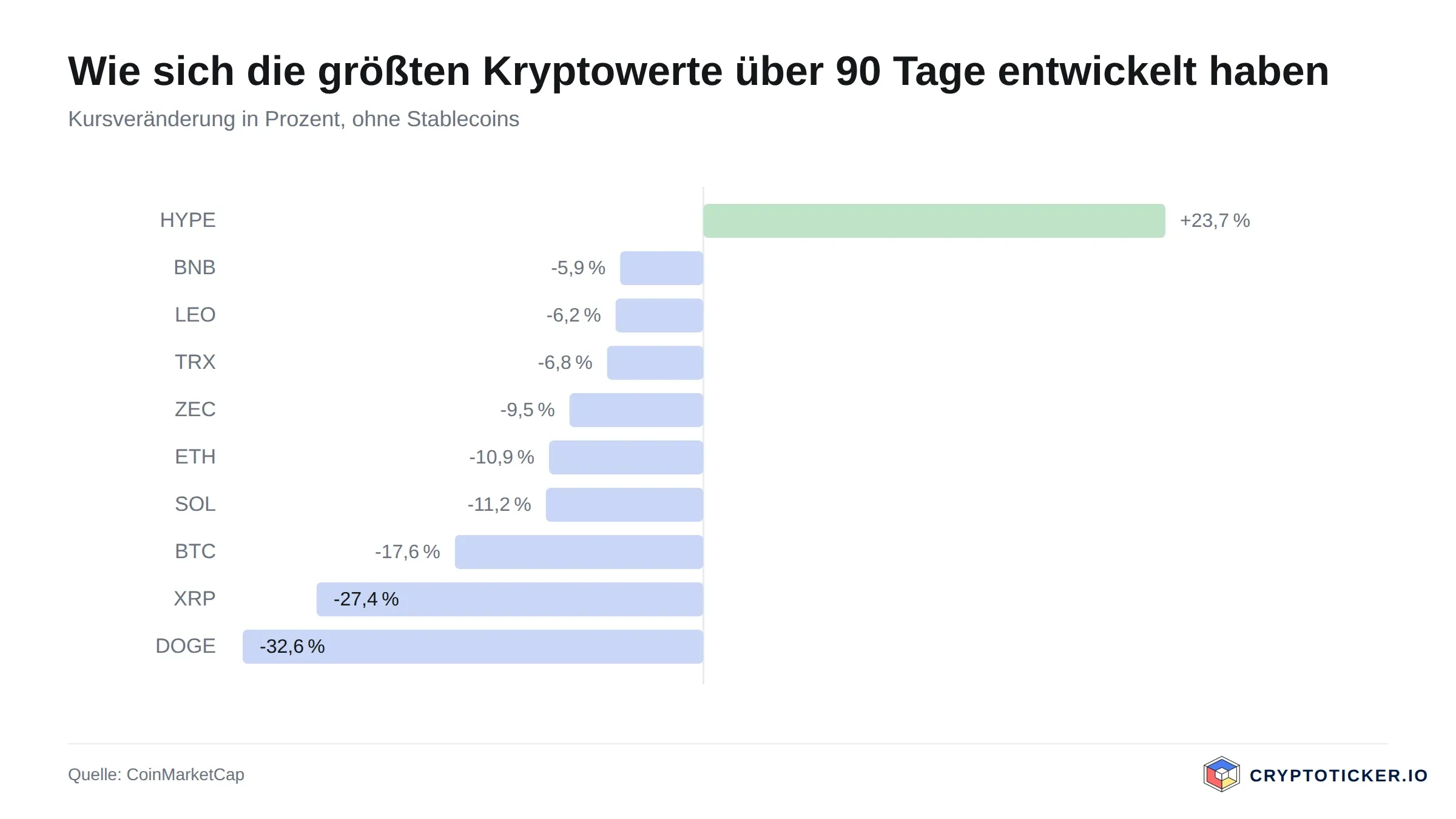
The largest crypto assets over 90 days, based on CoinMarketCap data
Nothing changes for the existing holding during this phase. You can still trade, still withdraw, still hold. Anyone who notices the deposit freeze has caught the most comfortable moment to react, because every route is still open. In practice almost nobody notices it, because hardly anyone happens to be depositing at that point.
One detail is easily overlooked: the deposit freeze also covers transfers from another address of your own. If you have spread a holding across several platforms and want to pull it together to sell, you can no longer do so on the departing exchange after this date. Consolidation has to happen somewhere else.
The second restriction is the one most users notice, because it is visible: the trading pair disappears from the interface. From that moment you can no longer sell the token on that exchange. It remains in the account, it still has a market value at other venues, but the platform holding it no longer offers any way to exchange it for euros or for a stablecoin.
This is where many holders misjudge the situation. The balance is shown in the account, a price sits next to it, and the conclusion drawn is that everything is fine. The value displayed comes from external price sources, though, and says nothing about whether you can still realise it on that platform. Selling now happens elsewhere, and the token has to get there first.
Usually the ancillary functions are switched off along with spot trading, such as the instant-buy screen or the built-in convert function that turns balances over without an order book. At OKX this happened for the tokens MAJOR and J on May 30, 2026 at 08:00 UTC, several days before the actual trading halt. Anyone relying on the convert function as an emergency exit was therefore left without it before the delisting date itself.
The Withdrawal Deadline Is the Date Where It Genuinely Gets Expensive
The third restriction is the decisive one. From the stated moment, the affected tokens can no longer be transferred to an external address. That ends the last opportunity to get the holding to safety under your own steam. Everything that happens afterwards rests with the exchange.
Exchanges typically set this deadline generously, measured against the other dates. At OKX, in the case of MAJOR and J, close to twelve weeks separate the trading halt from the end of withdrawals. That generosity is precisely why the deadline passes so often: establish in June that you have until August and the matter gets set aside and never picked up again.
What happens to the holding once the deadline expires varies from exchange to exchange and is frequently left unsettled. Some platforms announce that they will convert residual balances into a stablecoin at a later point. Others say nothing and leave the position where it is. What both variants have in common is that you do not control them. This cut-off date is therefore the only one in the whole sequence that has to go in your calendar.
Untradable Assets: Where the Balance Ends Up Once Withdrawals Close
After the final restriction, most exchanges run a tidying-up step. The holding is moved out of the trading account into a general balance account and kept there under a heading of its own. OKX describes this process verbatim in both current announcements: once the delisting is complete, holdings would be consolidated into the funding account, withdrawal and transfer functions would be temporarily suspended in the meantime, and the holdings would then be found under “Assets > Untradable assets”.
The term describes the state fairly precisely. The token has not gone, it is visible in the account, it is still assigned to you. What it is not is tradable, and whether and when a withdrawal becomes possible again is not stated in the announcement. Anyone who ends up in this category has not suffered a total loss, but does hold a position with no way out, and someone else determines how long that lasts.
This very vagueness is why the deadline deserves to be taken seriously. A phrase such as “temporarily suspended” with no end date is not a commitment anyone could enforce, and it does not serve as a plan. The plan is to act beforehand.
The OKX Case: Two Withdrawal Deadlines, August 26 and November 7, 2026
Two delisting processes are currently running in parallel at OKX, and together they show neatly how far apart the dates can lie. Both announcements are publicly available in the exchange's European support section. They are relevant for German users because OKX operates its own regulated trading platform here, whose launch we covered in June 2025.
MAJOR and J: Withdrawals Until August 26, 2026, 08:00 UTC
For the two tokens MAJOR and J, OKX announced the sequence on May 26, 2026. Deposits were stopped the same day at 08:00 UTC. The ancillary functions fell on May 30. The MAJOR pair against the dollar disappeared on June 2 between 08:00 and 10:00 UTC, with MAJOR/USDT and J/USDT following on June 5 in the same window. Withdrawals close, according to the announcement, on August 26, 2026 at 08:00 UTC.
What stands out in this case is the gap: almost twelve weeks separate the last trading day in early June from the end of withdrawals, during which the token sat visible in the account with nothing happening. MAJOR comes out of the Telegram gaming scene and was distributed correspondingly widely among retail holders. That is the group most likely to miss a deadline, because the amounts are small and the effort of withdrawing looks large by comparison.
GODS, PRCL and DUCK: Withdrawals Until November 7, 2026
The second process was announced on August 7, 2026 and covers eight trading pairs. On August 14, GODS against the dollar, PRCL against the dollar, PRCL/USDC, PRCL/EUR and DUCK against the dollar all fell, each between 08:00 and 10:00 UTC. The remaining pairs GODS/USDT, PRCL/USDT and DUCK/USDT are scheduled, according to the announcement, for this Monday, August 17, 2026, in the same window.
One detail of that list is particularly relevant for European users: PRCL/EUR is a euro pair, which is exactly the quotation through which German users would typically have traded the token. On the end of withdrawals there is a discrepancy in the sources that should not be smoothed over here: the OKX announcement gives November 7, 2026 at 08:00 UTC, while the trade publications crypto.news and EconoTimes give 16:00 UTC on the same day. Anyone affected should plan around the earlier of the two times rather than the later one.
What OKX intends to do with the residual balances of GODS, PRCL and DUCK after that date is not stated in the announcement. Transferring the practice of other exchanges to this case would be speculation, so the point simply stands as open. We have collected an overview of further cut-off dates in this period in our roundup of crypto exchange deadlines; the OKX date of August 26 is not yet included there.
Open Orders and Trading Bots Are Cleared Away, but Not Instantly
One aspect that gets lost in the fuss around the deadlines concerns everything running automatically on the exchange. Open limit orders on an affected pair are cancelled by the system when the delisting takes effect. OKX notes in both announcements that this cancellation can take one to three business days. During that time the balance reserved for the order is blocked and unavailable for a withdrawal.
Much the same applies to trading bots. According to the exchange, bots on affected pairs are closed down in stages on the respective delisting day between 07:00 and 08:00 UTC. Anyone wanting to avoid fees or unfavourable execution prices in an automatic closure should end them manually beforehand. That is the exchange's own advice, and it makes sense: a forced closure takes no account of how thin the order book has become in the final hours before a delisting.
For planning purposes: anyone starting a withdrawal shortly before the deadline should factor in the cancellation period. Three business days ahead of the cut-off is not an over-cautious buffer where open orders are involved, but the range the exchange itself quotes.
Self-Custody or Another Exchange: Where the Token Belongs After the Withdrawal
Once the decision to withdraw is made, two destinations remain. The first is a wallet whose keys you control yourself. The advantage is that no further deadline hangs over you: a token in self-custody cannot be delisted by anyone. The price is responsibility for the recovery words, and that price is real.
The second destination is another exchange that still lists the token. That makes sense if you intend to sell anyway, since self-custody would only be a waypoint. Before transferring, it is worth checking whether the target platform accepts the token at all and whether it supports the same network. A token often exists on several blockchains, and a deposit over the wrong network is the most expensive way to meet a deadline. If the choice is to fall on a platform supervised in Europe, the supervision question already narrows the field considerably.
What applies in both cases: check the withdrawal fee before you start. On small residual balances it can consume the value of the position. That is a legitimate reason to forgo a withdrawal, but it should be a deliberate decision and not the result of putting things off.
What a Delisting Triggers for Tax Purposes and What It Does Not
For German investors the tax treatment is usually simpler than feared. Cryptocurrencies count as other economic assets, and gains from a sale fall under private disposal transactions in section 23 EStG. After a holding period of more than one year a gain is tax-free; below that, an exemption threshold of 1,000 euros per calendar year applies to all private disposal transactions taken together.
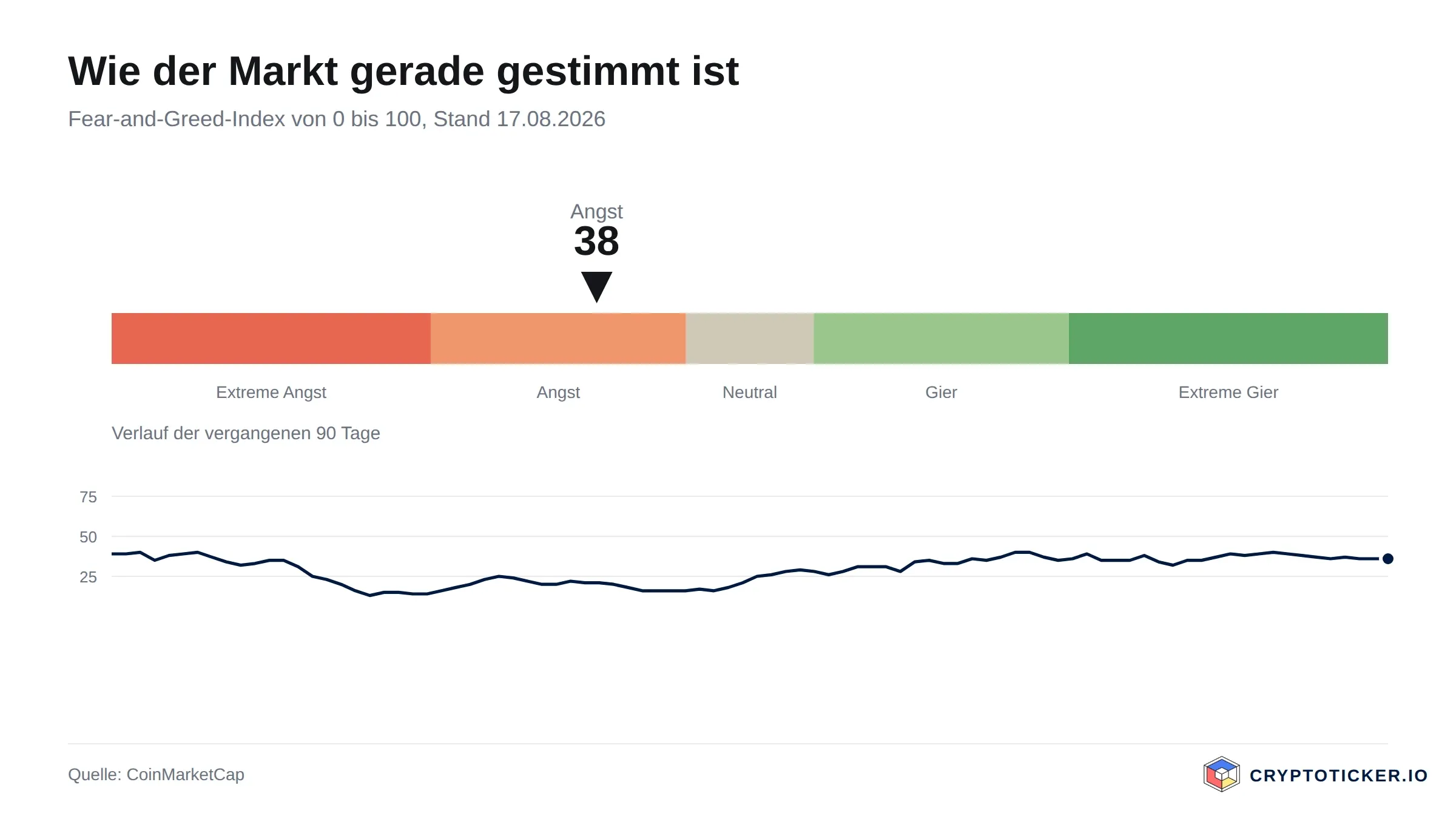
The Fear and Greed Index places market sentiment between extreme fear and extreme greed
A plain transfer from an exchange to your own wallet is not a sale. No owner changes, no gain arises, and the holding period continues to run unbroken. A delisting on its own therefore triggers nothing. The process only becomes relevant for tax when you sell the token or swap it for another, and that swap counts just as a sale for euros does.
The special case that deserves attention is an exchange converting residual balances into a stablecoin of its own accord after the deadline. In economic terms that is a swap and therefore a disposal, one you neither initiated nor scheduled, and one that nonetheless lands in your tax return. Whether an exchange proceeds that way is a question for the individual announcement; OKX has not commented on the point for the tokens named here. For documenting such events, a portfolio tracker that pulls transactions automatically from the exchange account and records the forced swap with date and price is helpful.
Why the Announcement Almost Never Reaches You
Delistings are made public through the channels an exchange uses anyway: a notice in the announcements section, a post on social media, occasionally an email. A targeted notification of precisely those users who hold the token is not the rule. Anyone who has unsubscribed from an exchange's marketing emails, which many do for good reasons, cuts themselves off from this information too.
There is a language problem on top of that. The announcements appear in English as a rule, and German-language coverage picks them up only when a well-known token is involved or the price reacts sharply. With niche assets, often neither happens. On the two OKX processes described here, our check of the German-language media found no editorial coverage to date.
The consequence is uncomfortable but plain: responsibility for noticing rests with you. That argues for not leaving small residual balances sitting on exchanges in the first place, and it argues for going through account overviews once or twice a year rather than relying on a notification that may never arrive.
The Checklist: How to Find Out Whether a Delisting Affects You
The effort is manageable if you work through it systematically. These points cover the usual cases:
- Open the account overview and look at every position, including those with very small amounts. That is exactly where forgotten holdings sit, and exactly those are the ones running into deadlines.
- Look for a category covering non-tradable balances. At OKX it is called “Untradable assets”, and similar terms apply at other platforms. If anything is listed there, a delisting has already passed you by.
- Open the exchange's announcements section and work through the delisting category. The announcements stay up permanently and name all four dates.
- Check whether the token can still be sold on the platform. If the trading pair is missing, a withdrawal deadline is already running and you then have to find its end date.
- Put the deadline in your calendar, with a reminder at least a week ahead, so that cancellation periods and network delays fit inside it.
- Choose the right network when withdrawing and send a small test amount first, if the position is large enough to justify paying the fee twice.
What a Delisting Says About the Token and What It Does Not
A removal is often read as a verdict on a project. That falls short. Exchanges regularly cite reduced trading volume, insufficient liquidity or a routine review of listing criteria as reasons, and none of these says anything about the technology or the future of the project. OKX points in both announcements to its regular review of listing qualification and to its own delisting policy, without assessing the individual tokens.
What a delisting does say something about is tradability. When a token disappears from several larger platforms, the exit gets more expensive with every removal, because the remaining order books grow thinner. That is a statement about your ability to sell rather than about fair value. For your own assessment, the number of venues still trading it is therefore more useful than the question of why one particular exchange is stepping away.
Just how routine these events have become is clear from a look back over recent weeks. Among others, we reported on the forced liquidation at Kraken, which affected 56 tokens. Delistings are no longer an exceptional case to be dealt with when it arises; they are a recurring event for which a holder needs a routine.
Delisting Deadlines Under Control: What to Take Away
- Go through your account overviews today and look for non-tradable holdings. Anyone holding MAJOR or J at OKX has until August 26, 2026 at 08:00 UTC; for GODS, PRCL and DUCK, withdrawals end on November 7, 2026. For anything you find and want to keep, self-custody is the destination: the hardware wallet comparison shows which device suits which size of holding.
- Decide deliberately for each position between withdrawing and selling, instead of letting the deadline pass. If the token is to stay liquid, it belongs on a platform that still lists it; our overview of regulated crypto exchanges narrows the field to supervised providers.
- Document every forced swap immediately. When an exchange converts residual balances itself, a disposal arises that you did not initiate but that belongs in your tax return. A tool from our comparison of crypto tax software pulls such events automatically from the exchange account.
The two announcements this article rests on are publicly accessible: the OKX notice on MAJOR and J of May 26, 2026 and the OKX notice on GODS, PRCL and DUCK of August 7, 2026. Both give the exact times and the list of affected trading pairs.
(As of August 17, 2026. This article is not investment advice. Prices and fee structures change; check the terms with the provider before you buy.)