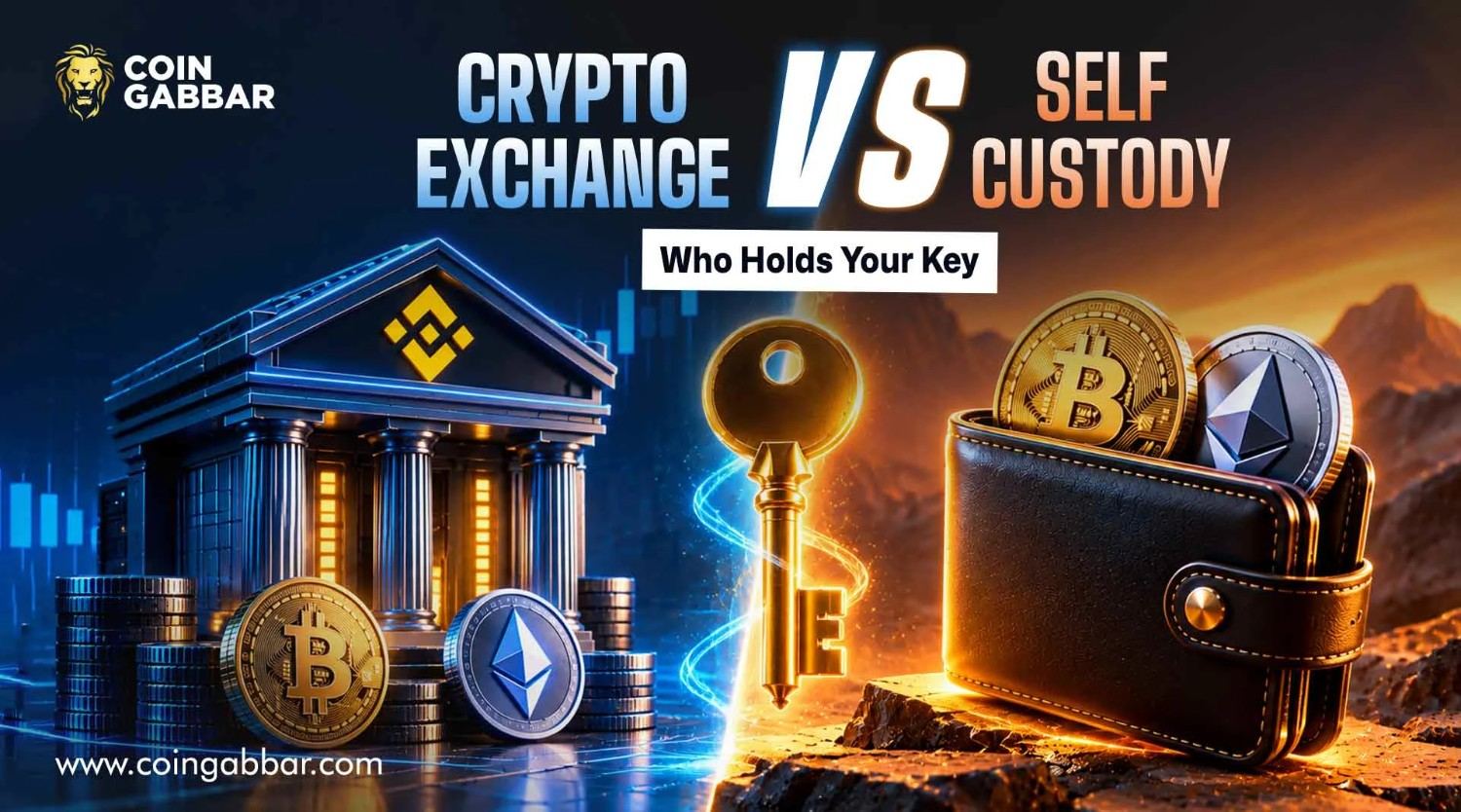
Crypto Exchange vs. Self-Custody: Which Option Keeps Your Coins Safer Most people spend their time picking which coins to buy. Where to keep them matters just as much. The crypto exchange vs.
Crypto Exchange vs. Self-Custody: Which Option Keeps Your Coins Safer
Most people spend their time picking which coins to buy. Where to keep them matters just as much.
The crypto exchange vs. self-custody choice decides who holds the keys, and whoever holds the keys controls the money.
This article compares safety, fees, and control in plain words. It also looks at some recent hacks to show how each option can go wrong.
What Is Crypto Exchange Custody, and How Does It Work?
Exchange custody means that the exchange keeps the private key. A user registers, deposits funds or coins, and is able to view a user balance in the app.
This means that the exchange maintains the majority of coins in cold (offline) wallets and a small number of coins in hot (online) wallets to be able to quickly pay out withdrawals.
Some exchanges also provide proof of reserves to demonstrate that they have the assets to cover their liabilities, although this is not a complete guarantee. In a nutshell, the user has a claim over the exchange, but not the keys.
Advantages and Disadvantages of Exchange Custody
Advantage
This is quick to register, with no complicated applications, and speedy trading.
It resetting a password and seeking assistance when it goes wrong is available.
It's not difficult to make coins to money.
Disadvantage
The data may be lost if it is corrupted.
One failure can affect many users at the same time, and withdrawals may be suspended during an attack
Users must rely on the platform's good health.
What Is Self-Custody, and Why Do Holders Choose It?
Self-custody is when the owner of the assets holds the private keys, which are usually stored in either the software wallet or the hardware wallet. A hardware wallet is a small physical device that keeps those keys offline.
With this option, companies cannot freeze or lend any of the assets. This method is preferred because it provides owners with the ability to control, protect, and remain anonymous.
Key Features of Self-Custody Wallets
Private keys: exclusive possession by the owner.
Seed phrase: a collection of 12 or 24 words allowing the recovery of the crypto wallet.
Wallet types: the options of software wallets, hardware wallets, and multisig systems where more than one permission is necessary.
No intermediaries: transferring the coins without any approval from any platform.
Your own assets: the crypto remains with the owner even when the exchange stops functioning.
Crypto Exchange vs. Self-Custody: Convenience or Control, Which Wins?
There are situations in which neither of the parties involved can claim a victory. Consistency is a strong advantage of exchange transactions performed quickly, making it simple for clients to perform business with their money.
But self-custodianship is better in terms of control; only the person having the coins can transfer their ownership. Therefore, the choice of platform comes down to one central point: is it more advantageous to sacrifice some of the control for the sake of convenience or take that extra effort to be in full control of their coins?
Comparison Table: Exchange Custody vs. Self-Custody
Factor
Exchange Custody
Self-Custody
Key control
Exchange
Holder
Main risk
Hacks, freezes
Lost keys, phishing
Ease of use
Very easy
Takes some learning
Recovery
Support can help
Seed phrase only
Fees
Trading and withdrawal fees
Network fees, wallet cost
Privacy
ID checks (KYC) usually needed
No sign-up needed
Best for
Active traders
Long-term holders
Which Option Keeps Coins Safer?
Both can fail in different ways. The report by TRM indicates that there have been a total of 207 hacks in the first half of 2026, which is more than double the number in the corresponding period in 2025.
Nevertheless, the loss amount decreased to less than $972 million. The report has also shown that approximately 75% of the losses can be attributed to stolen keys, weak custody systems, and weak signing tools, instead of bugs in the code.
On September 24, 2026, Bitget reported that over $350 million was taken from its exchange. The Bybit attack, which took place in 2025, accounted for about 44% of the total $3.4 billion of thefts in that year.
Self-custody can help avoid failures of the exchanges, but hacked wallets and phishing attacks still lead to significant losses.
Hacks, Keys, and Smart Storage Rules
Keep only trading money on an exchange.
Turn on two-factor login and a list of approved withdrawal addresses.
Store long-term coins in a hardware wallet.
Write the seed phrase on paper, never in a photo or a cloud note.
Keep two backups in two safe places.
Never share the seed phrase with anyone, even someone who claims to be support.
Test recovery with a small amount first.
Lost Keys and Phishing: How Self-Custody Risk Appears
With self-custody, the holder carries the load. A lost seed phrase can't be reset, and no support team can bring the coins back.
Family members can also get locked out if the keys are lost along with the owner, so a clear plan for heirs is worth making. Phishing is the other big danger. Fake wallet sites and drainer approvals trick users into signing a harmful request.
In the first half of 2026, CertiK counted about $366 million lost to phishing and about $445 million to hacked wallets. The best habit is to read every prompt before signing.
How to Choose the Safest Way to Hold
The safest choice depends on the amount, the holder's skill, and how long the coins will be held. Small balances for active trading fit an exchange. Larger, long-term balances often fit self-custody, where no company can freeze them.
Fees matter too. Exchanges charge trading and withdrawal costs, while wallets charge network fees. The crypto exchange vs. self-custody choice should fit real habits, not hype.
Who Should Use an Exchange, and Who Should Self-Custody?
Exchange custody suits active traders, new users, and anyone who wants easy support and a quick way to cash out.
Self-custody suits long-term holders, larger balances, and people who care about privacy and can handle backups with care. Many holders end up using both.
Smart Rules for a Hybrid Setup With Exchange and Wallet
A hybrid setup keeps a small trading balance on an exchange and moves the rest to a wallet. That way, one failure can't wipe out everything.
Set a limit for exchange balances and move extra funds out.
Use a hardware wallet for the long-term share.
Send a small test transfer before any big withdrawal.
Check wallet addresses twice and bookmark official sites.
Review the setup after every major hack headline.
Fees Compared: Where the Costs Really Hide
Exchanges make money from trading fees, price spreads, and withdrawal charges. Some also charge extra for card purchases or fast transfers. Self-custody has no platform fee for holding, but every transfer pays a network fee, and a hardware wallet costs money upfront.
For someone who trades often, exchange fees add up fast. For a long-term holder, a one-time wallet cost is often cheaper over the years.
Final Thoughts
The crypto exchange vs. self-custody debate has no single winner. Exchanges bring ease and support but carry custody risk, as recent hacks show.
Self-custody wallets bring control but need careful backups and sharp eyes when signing. Holders who match the method to the amount, their skill, and their goal, and who keep a smart hybrid setup, are better protected.
Disclaimer
This article is for informational purposes only and is not financial, investment, tax, or legal advice. Crypto is risky, and losses can be total. Each product carries its own separate risks. Hack numbers and exchange details change fast, so readers should confirm current facts with official sources before moving funds. Past events do not predict future results.