Crypto venture capital is splitting in two, and the funds caught in the middle may not survive. As limited partners demand proof of real product-market fit from portfolio companies, general p
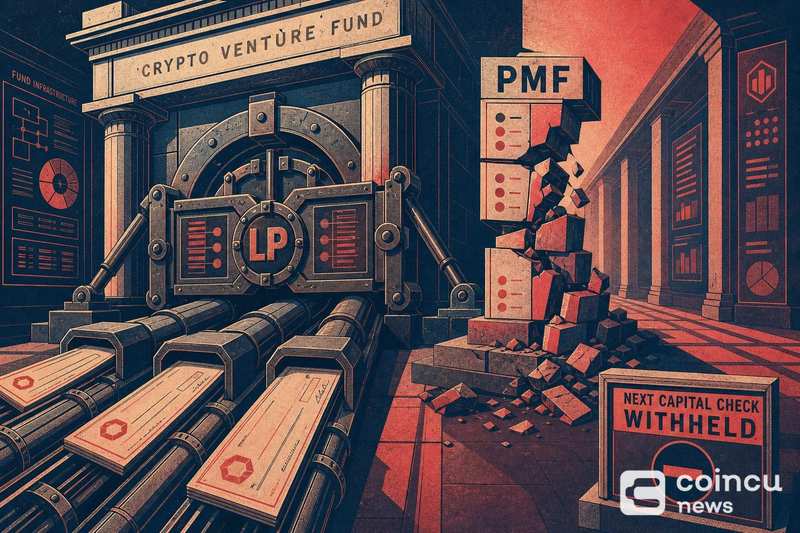
Crypto venture capital is splitting in two, and the funds caught in the middle may not survive. As limited partners demand proof of real product-market fit from portfolio companies, general partners running mid-sized generalist funds face a fundraising wall that narrative alone cannot climb.
The argument comes from Dara, a partner at Hashgraph Ventures, who laid out what he calls a "bifurcation thesis" for the industry. Large platform funds and niche boutique vehicles under $50 million will thrive, he argues, while mid-sized generalist funds in the $100 million to $500 million range are structurally weakening.
Source: @dara_venture on X
The data supports the pressure. Investors allocated roughly $1.1 billion to just eight new crypto venture funds in Q1 2026, the fewest number of new funds in a quarter since Q3 2020. That is not a market welcoming generalists with open arms.
Why Crypto GPs Are Entering a Mid-Life Crisis
A general partner, or GP, manages a venture fund. A limited partner, or LP, provides the capital. The relationship is simple in theory: the GP deploys, the LP waits for returns. In practice, the reckoning arrives when the GP comes back asking for a second or third fund.
During the 2021 bull market, fundraising was fast and loose. Token listings, quick markups, and narrative momentum were enough to attract capital. That era is over. LPs now ask harder questions about realizations, repeatable customer demand, and whether portfolio companies can survive without the next token cycle.
For funds launched between 2021 and 2023, the clock is ticking. They are past the deployment phase but have not yet produced the liquidity events that justify a successor fund. This is the "mid-life crisis": too mature to coast on potential, too early to show definitive outcomes.
The pressure is compounded by competition from outside crypto. KPMG reported that global venture capital investment surged to a record $330.9 billion in Q1 2026, driven largely by AI-focused megadeals. Institutional allocators have alternatives, and crypto GPs must compete for attention against sectors with clearer near-term revenue stories.
Galaxy Research noted that increased interest in artificial intelligence, spot ETFs, and digital asset treasury companies is competing directly with crypto venture funds for institutional capital. When an LP can get crypto exposure through a publicly traded vehicle like Strategy's treasury operations, the case for locking up capital in a blind pool weakens.
What Product-Market Fit Actually Looks Like in Crypto
Product-market fit, or PMF, is the point where a startup's product meets genuine, sustained demand. In crypto, this concept is routinely distorted by token incentives, airdrop campaigns, and speculative usage spikes that evaporate once rewards dry up.
A protocol with 500,000 wallets and zero retention after an airdrop does not have PMF. A DeFi application generating consistent fee revenue from repeat users does. The distinction matters enormously when LPs evaluate whether a GP's portfolio contains real businesses or temporary experiments.
Vanity Metrics Versus Durable Signals
Vanity metrics include total value locked inflated by mercenary capital, social media follower counts, and one-time transaction volumes around token launches. These numbers look impressive in pitch decks but collapse under scrutiny.
Durable PMF signals vary by category. For infrastructure projects, developer stickiness and integration counts matter. For DeFi protocols, recurring fee generation and organic volume without incentive programs are key. For consumer crypto applications, weekly active user retention beyond 30 days is a meaningful bar.
The data shows how stark the divide has become. According to CryptoRank, Series C+ capital surged 1,020% year-over-year and 320% quarter-over-quarter in Q1 2026. Late-stage companies with proven traction are absorbing a disproportionate share of capital.
Meanwhile, Seed and Pre-Seed rounds together aggregated only $304.9 million, representing just 5.2% of total VC capital in the quarter. Early-stage bets are not disappearing, but the capital is concentrating in fewer, higher-conviction positions rather than spreading across dozens of speculative plays.
Why LPs Won't Re-Up Without Portfolio-Level Proof
Crypto startups raised $4.56 billion across 217 deals in Q1 2026. The headline number looks healthy, but the distribution underneath reveals concentration, not broad recovery.
$4.56 billion across 217 deals Q1 2026 funding looked healthy in aggregate, but the story underneath was concentration rather than broad recovery.
April 2026 made the selectivity even clearer. Funding fell to $659 million across 63 deals, the lowest monthly figure in nearly two years.
$659 million across 63 deals The April drop supports the article's argument that capital is flowing into fewer convictions, leaving weaker middle-tier players exposed.
LPs evaluating whether to commit to a GP's next fund are looking at portfolio quality with fresh skepticism. A fund that deployed into 30 projects but can point to only one or two with credible paths to liquidity looks undisciplined. The question is no longer "did you deploy into interesting narratives?" but "did any of your companies find real users who pay or stay?"
Paper gains from token markups no longer satisfy sophisticated allocators. An unrealized 10x on a token that trades $50,000 in daily volume is not a return; it is a number on a spreadsheet. LPs want to see realized distributions, or at minimum, portfolio companies with revenue trajectories that justify current valuations.
What LP Diligence Looks Like Now
Institutional LPs evaluating crypto fund re-ups are increasingly asking for cohort-level retention data from portfolio companies, fee revenue breakdowns separated from token incentive subsidies, and realistic liquidity timelines that account for token lockups and thin secondary markets.
They also want to understand whether the GP has a repeatable underwriting edge. Did the fund's winners come from a systematic sourcing process, or were they lucky bets in a rising market? The answer determines whether the next fund can replicate performance or whether the track record was a product of cycle timing.
Galaxy Research data underscores this: with average new crypto fund size falling to roughly $125 million and median rising to roughly $55 million, the market itself is signaling that smaller, more focused vehicles are what LPs are willing to back. The middle is hollowing out.
What Crypto Funds Must Change to Earn the Next Check
The path forward for mid-sized GPs requires a fundamental shift in portfolio construction. Instead of deploying across 25 to 40 companies to maximize optionality, funds need concentrated portfolios of 10 to 15 positions where the GP can provide meaningful operational support.
Reserve strategy matters more than it did during the spray-and-pray era. Holding back 40% to 50% of the fund for follow-on investments into companies that demonstrate genuine PMF signals allows GPs to double down on winners rather than spreading capital thinly across an entire vintage.
Operational support is becoming a differentiator. Funds that can help portfolio companies with go-to-market execution, hiring, regulatory navigation, and business development have a tangible value proposition beyond capital. In a market where crypto companies are pursuing public market listings, the ability to guide founders through that process adds real value.
Reporting discipline is the final piece. GPs who proactively share granular portfolio data with LPs, including honest assessments of which companies are struggling, build trust that generic quarterly letters cannot. Transparent communication about timelines and proof points resets LP expectations before they become grievances during re-up conversations.
According to the Hashgraph Ventures analysis, mid-sized players may have roughly 36 months to adapt, though that estimate is a forward-looking projection rather than an independently verified figure. Dara's view is that five to ten mid-sized crypto funds could liquidate or convert within two years, though this remains an unconfirmed forecast.
The firms that will earn the next LP check are the ones building portfolios where PMF is measurable, not promised. In a market where institutions like Bitmine Immersion Technologies hold billions in crypto assets as an alternative to fund commitments, venture GPs must offer something that passive exposure cannot: active value creation backed by evidence.
FAQ: Crypto Venture PMF and LP Fundraising
What is the difference between a GP and an LP in crypto venture capital?
A GP (general partner) manages the fund, makes investment decisions, and earns management fees and carry. An LP (limited partner) provides the capital, has no say in individual deals, and expects returns over a fund's lifecycle, typically seven to ten years.
What does product-market fit mean for a crypto startup?
PMF means the startup's product has found sustained, organic demand from real users. In crypto, this is measured through retention rates, recurring fee revenue, and usage patterns that persist after token incentives end, not through headline metrics like total wallets created or one-time transaction spikes.
Why are LPs hesitant to commit to new crypto venture funds?
LPs face more attractive alternatives, including AI-focused venture funds, spot Bitcoin ETFs, and publicly traded digital asset companies. Crypto venture funds must now compete on demonstrated portfolio quality rather than market narrative, and many mid-cycle funds have not yet produced the realized returns needed to justify a successor vehicle.
Disclaimer: This article is for informational purposes only and does not constitute financial or investment advice. Cryptocurrency and digital asset markets carry significant risk. Always do your own research before making decisions.
The post Crypto GPs' Mid-Life Crisis: Without PMF, There Is No LP's Next Check was initially published on Coincu.