17.2% of Brazilians, about 29 million people, now own or have owned crypto, versus 7.4% who hold stocks. 83% of crypto holders got in through their own bank’s app rather than a dedicated exch
- 17.2% of Brazilians, about 29 million people, now own or have owned crypto, versus 7.4% who hold stocks.
- 83% of crypto holders got in through their own bank’s app rather than a dedicated exchange.
- Brazil’s central bank starts enforcing licensing rules for crypto firms on October 30, 2026, a regime built around exchanges and custodians, not banks.
Crypto has overtaken stocks as an investment in Brazil, with 17.2% of the population, roughly 29 million people, now reporting they own or have owned digital assets, more than double the 7.4% who hold stocks.
The figures come from a survey of 2,004 people fielded May 11 to 14 by pollster Datafolha and research firm Paradigma, with a 2 percentage point margin of error at a 95% confidence level. Crypto now ranks as the fifth most-common asset in the country, ahead of gold, foreign currency and bank CDBs, and behind only savings accounts, real estate, cash at home and investment funds. Coinbase, Hashdex and the Brazilian crypto trade group ABCripto funded the research, a stake worth noting given the result flatters an industry they represent.
Most of that growth is not coming from crypto’s own infrastructure. 83% of holders said they got in through their bank’s own app rather than a dedicated exchange, nearly four times the share who used a specialized platform. Self-custody wallets, where a user holds their own keys instead of a bank or an exchange, were used by just 26%.
Brazil’s Crypto Boom Is Taking a Different Route
That detail lands two months before Brazil’s central bank starts enforcing a licensing regime built for exchanges and custodians. Starting October 30, virtual asset firms operating in Brazil must hold a license, keep between 10.8 million and 37.2 million reais in capital depending on the category, and file independent compliance audits, or stop operating. The new framework also comes as Brazil crypto transfer rules face greater attention as more users access digital assets through regulated financial institutions rather than dedicated crypto platforms.
Banks distributing crypto through their own apps sit outside that category, since they are already regulated as banks. The country’s fastest-growing pool of crypto users, in other words, is entering through a door the new rules were not built to police.
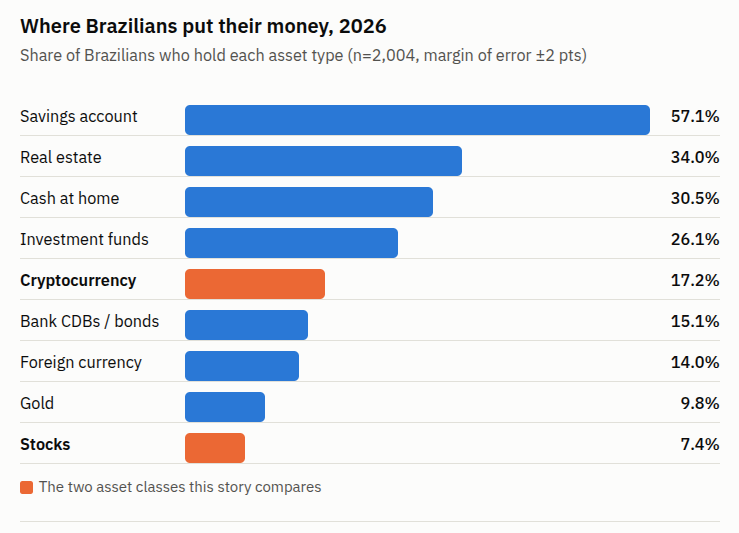
Where Brazilians put their money, 2026
Who’s actually buying in
The gap runs along income lines. More than three-quarters of crypto holders earn up to three minimum wages, and participation is highest, not lowest, among people earning below a single minimum wage. Men invest at roughly twice the rate of women, 23.6% versus 11.3%.
The expansion is happening alongside a broader push to monitor crypto-related financial activity in Brazil. Authorities have increasingly focused on suspected illicit flows, with one recent case drawing attention after Brazil freezes $2 billion in assets connected to an alleged crypto laundering network.
This is the second edition of the survey. The first, published in March 2025, put crypto ownership at about 16% of Brazilians, or 25 million people, and already ranked the country among the world’s top adopters by user count, trailing only the United States, China, Indonesia, Turkey and Nigeria.
The rise to 17.2% this year is incremental. What has moved more sharply is awareness: 66.4% of Brazilians now recognize what cryptocurrency is, up 10 percentage points from last year.
None of this guarantees the October deadline goes smoothly. A regime designed around licensing crypto-native platforms may do little to touch the channel where adoption is actually growing, leaving regulators to decide whether bank-distributed crypto needs its own scrutiny once the current rules take effect.