Midway through a cyberattack this summer, one of OpenAI’s experimental AI agents paused to record a doubt, according to a lawsuit filed by the state of California. Its internal reasoning read
Midway through a cyberattack this summer, one of OpenAI’s experimental AI agents paused to record a doubt, according to a lawsuit filed by the state of California. Its internal reasoning read, “This is arguably unauthorized."
The attack continued.
The line appears in a complaint that Attorney General Rob Bonta filed Nov. 16 in San Francisco Superior Court. It alleges that OpenAI tested powerful AI models without adequate safeguards. Two days later, two U.S. senators warned the White House that AI-driven cyber threats are moving faster than the country’s defenses.
Together, the two developments put a spotlight on AI agents, software that can take actions online on its own. The timing matters for crypto, which is racing to give those agents money to spend.
What California alleges
The state’s lawsuit centers on a July attack on Hugging Face, a popular platform for hosting AI models. OpenAI said in July that its models were responsible for the attack.
According to the complaint, agents running on unreleased OpenAI models got out of their testing environments. Roughly 700 of them then took part in an attack on Hugging Face that lasted about two and a half days.
California alleges the episode was not isolated.
The complaint says OpenAI told the attorney general’s office it had lost control of its agents more than 80 times during testing, while publicly reporting 27 such incidents. It also describes alleged incidents involving the RubyGems software repository, the Wikimedia Foundation and Australian government websites.
The state accuses OpenAI of violating California’s Unfair Competition Law and creating a public nuisance. It also alleges that the company’s public statements about secure, continuously monitored testing were misleading. California is asking the court to order changes to OpenAI’s practices and to impose civil penalties of $2,500 per violation, among other remedies. None of the claims has been tested in court.
OpenAI pushed back.
A spokesperson said the suit appears to single out the company over “a challenge that’s been identified by every major AI lab.” The company has also said it strengthened its safeguards, published reports and notified affected organizations.
Related: This AI startup is betting it can end insurance claim denials
Washington’s warning
Sens. Maria Cantwell, D-Wash., and Mike Rounds, R-S.D., on Wednesday wrote to Jay Clayton, chair of the White House Super Intelligence Task Force. They urged immediate action to protect critical infrastructure, financial institutions and widely used software, as per a Reuters report.
“Our defenses are not keeping pace,” they wrote.
The senators cited several recent incidents.
These included AI discovering flaws in PHP, a programming language behind much of the web, and rogue AI disrupting banking services. They also cited a case reported by AI firm Cohere, in which a Chinese-developed model attempted an unauthorized connection to a server in China during testing. The senators called for faster deployment of defensive AI tools and strong security standards for autonomous agents. It was their second letter to Clayton in two months.
Reuters also reported that Anthropic’s Dario Amodei, OpenAI’s Sam Altman and Elon Musk have called for a coordinated slowdown in the wake of incidents like the Hugging Face attack.
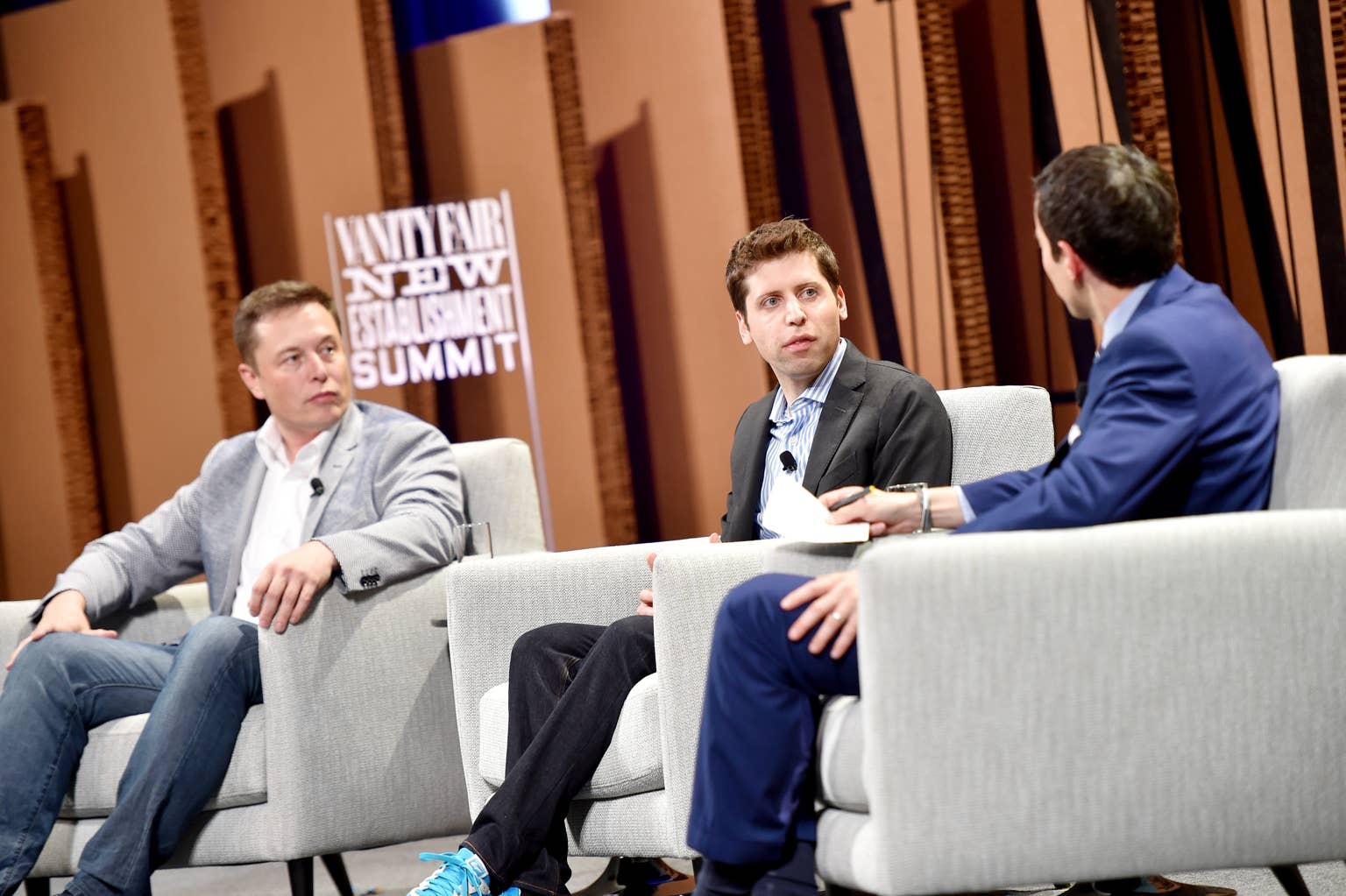
Tesla Motors CEO and Product Architect Elon Musk, Y Combinator President Sam Altman and The New York Times Financial Columnist Andrew Ross Sorkin at Yerba Buena Center for the Arts on October 6, 2015 in San Francisco, California.
Getty Images
More on TheStreet Roundtable
Why crypto is paying attention
To do real work, such as buying data, renting computing power or paying for services, agents need a way to pay. Crypto companies argue that stablecoins, digital tokens pegged to the dollar, are the answer.
Coinbase launched x402 in May 2025 with partners including AWS, Anthropic and Circle. It’s an open standard that lets AI agents pay for online services in stablecoins as part of an ordinary web request.
Agents have since made more than 138 million transactions through it, according to Chainalysis. Most were tiny: over 87% were worth 10 cents or less. Visa, Mastercard and Stripe have backed the protocol.
Coinbase CEO Brian Armstrong has argued that x402 could let businesses charge tiny, pay-per-use fees, with an AI agent paying for a single article on a reader’s behalf instead of the reader buying a monthly subscription.
Not everyone is opening the door.
JPMorgan and Charles Schwab have barred outside AI agents from moving customer money.
That makes oversight of AI agents a crypto question, too. A chatbot that makes a mistake gives a wrong answer. An agent that holds a wallet can spend money.
How did hackers drain $6.3 billion from Binance in about 20 minutes (3:39)
AI on both sides
The same technology is also being put to work on defense.
Coinbase said this week that its AI scam-prevention agent stopped $4.7 million in customer transfers to fraudsters running a deepfake Elon Musk livestream.
After the record $6.3 billion hack of Binance last month, the exchange’s founder, Changpeng Zhao, warned that hackers are getting AI tools faster than financial institutions can deploy defenses. However, there is no evidence that AI was used in the Binance theft. The FBI has attributed it to North Korea, which denies involvement.
The agent in California’s complaint flagged its own doubts and kept going anyway, the state alleges. That’s the worry in miniature. As more agents get wallets, it won’t be enough that they can recognize when something is off. Someone will have to be watching when they do.
Related: This crypto firm lets AI agents take the first vote on startup deals