Crypto Regulation News: Who's Leading the 2026 Policy Race? Today's biggest crypto regulation news isn't coming out of Washington — it's coming from five other capitals. While the U.S. Senate
Crypto Regulation News: Who's Leading the 2026 Policy Race?
Today's biggest crypto regulation news isn't coming out of Washington — it's coming from five other capitals. While the U.S. Senate debates procedural details of a single bill, Japan, South Korea, Russia, Hong Kong, and Vietnam have all rewritten, passed, or scheduled final votes on their own digital asset frameworks this month alone.
Crypto Regulation News: Who's Moving While the US Waits
Japan's National Diet passed its FIEA amendment on July 15, 2026, formally reclassifying blockchain as a financial instrument rather than a payment tool. A companion tax reform plan would cut crypto gains taxation from as high as 55% down to a flat 20.315%, aligning digital assets with how Japan taxes stocks — though the tax cut itself is targeted for 2028, pending final legislative steps.
South Korea moved the same week. On July 15, the Ministry of Economy and Finance unveiled a National Asset Basic Act that would replace a 76-year-old property law and formally classify virtual asset as part of the state's roughly $940 billion asset portfolio. The plan includes tokenizing state-owned real estate through security tokens, piloting tokenized government bonds tied to the Bank of Korea's CBDC in 2027, and advancing rules for won-pegged stablecoins and spot crypto ETFs.
Hong Kong continues building out regulated stablecoin and real-world-asset infrastructure under its existing licensing regime, while Singapore keeps expanding institutional licensing pathways for digital asset firms — both jurisdictions positioning themselves as steady, predictable venues while other markets debate.
Russia, meanwhile, is entering its final legislative stretch. The State Duma is scheduled to hold second and third readings of its "On Digital Currency and Digital Rights" bill on July 22, 2026 — tomorrow, at time of writing. If passed, the law formally recognizes crypto as property, permits its use in cross-border trade settlements, and brings exchanges and brokers under Bank of Russia licensing, with main provisions taking effect September 1, 2026.
Vietnam Crypto Fines: New Penalties Take Effect September 1
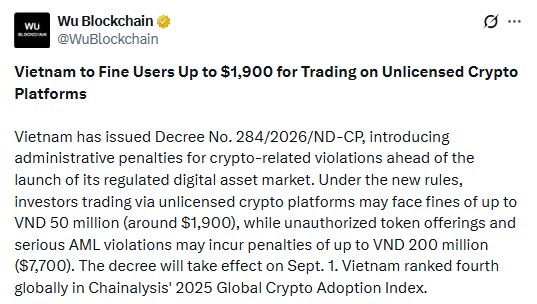
Vietnam has taken a different but related step: enforcement. The country issued Decree No. 284/2026/ND-CP, introducing administrative penalties ahead of the launch of its regulated digital asset market. Under the decree, investors trading through unlicensed digital asset platforms face fines up to VND 50 million (about $1,900), while unauthorized token offerings and serious anti-money-laundering violations carry penalties up to VND 200 million (about $7,700). The rules take effect September 1, 2026.
 Source: X(formerly Twitter)
The timing matters. Vietnam ranked fourth globally in Chainalysis' 2025 Global Crypto Adoption Index, reflecting one of the highest levels of grassroots Web3 usage anywhere in the world. Rather than restrict that activity outright, the decree pairs penalties with the buildup of a licensed, regulated market — funneling existing demand toward approved platforms instead of banning it.
CLARITY Act Status: Where the US Actually Stands
Against that backdrop, the U.S. picture looks noticeably slower. The Digital Asset Market Clarity Act passed the House 294–134 back in July 2025 and cleared the Senate Banking Committee 15–9 in May 2026, but a full Senate floor vote still hasn't happened. Senate Majority Leader John Thune has pledged a vote before the August recess, with the week of July 20 discussed as the target — but a merged Senate draft released this month dropped an ethics provision that several Democratic senators have called a precondition for their support, and passage still requires roughly seven Democratic crossover votes to clear the 60-vote threshold.
Senator Cynthia Lummis has framed the stakes bluntly, warning that missing this window could push the next realistic legislative opportunity to 2030 — a delay measured in years while Japan, Korea, Russia, and Vietnam are all moving in months.
Conclusion
Today's crypto regulation news is turning into a story of pace as much as policy. Japan cut through decades-old classification rules in a single Diet session. Korea folded crypto into a $940 billion national asset framework. Russia finalizes its property-status law this week. Vietnam is enforcing its way toward a licensed market. The CLARITY Act, meanwhile, is still waiting on a floor vote — with the clock now measured in days before the August recess.
Disclaimer
This article is for informational purposes only and does not constitute financial, legal, or investment advice. All legislative details, dates, and figures are based on publicly available government and legal sources as of July 21, 2026, and are subject to change as legislation and rulemaking continue. Always consult official government sources for the latest regulatory status in any jurisdiction.