
Markets6 min read
Why Is Akedo (AKE) Price Surging Today?
Akedo (AKE) traded at $0.02554098 on September 15, 2026, up 64.66% over the prior 24 hours, yet the move sits against on-chain data showing that 99.8% of AKE transfer volume was flagged as wa
Solana has just activated on its mainnet an upgrade awaited for several months. The maximum size of a transaction increases from 1,232 to 4,096 bytes, or 3.3 times more space. The new v1 form
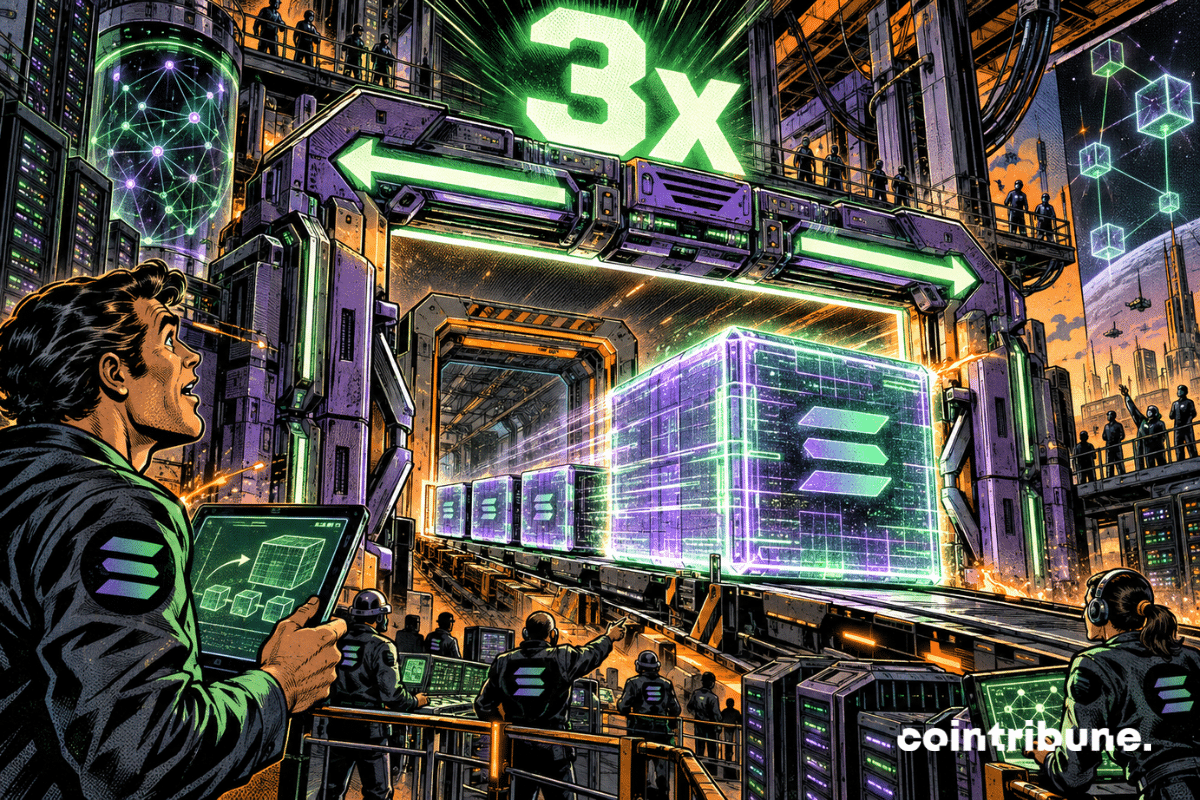
Solana has just activated on its mainnet an upgrade awaited for several months. The maximum size of a transaction increases from 1,232 to 4,096 bytes, or 3.3 times more space. The new v1 format has been active since the beginning of epoch 1,035 on September 15. For the crypto ecosystem, the change mainly targets operations too large to fit until now in a single transaction: zero-knowledge proofs, multisignatures, and new onchain signature systems.
The change was announced several days before its activation. Cointribune already explained how Solana planned to triple the available space for its complex transactions. This time, it is no longer just a schedule: Transaction v1 has arrived on the mainnet.
The old limit of 1,232 bytes dates back to Solana’s beginnings. Transactions then had to fit within a network packet of 1,280 bytes, of which 48 were reserved for headers. The migration to QUIC has since made this constraint much less relevant. The SIMD-0296 and SIMD-0385 proposals thus set the new ceiling at 4,096 bytes.
Why 4,096? It is also the standard size of a memory page used by validator hardware. Solana could have chosen more, but processing would then have started to span multiple memory pages.
Legacy and v0 formats are not disappearing. A crypto wallet does not need to adopt v1 to continue sending its usual transactions. Applications that want to benefit from the 4,096 bytes must, however, use the new format.
Your 1st cryptos with BitpandaThis link uses an affiliate program.For the user simply sending SOL, the difference may be invisible. For some developers, much less so. A classic signature on Solana already occupies 64 bytes. Operations with many signers, certain cryptographic proofs, or multiple instructions could quickly reach 1,232 bytes. It was necessary to split the operation, use Address Lookup Tables, or resort to bundles.
With v1, more work fits into a single crypto transaction. The Solana Foundation provides a telling example with Token-2022. A confidential transfer requiring three zero-knowledge proofs, the transfer instruction, and several closing instructions occupies 2,897 bytes. It far exceeds the old limit. With 4,096 bytes, its ten instructions can now be placed in a single atomic transaction.
One confirmation instead of several. Fewer signatures to pay for. And above all, either the entire operation succeeds, or it completely fails. Solana is working in parallel on speed. In August, the network reduced its block creation time from 400 to 350 milliseconds. The stated goal remains 200 ms, but the next steps still need to be activated separately.
The transaction size and slot time address two different problems. One gives more space to complex crypto applications. The other reduces the delay between blocks.
The 4,096 bytes do not mean that every Solana transaction will suddenly become three times heavier. The new format is optional. This is important for an already very active network. Solana processed 4.2 billion transactions in July, 13.5% more than in June and nearly twice as many as in December 2025. This monthly record had already shown the increase in activity on the blockchain.
There is still a tradeoff. A 4,096-byte transaction carries more data than a 1,232-byte transaction. If large formats become frequent, they will consume more bandwidth and space during propagation.
Solana has therefore kept several limits. The v1 format remains capped at 12 signatures, 64 accounts, and 64 instructions, even if its binary structure could theoretically encode more.
There is also work to be done on the infrastructure side. Wallets can continue to send legacy or v0. But RPCs, explorers, indexers, and other services that read the blockchain must know how to decode v1 when such a transaction appears. Software stuck on an old implementation may fail or misinterpret some data.
For Solana, the gain is therefore quite concrete. The crypto network does not automatically process three times more transactions thanks to this update. It can simply fit much more into each transaction when the application needs it. The 1,232 bytes had held since the network’s beginnings. Since September 15, they are no longer the ceiling.