Those 240 taxpayers represented approximately 1.4% of the people in the dataset but generated around 52% of the gains. The more widely relevant development begins in 2027, when HMRC starts re
Those 240 taxpayers represented approximately 1.4% of the people in the dataset but generated around 52% of the gains. The more widely relevant development begins in 2027, when HMRC starts receiving customer and transaction data directly from cryptoasset service providers.
A swap between two cryptocurrencies can create a taxable gain before any pounds enter a bank account. CARF will give HMRC additional records against which to check those transactions.
This article concerns individual UK taxpayers. Different rules can apply to companies, trustees, people trading as a business and those whose tax residence is outside the UK.
A small group generated half the reported gains
The figures cover individuals who reported Capital Gains Tax-liable cryptoasset disposals through the dedicated section of their 2024–2025 Self Assessment returns.
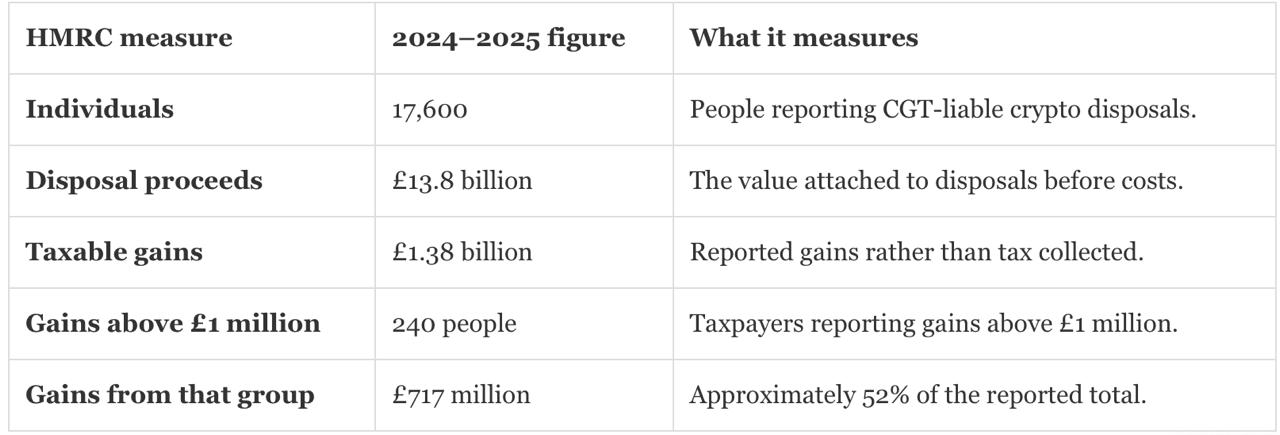
Based on HMRC’s rounded totals, the 240 people at the top averaged close to £3 million in gains. The remaining 17,360 individuals averaged approximately £38,000. This also explains why the £78,000 average reported across the complete dataset does not describe a typical taxpayer.
The £13.8 billion in proceeds represents disposal value rather than profit or tax owed. Acquisition costs, qualifying expenses and capital losses affect the eventual taxable amount. The dataset also excludes crypto income reported through other parts of the tax return and activity that was never declared.
The figures and their scope are available in the official HMRC release.
A token swap can trigger Capital Gains Tax
HMRC’s definition of a disposal covers more than a conventional sale. An individual may create a taxable gain or loss by:
- Selling cryptoassets for pounds or another fiat currency.
- Exchanging one type of cryptoasset for another.
- Using cryptoassets to purchase goods or services.
- Giving cryptoassets to another person, subject to exceptions for transfers including those to a spouse, civil partner or qualifying charity.
How a crypto-to-crypto gain can arise
Consider an investor who purchases ETH for £2,000 and later exchanges it for £3,500 of USDC. The ETH is valued at £3,500 when it is disposed of, producing a preliminary gain of £1,500 before allowable expenses and the applicable cost-matching rules.
The calculation uses the sterling market value at the time of the exchange. Receiving another token instead of pounds does not defer recognition of the ETH gain.
Stablecoin activity can produce additional records. Exchanging Bitcoin for USDC disposes of the Bitcoin, while later spending or exchanging the USDC can create another disposal. A fee paid with tokens must also be considered separately because the tokens used for that fee leave the owner.
The recordkeeping problem extends beyond the UK. Our report on South Korea’s 2027 crypto tax shows how another major market will also treat token-to-token swaps as taxable events, although its rates, allowances and loss rules differ from those in Britain.
Transfers of the same asset between wallets under the same person’s beneficial control are generally treated differently because ownership remains unchanged. The beneficial-ownership condition matters when assets enter custodial services, lending arrangements or decentralized protocols. HMRC defines the relevant transactions in its cryptoassets manual.
The purchase price may not be the taxable cost
The ETH example uses one purchase to illustrate the underlying principle. Actual calculations can be more complicated because HMRC generally groups each type of token into its own cost pool.
Acquisitions increase the pool’s total cost. A disposal removes a corresponding proportion. Separate matching rules apply to tokens acquired on the same day or within 30 days after a disposal, so taxpayers cannot simply select whichever purchase produces the smallest gain.
Allowable deductions may include the original sterling acquisition cost, transaction fees and certain professional or valuation expenses. Reported capital losses may reduce gains where the relevant conditions are met. HMRC provides calculation and recordkeeping details in its guidance for individuals.
Crypto received through employment, self-employment, mining, staking or lending may first fall within Income Tax and, in some cases, National Insurance. A later increase in value can produce a capital gain when those tokens are eventually disposed of.
For the 2026-2027 tax year, the individual Capital Gains Tax annual exempt amount is £3,000. Individual rates are generally 18% or 24%. The applicable rate depends on taxable income, other gains and how much of the taxable gain falls within the available basic-rate band.
- Planned DeFi change: An HMRC policy paper sets out no-gain, no-loss treatment for certain qualifying cryptoasset loans and liquidity-pool arrangements from April 6, 2027. Until that date, users should apply the rules relevant to the tax year in which each transaction occurred and seek professional advice where beneficial ownership is unclear.
READ MORE:
 Ripple Takes On Wall Street With US Stock and Crypto Swaps
CARF gives HMRC provider-supplied records
The tax obligations covered above predate the Crypto-Asset Reporting Framework. CARF expands the customer and transaction data available to HMRC.
- January 1, 2026: UK implementation and provider data collection began.
- May 31, 2027: The first UK provider reporting deadline is expected.
- September 30, 2027: The UK plans its first exchanges with participating foreign tax authorities.
CARF forms one part of a wider expansion of UK crypto oversight. Coindoo has separately examined how Britain’s incoming crypto rules interact with its banking-access problem, an issue governed by financial-services and risk rules rather than tax reporting.
Service providers collect details including a customer’s name, date of birth, address, country of residence and tax identification number. Their annual submissions also cover reportable cryptoasset activity.
The international framework reaches participating overseas providers. Data belonging to a UK resident can pass from a foreign tax authority to HMRC, while the UK can send records concerning foreign residents to their home jurisdictions.
Provider records represent only part of a taxpayer’s history. A platform may not hold the acquisition cost from another exchange, activity conducted through separate wallets, previously reported losses or the income information needed to establish the applicable rate. HMRC can use CARF data to identify discrepancies, while the taxpayer continues to produce the final calculation.
Further information appears in HMRC’s CARF implementation policy.
The records UK crypto users should preserve
Exchange exports provide a starting point. A complete calculation may require records from every platform and wallet used during the relevant period.
- Transaction exports from every exchange.
- Dates, quantities and token types.
- Sterling values at acquisition and disposal.
- Trading, network and platform fees.
- Wallet addresses and self-custody histories.
- Pooled costs before and after disposals.
- Mining, staking, lending and employment income.
- Evidence supporting transfers between personally controlled wallets.
HMRC says qualifying income and gains for the 2025–2026 tax year must be reported through Self Assessment by January 31, 2027. Downloading records early reduces the risk of losing access when an exchange closes an account, limits historical exports or stops operating.
People who identify unpaid crypto tax from earlier years can use HMRC’s Cryptoasset Disclosure Service. Complicated histories involving DeFi, business activity, large gains or several jurisdictions may require a UK-qualified tax professional.
The transaction matters before the withdrawal
The event to track is the disposal: a sale, swap, purchase or transfer of ownership. CARF will give HMRC more provider data for checking those events from 2027, but accurate reporting will still depend on the taxpayer’s sterling valuations, pooled costs and complete transaction history.
Methodology: The article uses HMRC’s August 27, 2026 release, its cryptoasset guidance and manuals, current Capital Gains Tax rates and allowances, and official CARF implementation documents. Calculations derived from the published statistics are approximate because HMRC rounds its figures.
This article provides general information and does not constitute tax, legal or financial advice. Tax treatment depends on individual circumstances and can change. Readers should consult HMRC guidance or a qualified UK tax professional where necessary.
The post Crypto Tax: 240 UK Taxpayers Report £1M Gains – What Changes? appeared first on Coindoo.