Why Does Crypto Trading on Thanksgiving Continue 24/7? Crypto trading on Thanksgiving did not stop. Wall Street did. US stock exchanges closed on Thursday, 26 November 2026, while spot crypto
Why Does Crypto Trading on Thanksgiving Continue 24/7?
Crypto trading on Thanksgiving did not stop. Wall Street did. US stock exchanges closed on Thursday, 26 November 2026, while spot crypto kept trading. Some institutional channels still follow the US calendar, and they shape liquidity. This guide times each one in EST, UTC, and IST.
Glossary
Spot market: Trading of the asset itself for immediate delivery.
ETF: A fund whose shares trade on a stock exchange.
Realised variance: A measure of how much a price actually moved.
Post-market session: Stock trading after the regular session closes.
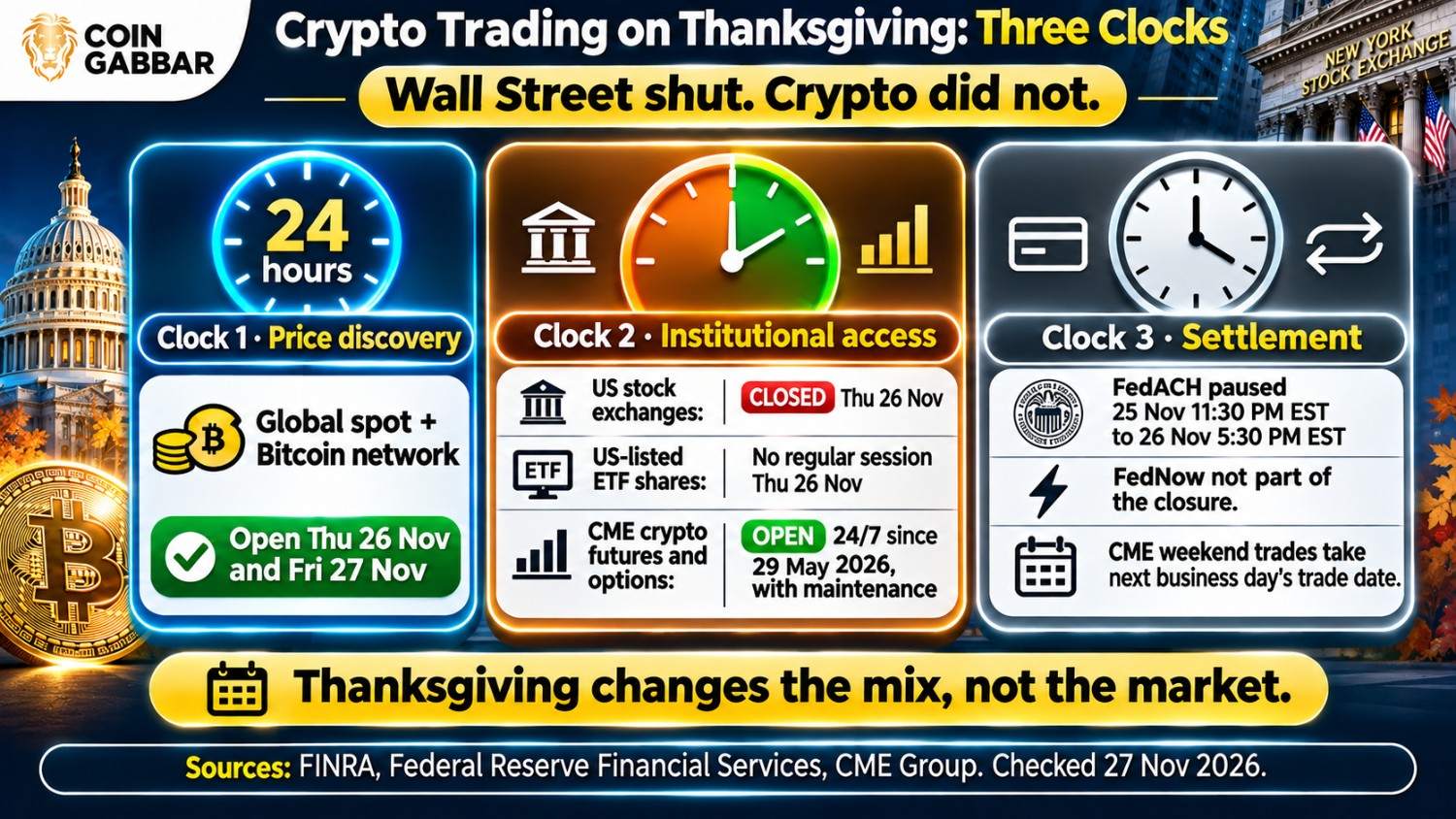
Does Crypto Trading Stop on Thanksgiving?
No. Crypto trading on Thanksgiving continues because spot exchanges and the Bitcoin network run around the clock. What pauses is Wall Street. US stock exchanges were closed on Thursday, 26 November 2026, and the regular session ended at 1:00 PM EST on Friday, 27 November.
What Are the US Stock Market Thanksgiving Hours for 2026?
Thanksgiving Day fell on Thursday, 26 November 2026. FINRA's trade-reporting notice lists a closure that day and shorter hours on Friday.
Event
US time
UTC
IST
Thu 26 Nov: US stock exchanges
Closed all day
n/a
n/a
Fri 27 Nov: the regular session opens.
9:30 AM EST
14:30
8:00 PM
Fri 27 Nov: regular session closes.
1:00 PM EST
18:00
11:30 PM
Fri 27 Nov: post-market trading ends.
5:00 PM EST
22:00
3:30 AM, Sat 28 Nov
Fri 27 Nov: SIFMA recommended bond close.
2:00 PM EST
19:00
12:30 AM, Sat 28 Nov
Mon 30 Nov: regular session resumes
9:30 AM EST
14:30
8:00 PM
Source:FINRA TRF holiday notice for 26 and 27 November 2026, checked 27 November 2026. SIFMA's close is a recommendation, from its 12 November 2026 schedule. EST = UTC−5. IST = UTC+5:30.
Not every US security stops at 1:00 PM. Post-market sessions run to 5:00 PM EST, and access depends on the venue and broker.
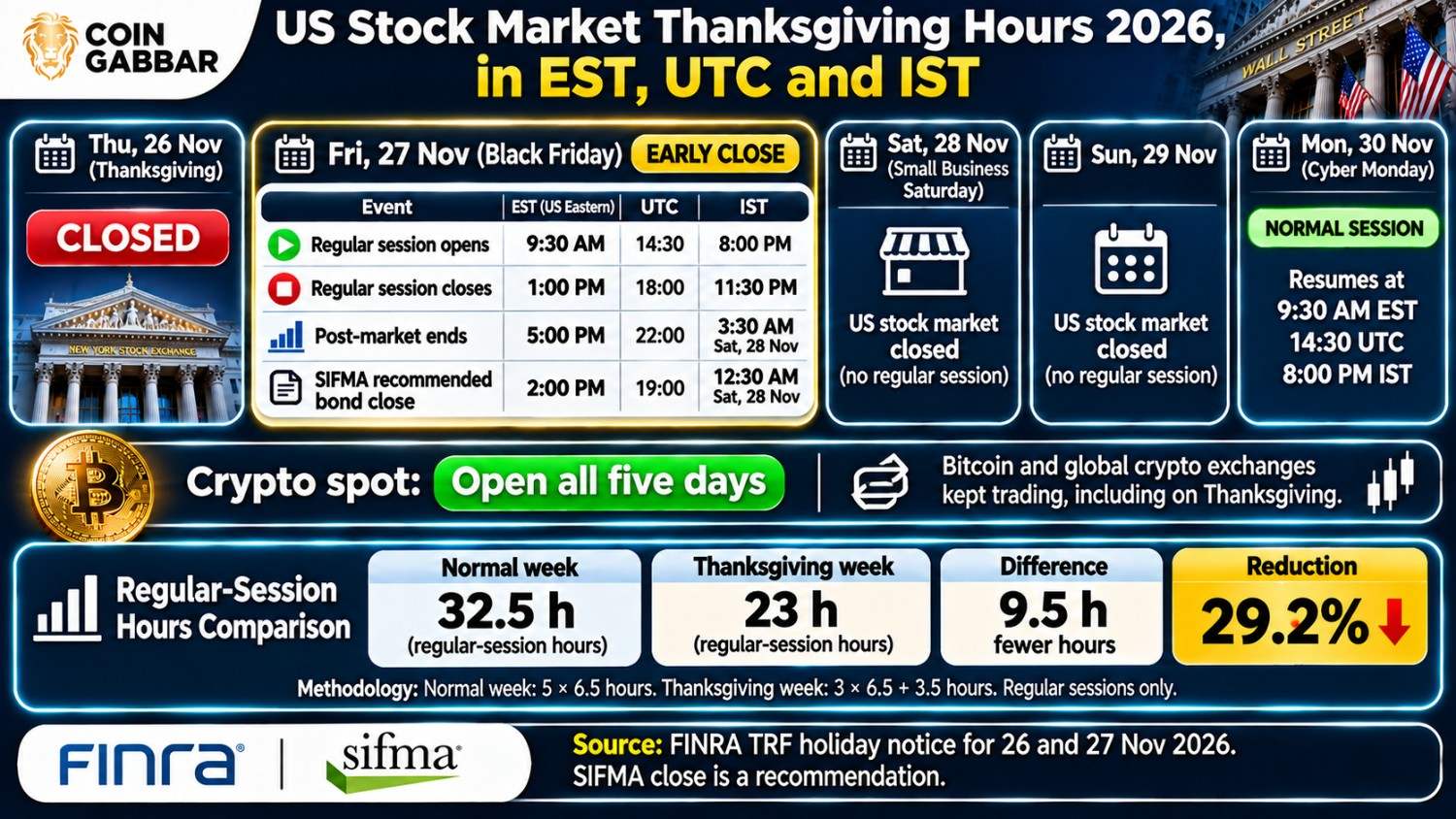
Here is an original calculation. A normal week has 5 × 6.5 = 32.5 regular-session hours. Thanksgiving week had 3 × 6.5 + 3.5 = 23 hours. That is 9.5 hours, or 29.2%, fewer. It counts regular sessions only, not extended trading or all US financial activity.
Why Does Crypto Trading on Thanksgiving Continue When Wall Street Closes?
The Thanksgiving crypto market in 2026 kept running because Bitcoin's network and global spot exchanges do not depend on one country's calendar. Other channels do. This table shows who was open.
Channel
Thu 26 Nov
Fri 27 Nov
Global crypto spot
Open
Open
Bitcoin network
Open
Open
CME crypto futures and options
Open, with maintenance
Open, with maintenance
US stock exchanges
Closed
Shortened session
US-listed ETF shares
No regular session
Shorter session, venue-based extended hours
US bond market (SIFMA recommendation)
Closed
Early close, 2:00 PM EST
Source: sections below, each with its own source and date.
How Do Bitcoin ETF Trading Hours Change on Thanksgiving?
US spot Bitcoin ETFs are exchange-traded, so their shares follow exchange calendars. Bitcoin kept trading on Thursday while the shares had no regular session. When the shares returned on Friday, their prices could reflect that move. Crypto trading on Thanksgiving therefore split into two markets: direct Bitcoin, which kept moving, and ETF shares, which waited for an exchange session.
The last completed ETF session before the holiday was Wednesday, 25 November 2026. No flow exists for 26 November, since no regular session ran.
Date (2026)
US spot Bitcoin ETF net flow
Tue 17 Nov
−$239.9M
Wed 18 Nov
−$306.5M
Thu 19 Nov
−$582.3M
Fri 20 Nov
−$669.2M
Mon 23 Nov
−$569.7M
Tue 24 Nov
−$231.4M
Wed 25 Nov
−$453.0M
Seven-session total
−$3,052.0M
Source:Farside Investors, data through 25 November 2026, retrieved 27 November 2026 (time not recorded). The total is CoinGabbar's sum of the seven daily figures.
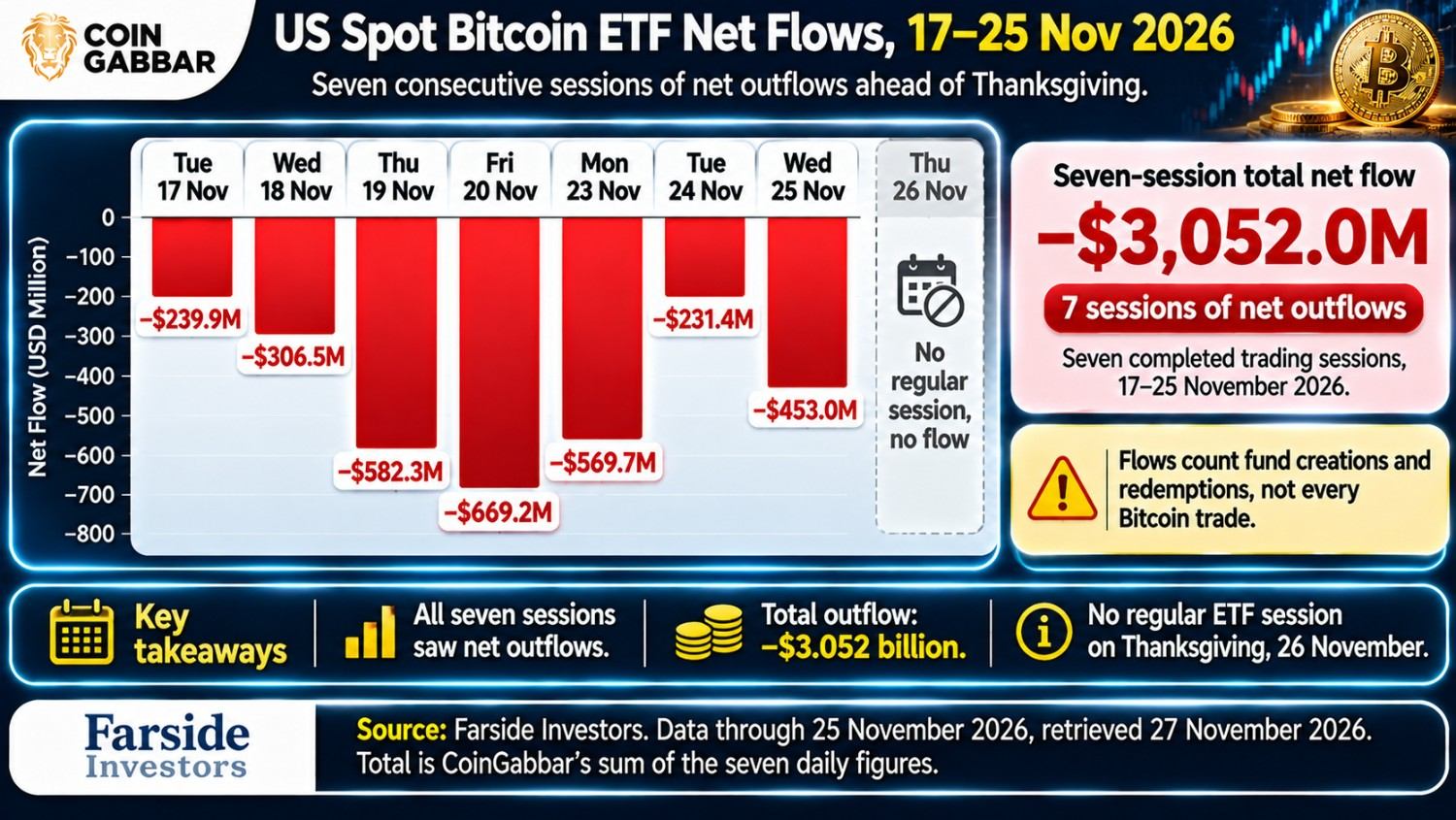
Flows measure fund share creations and redemptions. They do not count every Bitcoin trade. See the Bitcoin ETF flows guide.
Can CME Bitcoin Futures Trade 24/7 on Thanksgiving?
Yes, with maintenance breaks. CME moved its crypto futures and options to 24/7 trading on Friday, 29 May 2026. In itsrelease of 1 June 2026, CME reported more than 7,200 contracts, about $50 million in notional value, over the launch weekend. That figure is not Thanksgiving volume.
CME keeps at least a two-hour maintenance window each weekend. Its FAQ lists Saturday maintenance at 2:00–4:00 AM CT (08:00–10:00 UTC, 1:30–3:30 PM IST).
Trading runs nonstop, but clearing does not. Weekend and holiday trades take the next business day's trade date, so settlement and reporting still follow a calendar.
What Happens to Bank Transfers and Funding on Thanksgiving?
A 24/7 crypto market does not mean 24/7 access to every fiat payment service. Federal Reserve Financial Services, excluding Fed Now, closed on Thursday, 26 November 2026.
FedACH event
US Eastern Time
Processing ends
Wed 25 Nov, 11:30 PM EST
Processing resumes
Thu 26 Nov, 5:30 PM EST
Third file delivery begins.
Thu 26 Nov, 8:15 PM EST
Source: Federal Reserve Financial Services holiday schedules, checked 27 November 2026.
A Bitcoin transfer can confirm on-chain while an ACH deposit waits. Crediting times vary by exchange, bank, and payment rail, so no universal deposit time applies.
Does Crypto Market Liquidity Change When US Markets Close?
The best evidence is a peer-reviewed study by Huda Aldhahi, published on 8 September 2026 in the Journal of Risk and Financial Management. It used 87,672 hourly Kraken XBT/USD observations from 1 January 2016 to 31 December 2025. It matched 95 full weekday NYSE holidays with nearby weekdays.
In the institutionalized period, Bitcoin's share of realized variance during US trading hours fell 13.9 percentage points on those holidays. An even spread over a nine-hour US window would give 37.5% (9 ÷ 24). The effect was absent before 2019, and the volatility peak moved with US daylight-saving changes.
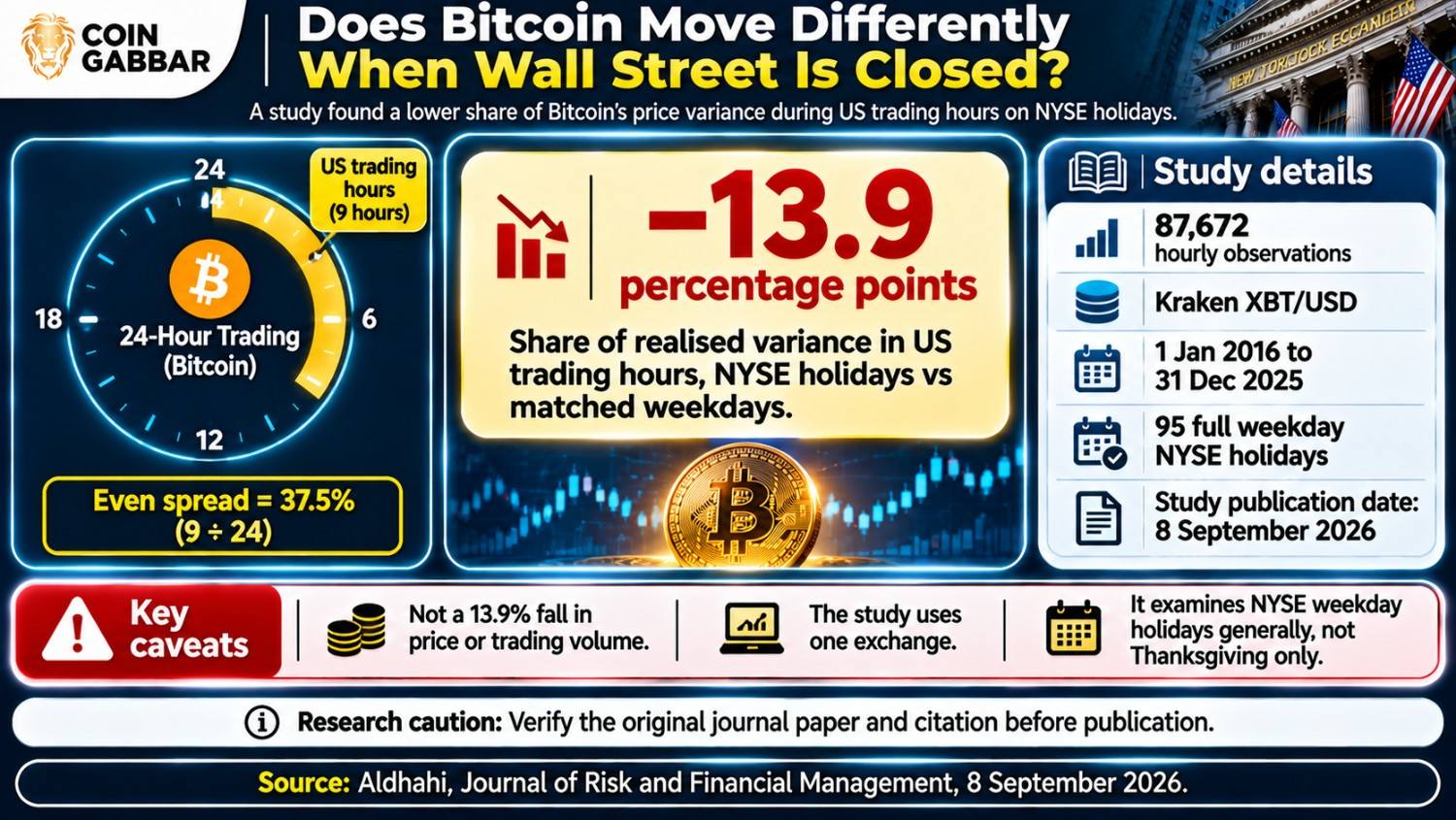
Three cautions apply:
The 13.9 points are a change in share of variance. It is not a 13.9% fall in volume, price, or total volatility.
The data come from one exchange.
The study covers NYSE weekday holidays in general, not Thanksgiving alone.
The author points to US-linked channels: regulated futures, listed equity exposure, spot ETFs, ETF creation and redemption, and hedging. When those sessions pause, the pattern of price variation can shift. This is crypto market liquidity viewed through market structure, not a claim that the market stops.
For readers, the practical point is simple. Do not assume crypto trading on Thanksgiving is thin or deep because of the calendar. Check spreads and depth on the day.
What Did the Bitcoin Market Show on Black Friday 2026?
All values below are rolling 24-hour dashboard figures fromCoinGlass, retrieved 27 November 2026, 13:49:10 IST (08:19:10 UTC). The US stock session was still about six hours from opening.
Metric
Value
Dashboard change
BTC/USD
$60,719.80
+1.20%
Spot volume
$4.72B
−32.20%
Futures volume
$49.36B
−39.03%
Futures open interest
$40.86B
+3.33%
Funding rate
0.0059% (about 6.5% annualized)
n/a
Liquidations
$84.53M (77% shorts)
n/a
Fear and Greed Index
12, Extreme Fear
n/a
Source: CoinGlass Bitcoin dashboard, 27 November 2026, 13:49:10 IST. Values change continuously.
Futures volume is far above spot volume, but they are different measures.Open interest counts outstanding positions, not daily trades. Thefunding rate shows positioning, not direction. These are not a controlled comparison with an ordinary Thursday, so they do not prove a holiday effect.
What Macro Data Came Before the Holiday?
The US Bureau of Economic Analysis released two reports on Wednesday, 25 November 2026, at 8:30 AM EST (13:30 UTC, 7:00 PM IST).
Indicator
Figure
Measure
Headline PCE price index, October
+3.8%
Year over year
Core PCE price index, October
+3.3%
Year over year
Real GDP, Q3, second estimate
4.3%
Annualized rate
Source: BEA personal consumption expenditures data and BEA GDP data, releases of 25 November 2026.
These releases do not show that macro data moved Bitcoin. That needs separate market-event evidence.
What Changes on 6 December 2026?
NYSE Arca will operate 23 hours a day, five days a week from Sunday, 6 December 2026, per an NYSE Regulation memo dated 10 November 2026. Status checked 27 November 2026.
This was not active on 26 or 27 November. It also does not make every Bitcoin ETF a 24/7 product. Listing venue, broker access, and product eligibility still apply.
What Should Traders Monitor Over the Holiday Weekend?
CoinGabbar frames Thanksgiving as three clocks that do not share one calendar.
Clock
System
Thanksgiving behavior
Price discovery
Global spot and the Bitcoin network
Kept running
Institutional access
US stocks, ETFs, CME derivatives
Stocks and ETFs paused; CME ran.
Settlement
Banks, ACH, clearing, reporting
Followed holiday calendars
Measure holiday liquidity with four separate tools: trading volume, bid-ask spread, order book depth, and slippage too. Low volume alone does not mean an illiquid market.
For a fair test, CoinGabbar's method compares fixed UTC snapshots on one exchange and pair against the four prior Thursdays:
Snapshot
UTC
Asian morning
04:00
European session
08:00
US cash open
14:30
US early close window
18:00
This is a CoinGabbar method. No snapshot results have been collected yet, so none are published.
Key Takeaways
Crypto trading on Thanksgiving continued - US stock and ETF sessions did not run on 26 November 2026.
The regular US stock session on Black Friday ended at 1:00 PM EST (11:30 PM IST), per FINRA.
CME crypto futures and options have traded 24/7 since 29 May 2026, apart from maintenance.
A study published on 8 September 2026 found Bitcoin's US-dollar share of variance fell 13.9 points on NYSE holidays.
Bank transfers follow their own holiday calendar, even when crypto prices keep moving.
CoinGabbar Expert Analysis
CoinGabbar analysis suggests crypto trading on Thanksgiving is a change of mix, not a shutdown. Price discovery stayed global. Institutional access split, with stocks and ETFs paused and CME open. Settlement kept its calendar. Three limits apply. The study uses one exchange. The dashboard figures are rolling 24-hour values. The flow data end on 25 November. So this is a reading of dated sources, not a price forecast. The most useful test is still the one above: Record spreads and depth at fixed times, then compare.
Disclaimer: This article explains market structure. It is not financial, legal, or tax advice. No outcome can be promised. Market data change continuously, so check each source before acting.