Wealthy investors now look at digital assets with growing attention, despite the persistent reservations of some advisors. A CoinShares survey conducted with 2,230 people in seven major econo
Wealthy investors now look at digital assets with growing attention, despite the persistent reservations of some advisors. A CoinShares survey conducted with 2,230 people in seven major economies shows that the majority already hold crypto. On average, these investments account for about 10% of their portfolios. Above all, many still plan to increase their exposure in 2026. The decline observed in February therefore did not change this trend, which relies mainly on diversification and a long-term vision.
In brief
- The majority of wealthy investors surveyed already hold digital assets.
- Digital assets represent on average about 10% of their portfolios.
- At least 85% of the investors concerned in five countries want to increase their exposure in 2026.
- The market drop in February pushed a majority of respondents to invest more.
- Bitcoin remains dominant, while young investors show higher exposure.
Crypto already present in wealthy portfolios
The CoinShares study covers investors with at least $500,000 in investable assets in the United States, the United Kingdom, France, Germany, Italy, Sweden, and Switzerland. The proportion of crypto holders varies by country. It reaches 54% in Sweden, while it approaches 70% in the United States, the United Kingdom, Germany, and Switzerland.
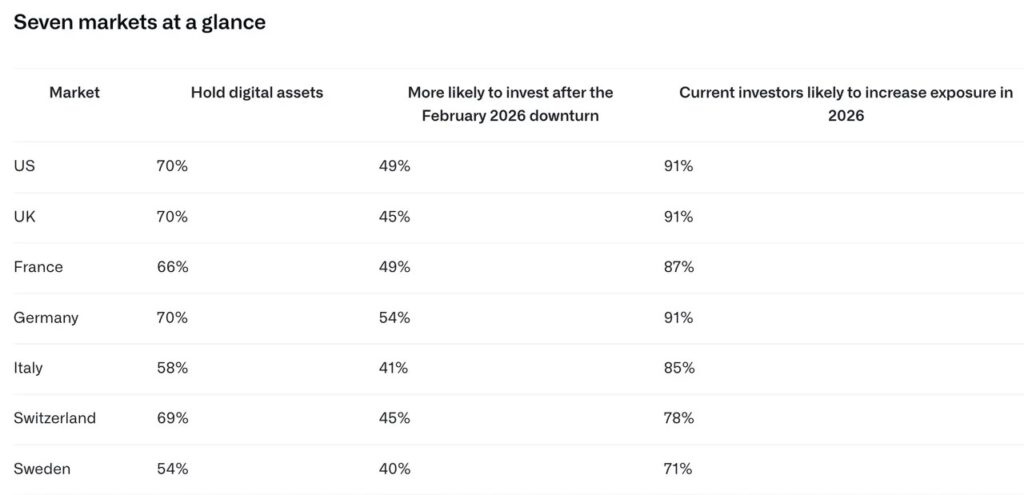 CoinShares survey of wealthy investors in seven countries. Source: CoinShares.
Overall, crypto already occupies a visible place in the wealth strategies studied. Their average weight reaches about 10% of portfolios according to responses collected in the study. However, exposure varies notably by investor profiles, markets, and individual choices.
This presence is mainly accompanied by a desire to strengthen existing positions. In five of the seven countries studied, at least 85% of investors already exposed to crypto plan to increase their allocation in 2026. In the United States, the United Kingdom, and Germany, this proportion rises even to 91%, highlighting the continuity of the movement.
Start your crypto adventure safely with KrakenThis link uses an affiliate program.
The February decline did not reverse the trend
The market pullback observed in February 2026 did not lead to massive disengagement among the wealthy investors surveyed. On the contrary, in the seven countries studied, the majority indicates that this drop pushed them to invest more. This reaction shows that recent volatility has not necessarily called into question their exposure strategy.
The stated motivations also provide important insight into their choices. Long-term appreciation and diversification rank first among the reasons given to hold digital assets. Speculation holds the last place. Only 6% of respondents define themselves as primarily short-term oriented investors.
Bitcoin remains the most widely held digital asset in this population. On average, 80% of investors in digital assets own it, while 89% of crypto holders also hold other digital assets. Moreover, 77% of respondents believe that Bitcoin will have an important role in the future global financial system.
Young crypto investors show higher exposure
The survey also reveals a marked gap between generations. Young investors allocate more funds to digital assets than older investors in the seven analyzed countries. In four of these markets, their exposure even reaches about twice that of older generations.
This difference fits into a context where crypto occupies a growing place in wealth discussions. The results, however, do not alone explain the precise reasons for this gap between generations. They mainly show that age is an associated factor with the observed level of exposure.
The question of regulation also appears in the responses. Nearly 79% of participants want stricter rules applied to digital asset markets. This position coexists with strong holdings and additional investment intentions, which reflects a demand for a more structured framework rather than a rejection of the sector.
Advisors are even more cautious than their clients
The study finally highlights a gap between some wealthy investors and their financial advisors. About four respondents out of ten in Switzerland, France, the United States, and Germany, when using an advisor, feel that the latter adopts an excessively cautious attitude towards digital assets.
In a statement attributed to Cointelegraph, Ric Edelman, founder of the Digital Assets Council of Financial Professionals and Edelman Financial Engines, believes that advisors remain slow to adopt this asset class. According to him, some lack knowledge or motivation to train, while several companies still limit discussions or investments related to digital assets.
Advisors are busy; they already manage a thriving business filled with satisfied clients – so why bother learning something new? – and most receive little or no encouragement from their firms.
Ric Edelman, founder of the Digital Assets Council of Financial Professionals and Edelman Financial Engines. Source: Cointelegraph.
This situation can also create a lack of support for the concerned clients. Advisors may not be aware of some investors’ digital holdings and thus miss needs related to taxation, wealth transfer, or philanthropy. However, Edelman disputes the 10% average allocation advanced by CoinShares, estimating that 2% to 5% would be more common according to his own research.
He nonetheless recommends allocations ranging from 10 to 40% depending on risk tolerance: 10% for a conservative portfolio, 25% for a moderate profile, and 40% for a dynamic profile. These recommendations contrast with the caution observed concerning retirement savings. A survey by the National Institute on Retirement Security indicates that 77% of Americans consider crypto risky in employer-sponsored retirement plans, with 46% considering it very risky.
The trend observed by CoinShares therefore suggests that wealthy investors continue to increase their exposure, despite market declines and reservations from some professionals. If the stated intentions for 2026 are confirmed, crypto could still hold an important place in wealthy portfolios, while the debate about its optimal weight and advisor support is likely to continue.