There is no evidence of a global cyber attack on November 17. No bank and no security agency, in Germany or anywhere else, has warned of such an attack. The only thing on the calendar for Nov
There is no evidence of a global cyber attack on November 17. No bank and no security agency, in Germany or anywhere else, has warned of such an attack. The only thing on the calendar for November 17 is a long-announced appointment: in the United States, the disaster management agency FEMA and the media regulator FCC are testing their nationwide emergency alert system over radio and television. That test has nothing to do with your bank account or your internet connection in Germany.
Even so, a closer look is worthwhile, especially if you invest in crypto. The rumor promises emptied accounts and an internet that goes dark for three months, and it arrives in a week when real attacks are making headlines: the theft at Binance, the attack on the French bank Crédit Mutuel Arkéa and hacked refrigeration systems in German supermarkets. Anyone who panic-sells their coins now or clicks on a supposed "rescue page" is more likely to lose money than through the announced hacker attack itself. This fact check separates rumor from fact and shows you how to protect Bitcoin and other crypto assets against real risks.
Cyber attack on November 17: what the rumor actually claims
The story can be summed up in a few sentences. On November 17, hackers are supposed to attack major banks worldwide, reset account balances to zero and then knock out the internet for three months. Anyone who wants to be prepared, the posts say, should stockpile food, drinking water, cash, gold and silver. Some versions speak of an "electronic doomsday", others of a planned disruption modeled on the pandemic.
Every version lacks evidence for these claims. There is no claim of responsibility, no technical analysis, no warning from any authority and no bank that has confirmed an attack. The only source cited is an unspecified location on the darknet. That is a typical feature of panic rumors: the source is built so that nobody can rely on it and nobody can disprove it.
Cyber attack, cyberattack, hacker attack: three names for the same thing
The posts switch freely between terms. A cyber attack is a targeted assault on computer systems, networks or data, through which perpetrators aim to extract money, steal data or disrupt systems. Hacker attack, cyberattack and cyber assault mean the same thing in everyday use. The choice of word is irrelevant to judging the rumor; what matters is whether there is any verifiable indication of the claimed attack.
Where the November 17 cyber attack rumor comes from
According to research published on November 3 by the Kazakh news portal Tengrinews, the warning goes back to a user on the X platform who cited an anonymous darknet source and urged people to buy supplies, cash and precious metals. At around the same time, a second claim began circulating from October 27: seventeen countries and the EU had supposedly told their citizens to stock up on food and water. According to the portal, that post drew around 5.3 million views.
The two narratives then merged on X and Threads into a single story that spread mainly across the Russian-speaking web and Central Asia before reaching English- and German-language accounts. A journalist at the fact-checking outlet Factcheck.kz told Tengrinews that the government notices were ordinary information leaflets and that the list of countries had been stitched together from reports with no connection to one another.
Government preparedness advice is not an attack alert
The grain of truth is quickly explained. In October, the United Kingdom launched a campaign recommending that households keep supplies for three days. Since its preparedness strategy of March 2025, the EU has been encouraging everyone to be able to look after themselves for at least 72 hours, and Norway extended its recommendation to one week back in 2024. Such advice covers power cuts, severe weather and infrastructure failures of every kind. None of it names a specific attack date, and no authority has linked November 17 to a cyber attack.
The Russian portal Lenta.ru also concluded in its own fact check that reports of a worldwide internet shutdown cannot be confirmed. A security expert quoted there ruled out an attack of that scale on the grounds of the resources it would require alone.
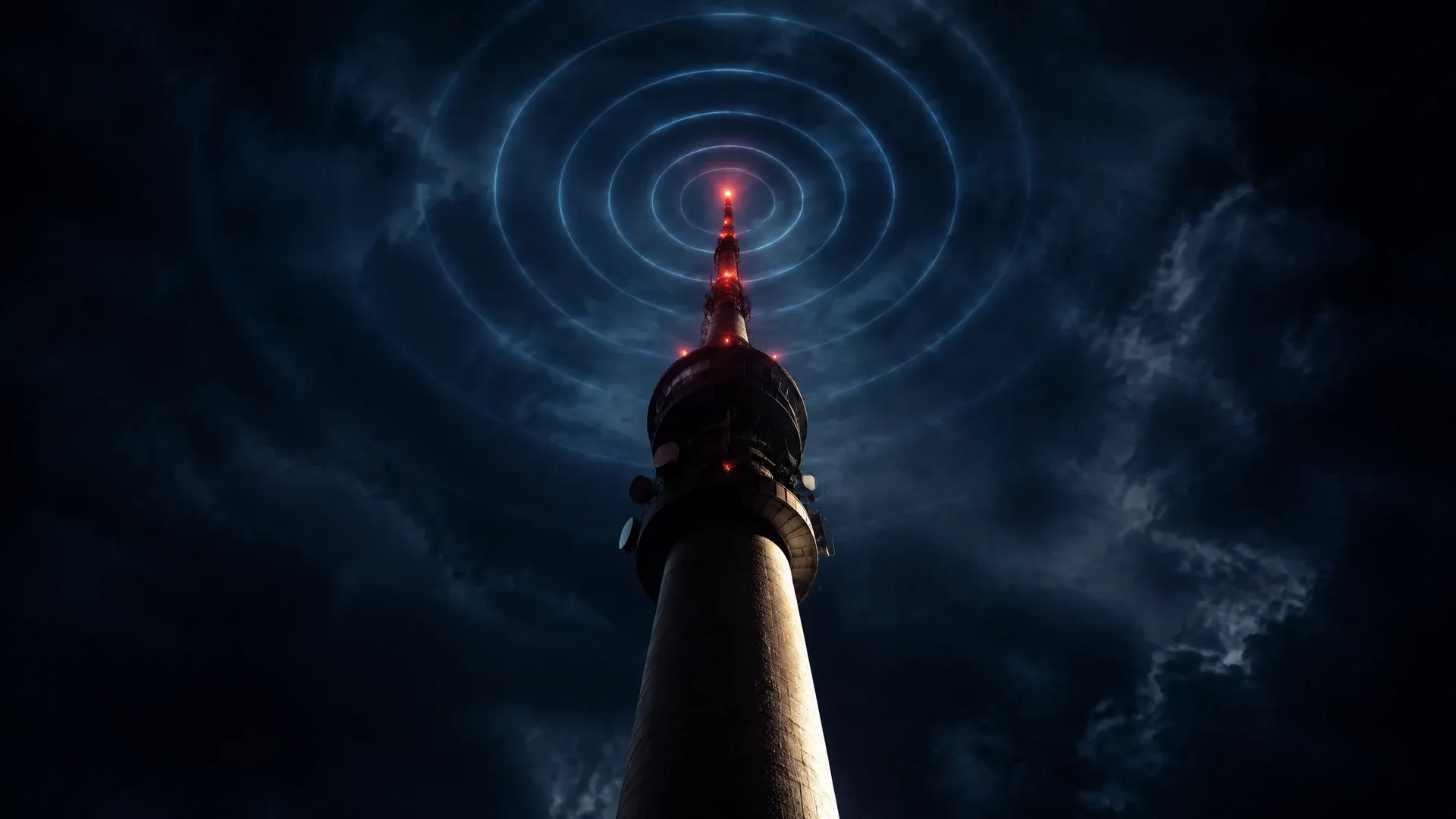
What will actually be broadcast on November 17: an announced test alert over US radio and television.
Emergency Alert System: what is really planned for November 17
The date has a verifiable background. In a public notice on September 16, the FCC announced that FEMA will broadcast a nationwide test of the Emergency Alert System, the US emergency warning system, on November 17 at 2:20 p.m. Eastern Time. In Germany, that is 8:20 p.m. Should the date be cancelled, for example because of a real emergency, December 3 is the backup date.
The test runs through radio and television stations, cable and satellite providers in the United States. These broadcasters interrupt their programming for a short announcement in English and Spanish. The wording has been published in advance and ends by stating that this is only a test and that the public does not need to do anything. Mobile phone alerts are not part of the test this year.
Test alerts of this kind are routine. The United States has run them regularly for years, and Germany has a comparable procedure with its nationwide warning day. Testing a warning system does not mean an attack is expected. Anyone looking for a grain of truth in the rumor will find only a scheduled date that has nothing to do with banks, account balances or the internet.
What is a cyber attack, in simple terms, and what can it really do?
A real cyber attack usually hits a specific target: a company, a city administration, a municipal utility or an IT service provider. The attackers break into the IT system using stolen login details, a security flaw or a booby-trapped email. They then often encrypt data with malware and demand a ransom, or they steal customer data and sell it on. In Germany, investigations are usually handled by the state criminal police offices and specialized public prosecutors.
For the victims, the consequences are usually local. If a cyber attack hits a city, its administration may be unable to issue appointments for days. If it hits a municipal utility or another energy supplier, the online customer portal is often down while electricity and drinking water keep flowing. That was the case, according to the supplier, in last year's attack on Stadtwerke Detmold: communication channels were affected, but supply was never at risk. In such cases, reliable information comes from the affected organization itself and the police, not from anonymous posts on social networks.
A simultaneous attack on all the world's major banks that wipes accounts and shuts down the internet for months does not fit this picture. The internet is a web of tens of thousands of independent networks with their own cables, data centers and operators; there is no central switch an attacker could flip. Banks, for their part, mirror their data across separate data centers and are required by supervisors to restore operations after a disruption. A successful attack can disrupt individual services for hours or days. That it could set every account balance in the world to zero is not technically plausible.
Real cyber attacks in November: refrigeration systems, Crédit Mutuel Arkéa and Binance
Part of the reason the rumor catches on so well is the news backdrop. There are plenty of real cyber attacks at the moment, and some of them directly affect people in Germany. The difference from the rumor: for each of these cases there are victims, authorities or companies that confirm the incident.
Hackers heat up supermarket refrigeration systems
In early November, unknown attackers tampered with the refrigeration systems of supermarkets in several European countries, including stores in North Rhine-Westphalia, Lower Saxony and Bavaria. According to ZDFheute, the systems of one store in Lower Bavaria were heated to as much as 50 degrees Celsius, according to the store, and large quantities of food had to be thrown away. In one case, according to the operator, the attack targeted the company that maintains the refrigeration equipment remotely. It followed a wave of attacks on hundreds of supermarkets in France. According to the report, the manufacturer of the system is investigating the cause. The perpetrators remain unknown, and public prosecutors are investigating.
The case shows what real attacks look like: the perpetrators hit poorly secured remote access points, they cause concrete damage, and they can be pinned to a place and a time. Customer accounts were not affected.
Bank, exchange, customer funds: what happened at Arkéa and Binance
The French cooperative bank Crédit Mutuel Arkéa confirmed on November 4 a cyber attack involving fraudulent transactions and said its customers' assets were not affected. Blockchain investigator ZachXBT links the attack to outflows of more than $133 million via crypto exchanges; the bank has not confirmed any amount. Details are in our report on the Crédit Mutuel Arkéa hack.
At Binance, the attack of October 29 hit a crypto exchange directly. According to our overview of November 3, around $6.3 billion was stolen there; the exchange says it has replaced about 98 percent from its own funds and is reopening withdrawals step by step. Our crypto hack news page summarizes the further cases that have come up since then. Around Binance, too, unfounded theories emerged immediately, which we examined in our Binance hack fact check.
Can a hacker attack wipe your bank account to zero?
The fear of waking up without any money is the core of the rumor. For your current account in Germany, the answer is clear. Banks do not keep balances in a single database that could be deleted with one command. Institutions back up every transaction several times, including at separate locations, and supervisors require contingency plans that kick in when needed. Even if an attack takes systems down, your balance remains in place as a claim against the bank.
Deposit protection up to €100,000 covers only bank balances
Statutory deposit protection covers balances in current, overnight savings and fixed-term deposit accounts up to €100,000 per customer and bank if a bank becomes insolvent. This protection applies when a bank fails, not to every technical disruption. What matters for you as a crypto investor: crypto assets are not covered, even if you hold them through a bank or an exchange. For licensed crypto service providers, the EU's MiCA regulation instead requires that client crypto assets be held separately from the firm's own assets. That protects you in an insolvency but does not replace deposit protection. Our comparison of regulated crypto exchanges shows which providers hold a license.
This leads to a sober assessment. The biggest risk to your money lies less in a global attack on all banks than in an attack on a single provider where you hold funds, and in fraudsters who exploit the excitement.
Crypto during an internet outage: what happens to Bitcoin on the blockchain
Many posts about November 17 are aimed squarely at crypto holders. Some say Bitcoin will then be worthless, others that only Bitcoin will survive the collapse. Neither claim holds up. The blockchain is a public ledger that thousands of independent computers around the world, known as nodes, store in full copies. If the network fails in one region, your coins remain recorded in that ledger; they do not disappear, and nobody can reset them to zero.
You cannot send anything during an outage, however. A transaction needs a connection to at least one node that relays it to the network. There are workarounds for special cases, such as broadcasting the blockchain by satellite, a service Blockstream has run since 2017. For private investors, these are of little relevance. The more important question is a different one: who holds the key to your coins?
If your crypto sits on an exchange, you can reach it only through that exchange's website or app. If the exchange goes down, for instance after a hacker attack, you wait until it reopens. If it sits in your own wallet whose recovery words you keep offline, access does not depend on any company. A hardware wallet is a small device that stores the private key and approves transactions only after confirmation on the device itself. We compare suitable models in our hardware wallet comparison.
Phishing after the rumor: how scammers exploit fear of November 17
The real risk behind panic rumors is rarely the announced attack. It is the fraudsters who latch on to the excitement. After major incidents, investigators regularly observe waves of phishing: emails, text messages or messenger chats that, in the name of a bank, an exchange or an authority, urge you to take supposed protective measures. Phishing is the attempt to obtain login details, seed phrases or transfers through fake messages or websites.
Around November 17, three scams are likely. First, messages asking you to move your money "before the attack" to a safe account or a specific wallet. Second, fake websites promising a wallet check or a security update and asking for your recovery words in return. Third, supposed investment offers that tout gold, silver or a particular coin as the only protection against the collapse.
How to spot a scam message about the cyber attack
- No genuine bank and no reputable exchange will ask you to move funds because of an announced attack.
- Nobody but you needs your seed phrase, including any support team or security service.
- Time pressure is a warning sign: if you are told to act "only until November 16", you are being pushed, not informed.
- Do not open links in messages. Go to your bank's or exchange's website yourself via the familiar address or the official app.
- If in doubt, call your bank on the number printed on your card and report suspicious messages to the police.
Panic selling costs more than any announced attack
A second risk is self-inflicted. If you sell crypto out of fear of November 17 to hold cash or gold instead, you pay fees and spreads and may lock in losses in an already volatile market. In Germany, a sale may also be taxable if you have held the coins for less than a year. A decision about your investments should be guided by your own goals rather than a date from an anonymous post.
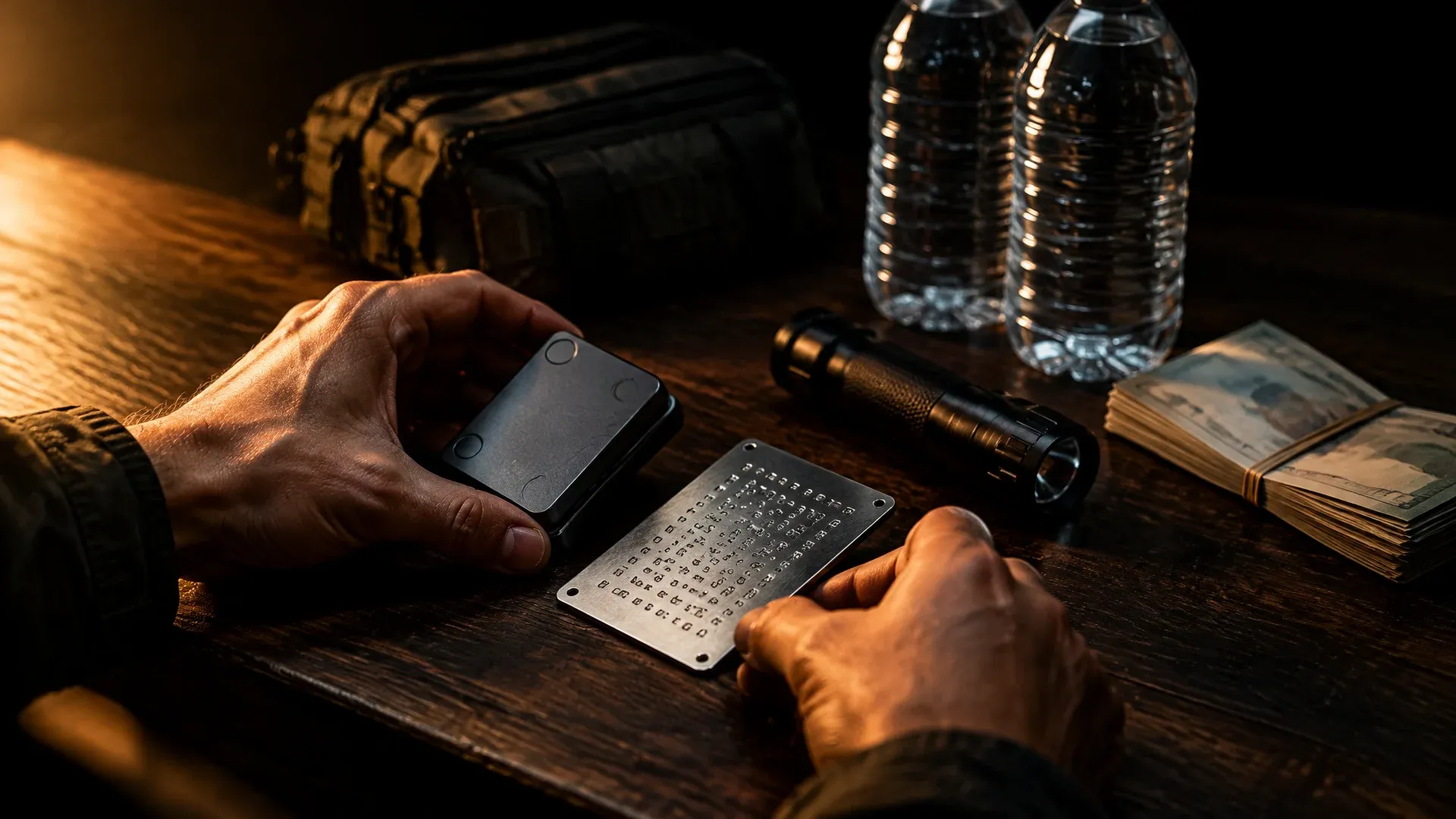
Preparing without panic: some cash and water at home, and the wallet's recovery words secured offline.
Seed phrase and hardware wallet: securing crypto independently of exchanges
Whether it is a rumor or a real incident, the sensible safeguards are the same, and they work on every day of the year. The seed phrase, the sequence of usually 12 or 24 words from which your wallet can be fully restored, belongs offline: on paper or, better, on a metal plate, in a place that fire and water cannot easily reach. A photo of it is off-limits, as is a copy in the cloud or in a notes app. Our guide on how to store your seed phrase safely explains how to set up the backup properly.
For accounts at exchanges and banks: enable two-factor authentication, ideally through an authenticator app or a hardware key rather than by text message. Where possible, set up a whitelist of withdrawal addresses so that money can only flow to addresses you have approved in advance. And keep only as much on an exchange as you need for trading. Whatever you hold for the long term is better kept in your own wallet. Also install every update for your operating system, browser and wallet app promptly, because many attacks exploit known flaws in outdated software.
Emergency supplies as recommended by Germany's BBK: sensible anyway
On one point the rumor is unintentionally right: a small stockpile does no harm. Germany's Federal Office of Civil Protection and Disaster Assistance (BBK) recommends being able to look after yourself for ten days if possible and stresses that even three days of supplies help a great deal. That means drinking water, non-perishable food, essential medicines and a folder with your most important documents. A little cash at home makes sense, because card payments do not work during a power cut.
This kind of preparation has nothing to do with November 17. Supplies help during power cuts, severe weather and infrastructure failures, which real cyber attacks on municipal utilities or suppliers can certainly cause. For crypto investors, one item belongs on the same list: the seed phrase, kept in a safe place you can reach without electricity or internet.
Cyber attack rumor: November 17 brings only a US alert test
The rumor of a global cyber attack on November 17 has no reliable source, and no authority is warning about it. On the evening of that day, FEMA will broadcast an announced test alert over radio and television in the United States, and nothing more. Real attacks happen all the same, and you can protect yourself against them with three steps that apply regardless of any date:
- Your own wallet for long-term holdings: Move the coins you do not trade to a hardware wallet and keep the seed phrase offline. You will find suitable devices in our hardware wallet comparison.
- Use only licensed providers: Check whether your exchange holds a MiCA license and keeps client assets segregated. Our comparison of regulated crypto exchanges provides an overview.
- Secure your accounts against phishing: Enable app-based two-factor authentication, use a withdrawal whitelist and do not open links in warning messages. For everyday use, a well-secured app wallet helps; you will find one in our software wallet comparison.
(As of November 6, 2026. This article is not investment advice. Prices and fee structures change; check the terms with the provider before you buy.)